Africa Loses One-Third of Its Fish to Spoilage. These 3 Innovations Are Fighting Back
One-third of fish caught in Africa never reaches consumers. Discover how ColdHubs, NutriFish and fishers’ cooperatives are using solar cooling, improved drying and collective action to reduce waste and increase incomes.

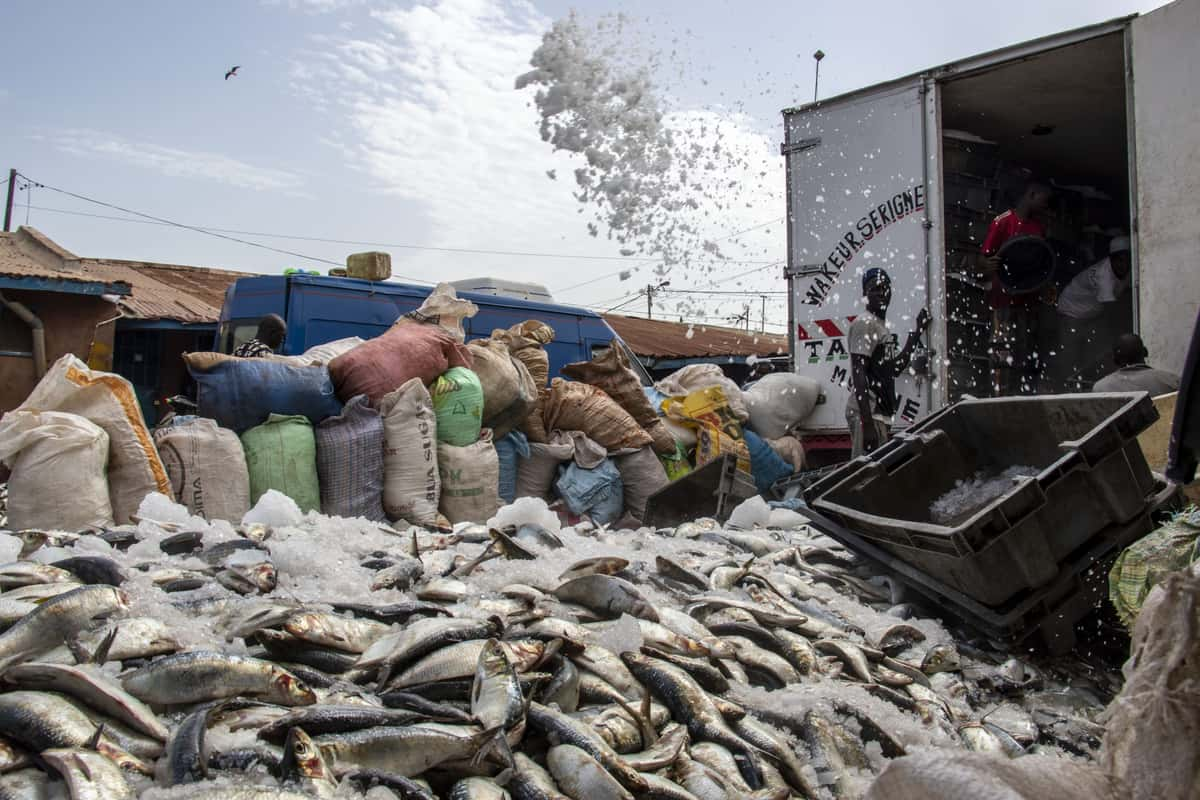
Africa has a fish problem. Not necessarily because the continent does not have enough fish. A huge amount of the fish already being caught simply never reaches the consumer.
The World Economic Forum says that one-third of all fish caught in Africa spoils before it reaches the plate, with the hot sub-Saharan climate making preservation particularly difficult. The losses mean less food for consumers and less income for fish processors, many of whom are women. That is a major problem because fish is not a minor part of Africa's food system.
According to the World Economic Forum's 2026 Investing in Blue Foods report, blue foods already provide approximately 18% of total animal protein consumed across Africa. The Forum estimates that doubling blue-food production could unlock an additional $17 billion in GDP while reducing Africa's protein gap by 25% relative to the global average.
So reducing fish waste is not simply an environmental issue. It is a nutrition, income, climate and economic-development opportunity. And African innovators are already working on it. Here are three approaches worth watching.
1. ColdHubs is bringing solar-powered refrigeration to Nigeria
One of the biggest problems facing fish sellers is surprisingly simple:
They do not have somewhere cold to keep the fish.
Fish begins deteriorating rapidly after it is caught, particularly in hot and humid environments. The Food and Agriculture Organization says effective chilling and hygienic handling are critical for controlling spoilage, while drying, salting and smoking can provide alternatives where cold chains are unavailable. This is where Nigerian startup ColdHubs comes in.
ColdHubs builds 100% solar-powered cold rooms designed for markets, farms and aggregation centres where reliable electricity can be difficult to obtain. Its facilities use solar power and battery storage to keep perishable food cold. The company has built a network across Nigeria. ColdHubs says it currently operates 58 locations across 28 Nigerian states.
The model is particularly interesting because customers do not necessarily need to build or purchase their own refrigeration infrastructure. Instead, ColdHubs provides a "pay-as-you-store" model, allowing farmers and traders to pay for storage when they need it. Its cold rooms can extend the shelf life of certain perishables from roughly two days to as much as 21 days. And ColdHubs is going beyond storage.
The fish cannot stay cold if the truck is hot
A cold room at the market only solves part of the problem. Fish still has to travel from the landing site or farm to the market. ColdHubs therefore also operates refrigerated transportation services for perishable products, including fish, meat, fruits and vegetables. The company's logistics operation uses temperature monitoring and refrigerated trucks to keep products cold during transportation. That is important because a cold chain is only as strong as its weakest link. You can have a modern cold room at the destination, but if the fish spends hours sitting in extreme heat during transportation, much of the value has already been lost.
ColdHubs' own 2022 impact report recorded 58 cold rooms across 28 states, more than 6,300 farmers and traders served, and 418,743 kg of food saved from spoilage in its facilities that year. It also reported more than 80 jobs created for women.
The company's current platform reports that users of its storage and ice services have experienced significant reductions in spoilage and higher incomes, although these figures are company-reported rather than independently verified.
The bigger idea is simple:
Use Africa's abundant sunlight to solve Africa's refrigeration problem.
2. NutriFish is using the sun to preserve small fish in Uganda
ColdHubs tackles spoilage by keeping fish cold. NutriFish takes a different approach:
Keep fish dry.
In Uganda, small freshwater fish such as silverfish, locally known as mukene, are traditionally dried in the open air. But open-air drying has disadvantages. Fish can be exposed to dust, insects, animals, rain and contamination. It can also take time, while poor drying conditions can reduce product quality and shorten shelf life.
The NutriFish project, led by researchers at Makerere University's College of Natural Sciences, introduced solar tent dryers and raised drying racks to improve fish processing. The technology uses solar heat to accelerate the drying process while providing a more controlled environment than simply leaving fish exposed outdoors.
The results are striking.
Makerere University reports that the original NutriFish project, implemented from 2019 to 2023, found that solar tent dryers doubled women's incomes and tripled the shelf life of silverfish to almost five months. That changes the economics of the fish business. Instead of being forced to sell quickly because fresh fish is deteriorating, processors can preserve the product for substantially longer.
That means:
less waste → longer shelf life → more market opportunities → higher potential income.
The innovation is also about women
Women are particularly important in Africa's fish-processing economy. The World Economic Forum notes that fish spoilage reduces incomes for fish processors, most of whom are women. NutriFish therefore isn't simply introducing a piece of drying equipment.
It is changing the economics of a value chain where women play an important role. Makerere University's research team says the project established savings groups for women and youth and helped increase women's participation in profitable fish-related businesses.
And the project is continuing. In 2025, Makerere University announced NutriFishPLUS, a new CAD $0.8 million project designed to scale improved fish-processing technologies, improve market access and strengthen the livelihoods of fishing communities. The programme is being implemented with private-sector partners and is expected to run from 2025 to 2028.
The goal is bigger than drying fish. It is about creating a more efficient small-fish value chain.
3. Fishers' cooperatives are turning collective action into resilience
The third innovation is less about a machine. It is about people working together.
Fishers' cooperatives and associations can help small-scale fishing communities pool resources, improve market access, coordinate activities and gain a stronger voice when dealing with governments and other organizations.
They can also help communities access infrastructure that would be difficult for an individual fisher to afford.
For example, an IFAD-supported fisheries programme in Tanzania proposed solar dryers, drying racks, cold-chain facilities, refrigerated trucks and ice-making plants that would be owned or managed by fisher cooperative societies. The programme also planned to strengthen cooperatives' capacity for distribution and marketing.
There is another benefit:
cooperatives can function as social safety nets.
The FAO's General Fisheries Commission for the Mediterranean has highlighted the role of fishers' cooperatives in providing informal social protection and helping fishing communities remain resilient during economic shocks. Research from the Gulf of Guinea also shows how fisheries cooperatives can support women, improve access to resources and help communities coordinate responses to crises. In Côte d'Ivoire, for example, a women's fisheries cooperative acquired a refrigerated container to help preserve fish for longer and reduce spoilage.
So the cooperative model can connect several pieces of the puzzle:
finance + storage + transportation + market access + bargaining power + community support.
That makes cooperatives an important complement to technology startups.
The bigger opportunity is not just stopping fish from spoiling
These three approaches demonstrate something important about African innovation. The solution to a major food-system problem does not necessarily require a futuristic technology. Sometimes it requires adapting relatively simple technologies to local conditions.
ColdHubs uses solar energy + refrigeration + logistics.
NutriFish uses solar heat + improved drying technology + better processing.
Cooperatives use collective organization + shared infrastructure + market coordination.
Different approaches.
Same objective:
Keep more of the fish that has already been caught. And that matters because producing more food is not the only way to improve food security. We can also get more value from the food we already produce.
Africa's blue-food opportunity is much bigger than fish
The World Economic Forum's latest blue-food report argues that Africa's aquatic food systems represent an underused economic opportunity. Blue foods already provide about 18% of animal protein in Africa, and the Forum estimates that doubling blue-food production could add $17 billion to GDP while creating millions of sustainable livelihoods. That means reducing post-harvest losses could have effects far beyond fishermen.
It could benefit:
Fishers
Women processors
Traders
Transport companies
Cold-chain startups
Food retailers
Consumers
Restaurants
Exporters
Local manufacturers
Technology companies
And there is an environmental dimension too.
The World Economic Forum argues that reducing food loss can improve nutrition and economic outcomes while reducing pressure on land and forests because more food reaches consumers without requiring additional production.
The startup lesson
There is an important lesson here for African entrepreneurs. Some of the continent's biggest opportunities may not come from inventing something completely new. They may come from looking at a massive inefficiency and asking:
Where is value disappearing?
In Africa's fisheries sector, value disappears when fish sits in the heat.
It disappears when there is no cold storage.
It disappears when transportation takes too long.
It disappears when fish is poorly dried.
It disappears when processors cannot access markets.
And it disappears when small producers lack the bargaining power or infrastructure to compete.
That creates opportunities for startups. ColdHubs is attacking the problem through cold-chain infrastructure. NutriFish demonstrates how processing technology and value addition can transform a traditional fish product. Cooperatives show how collective organization can make infrastructure, finance and market access more achievable.
Final thoughts
Africa does not necessarily need to catch more fish to get more nutrition and economic value from its fisheries. It may first need to waste less of the fish it already catches. The World Economic Forum's one-third spoilage figure makes the scale of the opportunity clear. And the innovations emerging across the continent show that solutions do not have to look the same everywhere.
In Nigeria, the answer can be a solar-powered cold room and refrigerated truck. In Uganda, it can be a solar tent dryer that gives small fish a much longer shelf life. Across fishing communities, it can be cooperation that gives people access to infrastructure, finance and stronger markets.
These are not just food-preservation projects. They are examples of African innovation solving problems at the intersection of technology, climate, nutrition and economic opportunity. The fish are already being caught. The next challenge is making sure more of them actually make it to the plate.

Author
Kwame MensahTech journalist covering AI, software, and emerging technologies impacting Africa's digital landscape and beyond.. Explore author & articles