

Anker Packs 150W Into a New 6-in-1 Travel Charging Station
Anker's new 150W 6-in-1 travel charging station can power laptops, phones and accessories from one outlet. Here's what it offers and who should buy it.

Travelling with several gadgets usually means travelling with several chargers. Anker's latest charging station is designed to change that. The Anker Travel Charging Station (6-in-1, 150W) packs four USB-C ports and two USB-A ports into a compact unit weighing just 290g. Total charging power reaches 150W, while either of its two primary USB-C ports can provide up to 100W when used individually.
At $79.99 in the US, it could be particularly useful for professionals, students, creators and frequent travellers who carry a laptop alongside a phone, tablet, smartwatch and other electronics. Nigerian pricing is not stable as when we checked, so buyers should treat imported local listings cautiously rather than relying on a converted dollar price as an official Nigerian MSRP.
Anker 6-in-1 150W Travel Charging Station Specs
Specification | Anker Travel Charging Station |
|---|---|
Model | A1A05 |
International Price | $79.99 |
Nigeria Price | ₦150,000 |
Total Output | 150W maximum |
Ports | 4 × USB-C + 2 × USB-A |
USB-C1 | Up to 100W |
USB-C2 | Up to 100W |
USB-C3 | Up to 45W |
USB-C4 | Up to 45W |
USB-A | Up to 12W |
Input | 100–240V, 50–60Hz |
Power Management | PowerIQ 4.0 |
Safety | ActiveShield 4.0 |
Dimensions | 149 × 67.5 × 22mm |
Weight | 290g |
Plug | 90-degree foldable |
Colours | Iron Gray / Radiant White |
Charging Cables Included | No |
Anker says USB-C1 and USB-C2 support 5V/3A, 9V/3A, 15V/3A and 20V/5A output, while C3 and C4 reach 45W.
150W From One Charging Station
The headline feature is 150W total output. That's enough capacity to make the device substantially more useful than a basic multi-port phone charger. The first two USB-C ports each support up to 100W when used individually, meaning either can handle compatible power-hungry laptops such as a MacBook Pro rather than limiting laptop charging to one specific port.
USB-C3 and C4 reach up to 45W each, making them better suited to smartphones, tablets, handheld gaming devices and other USB-C electronics. The two USB-A ports provide up to 12W, which could be useful for older accessories that haven't made the transition to USB-C.
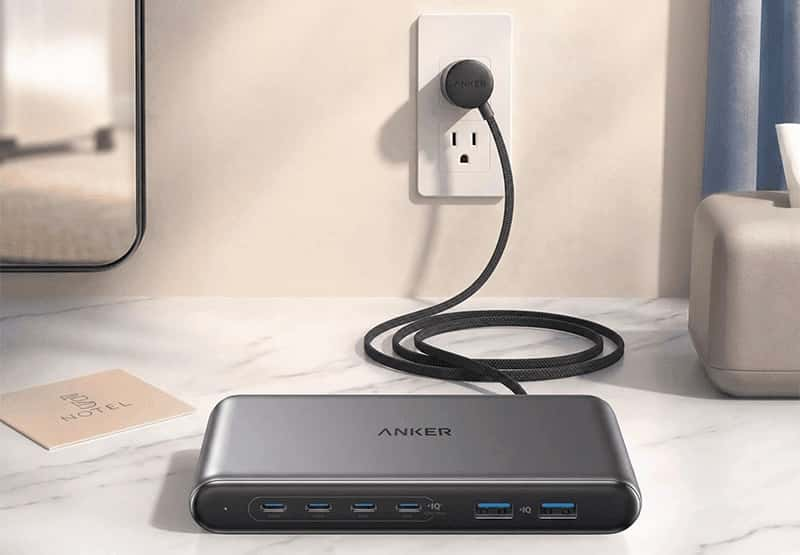
One important clarification: six ports doesn't mean six devices can each receive their maximum port wattage simultaneously.
The entire station has a 150W power budget. When multiple devices are connected, Anker's PowerIQ 4.0 dynamically distributes available power according to their charging requirements.
Use Case 1: Laptop + Phone + Tablet on a Business Trip
This is probably the most convincing reason to buy it. Imagine travelling with a MacBook Pro, iPhone, iPad, Apple Watch and AirPods.
Normally, that can mean multiple power adapters plus several cables competing for the limited sockets beside a hotel bed.
With this Anker station, the laptop can use one of the high-powered USB-C ports, while your phone and tablet use the remaining USB-C connections and smaller accessories occupy USB-A.
Everything comes back to one wall outlet. For consultants, software engineers, remote workers and business travellers, that reduction in charging clutter could be more useful than the raw 150W figure.
Use Case 2: A Student's Charging Hub
It also makes sense in a university hostel or student apartment. A student might own a USB-C laptop, smartphone, power bank, wireless earbuds, smartwatch and tablet. Instead of buying individual chargers or constantly unplugging one device to charge another—the six-port station can become the central charging point on a desk.
This is especially attractive for computer science and engineering students who might already travel with a laptop and multiple development accessories.
The downside is price. At $79.99, it's considerably more expensive than a basic multi-port charger, so students with only a laptop and phone probably don't need this much hardware.
Use Case 3: One Charger for Two Laptop Users
Two high-powered USB-C ports also make the station interesting for couples or colleagues travelling together. Anker advertises C1 and C2 as capable of up to 100W individually.
However, remember that 150W is the total shared capacity. Don't interpret “two 100W ports” as a promise of 200W simultaneous output. When several devices are attached, PowerIQ reallocates the available 150W.
That's an important distinction when shopping based purely on the numbers printed beside each port.

Use Case 4: Content Creators on the Road
Content creators tend to accumulate electronics quickly. A typical travel bag might contain a laptop, smartphone, tablet, camera accessories, wireless microphone system, power bank and earbuds. The four USB-C ports are particularly useful here because modern creator equipment increasingly uses USB-C.
A creator could charge a laptop while topping up a phone, power bank and camera-related accessory without packing several separate wall adapters.
At 290g, the station adds some weight, but potentially removes several heavier individual chargers from the bag.
Use Case 5: A Cleaner Home or Office Desk
Despite “Travel” being in the name, this doesn't need to live inside a suitcase. It can operate as a permanent desktop charging hub.
Connect your laptop, phone, tablet, earbuds and other accessories and you have one charging location instead of several adapters occupying wall sockets. That makes it useful for home offices, shared workspaces, dorm rooms and small desks where outlet availability is limited.
Surprisingly Portable for 150W
The physical design may be just as important as the output. The station measures approximately 5.9 × 2.7 × 0.87 inches (149 × 67.5 × 22mm) and weighs 0.64lb or 290g. Anker compares its footprint with a phone, while the 22mm thickness makes it relatively easy to slide into a laptop or technology bag.
There's also a 90-degree folding plug and flat braided power cable, helping reduce the usual mess associated with travelling with a desktop charging station. And because its input supports 100–240V at 50–60Hz, the power electronics can operate across common international mains voltages.
You may still need the appropriate physical plug or adapter for the country you're visiting.
ActiveShield 4.0 Handles Safety
Packing 150W into a relatively thin enclosure creates a thermal-management challenge.
Anker uses its ActiveShield 4.0 protection system, which it says performs more than 10 million temperature checks per day. The charger also includes seven layers of protection covering conditions such as excessive temperature, current, voltage and short circuits.
There's an important limitation here. Anker states that prolonged operation at maximum load can trigger overtemperature protection, at which point the station will automatically reduce output power to protect itself.
That's preferable to unsafe operation, but buyers shouldn't assume 150W means the charger will indefinitely sustain maximum output regardless of temperature.
What Doesn't It Have?
The biggest omission is AC outlets. This isn't a traditional power strip. All six connections are USB ports. You can't connect a monitor, television, printer or another device requiring a normal wall plug.
There is also no wireless charging pad, so Apple Watch and wireless earbuds still require their respective charging cables or pucks.
And Anker doesn't include USB charging cables. You'll need suitable cables capable of handling the wattage required by your devices.
Another consideration is proprietary charging technology. Anker notes that some devices may charge faster with their manufacturer's own charger because this station doesn't support every brand-specific charging protocol.
Should You Buy It?
The Anker 150W 6-in-1 Travel Charging Station makes the most sense when you're already carrying several USB-powered devices. A person with only a smartphone and earbuds would be paying for capacity they rarely use.
Someone travelling with a 100W laptop, phone, tablet, power bank, smartwatch and earbuds has a completely different problem—and that's where this product becomes compelling.
It's particularly attractive for:
Frequent travellers who encounter limited hotel sockets
Remote workers carrying laptops and several accessories
Students who want one charging hub for a desk or hostel
Content creators travelling with numerous rechargeable devices
Couples or colleagues who want to share one high-powered charging station
Final Verdict
The Anker Travel Charging Station 6-in-1 150W is less about charging one device incredibly fast and more about eliminating the need to carry six separate chargers.
Four USB-C ports, two USB-A ports, two individually capable 100W USB-C connections, 150W total output and a compact 290g body create an unusually practical combination.
The limitations are straightforward: no AC outlets, no wireless charging, no included USB charging cables and 150W must be shared between connected devices. Heavy sustained loads can also cause the safety system to reduce output.
At $79.99, it isn't cheap, but the value becomes easier to justify if it replaces several chargers already taking up space in your travel bag.
For a Nigerian or African professional travelling with a laptop and several devices or a student building a desk setup around USB-C—the attraction is simple: one wall socket, one charging station and up to six devices.
That's a much more useful travel feature than simply putting a bigger wattage number on another laptop charger.
Read more: Oraimo PowerNova L21 Review: A Compact 20,000mAh Power Bank That Can Keep Your Phone Going All Day
Read more: Best Budget 10,000mAh Power Banks to Buy: Oraimo, itel and Infinix Compared
Read more: Apple 40W Charger Review: Best Fast Charger for iPhone?

Author
Nkechi OkaforMobile device specialist focused on smartphones, tablets, and wearables for the African market. Explore author & articles





