

Apple's Future Smart Glasses Could Become Your Personal Health Coach
Apple's future smart glasses could evolve into a health and fitness wearable, using cameras, sensors and AI to understand movement and potentially provide hands-free workout assistance.

Apple's long-rumoured smart glasses could eventually become much more than a hands-free camera and AI assistant. The more interesting possibility is health.
Recent reporting indicates that Apple sees health and fitness as part of the long-term potential of its smart-glasses platform. Sensors could eventually capture movement data and enable fitness-tracking capabilities, although these additions aren't expected to be a major feature of the first-generation product.
That distinction matters. The first Apple smart glasses increasingly look like an attempt to put cameras, audio and AI into something resembling ordinary eyewear.
What could come afterward is potentially much more ambitious. If Apple can combine what glasses see with information from the Apple Watch, AirPods, iPhone and Apple Health, smart glasses could eventually become another set of sensors helping Apple understand not only where you are and what you're looking at, but what you're doing.
These Aren't Really AR Glasses — At Least Not Yet
It's easy to hear “Apple glasses” and imagine a lightweight Vision Pro with digital information floating in front of your eyes. That's not what the first model is expected to be.
Current reporting suggests Apple's initial smart glasses will have no built-in display. Instead, they're expected to use cameras, microphones, speakers, sensors and AI capabilities while remaining connected to the wider Apple ecosystem.
Reported functionality includes:
Taking photos
Recording video
Handling calls
Playing audio
Interacting with Siri
Understanding objects and surroundings
Responding to voice requests
Potentially recognising hand gestures
The glasses are expected to use cameras to provide visual information to Apple's AI systems so Siri can understand more about what the wearer is seeing. That makes them conceptually closer to AI glasses than a traditional augmented-reality headset.
True Apple AR glasses with information displayed directly in the lenses appear to remain further away.
Why Would Apple Put Health Features in Glasses?
At first, glasses don't seem like an obvious health device. They're on your face rather than your wrist. But their position creates a different opportunity. A smartwatch is excellent at measuring information about your body. Glasses can potentially gather information about your movement and surroundings.
That's an important distinction. Cameras and motion sensors could potentially help an AI system understand whether you're walking, exercising or performing another physical activity.
Current reporting indicates Apple has explored using sensors in future glasses to capture movement information for fitness purposes. That doesn't mean Apple has confirmed specific exercises or coaching features. But the underlying idea makes sense: glasses can observe movement from a perspective that a watch simply doesn't have.
The Vision Pro Already Showed Apple Was Thinking About This
This health direction didn't appear out of nowhere. Apple reportedly explored bringing a more interactive version of Fitness+ to Vision Pro.
The concept involved using the headset's body-tracking capabilities while users followed workouts, potentially allowing the device to understand aspects of their movement and exercise form.
The idea ultimately didn't progress. One obvious problem was the hardware itself.
Vision Pro is a substantial headset. Wearing something that heavy while exercising isn't particularly practical, and reporting indicates weight and technical limitations contributed to the project being abandoned.
Smart glasses fundamentally change that equation. Something lightweight enough to wear throughout the day is much better suited to fitness than a large mixed-reality headset.
Could the Glasses Become an AI Fitness Coach?
Potentially—but this is where it's important to separate what has been reported from what the technology could eventually enable. Apple's reported work supports the idea of health and fitness capabilities eventually coming to its glasses.
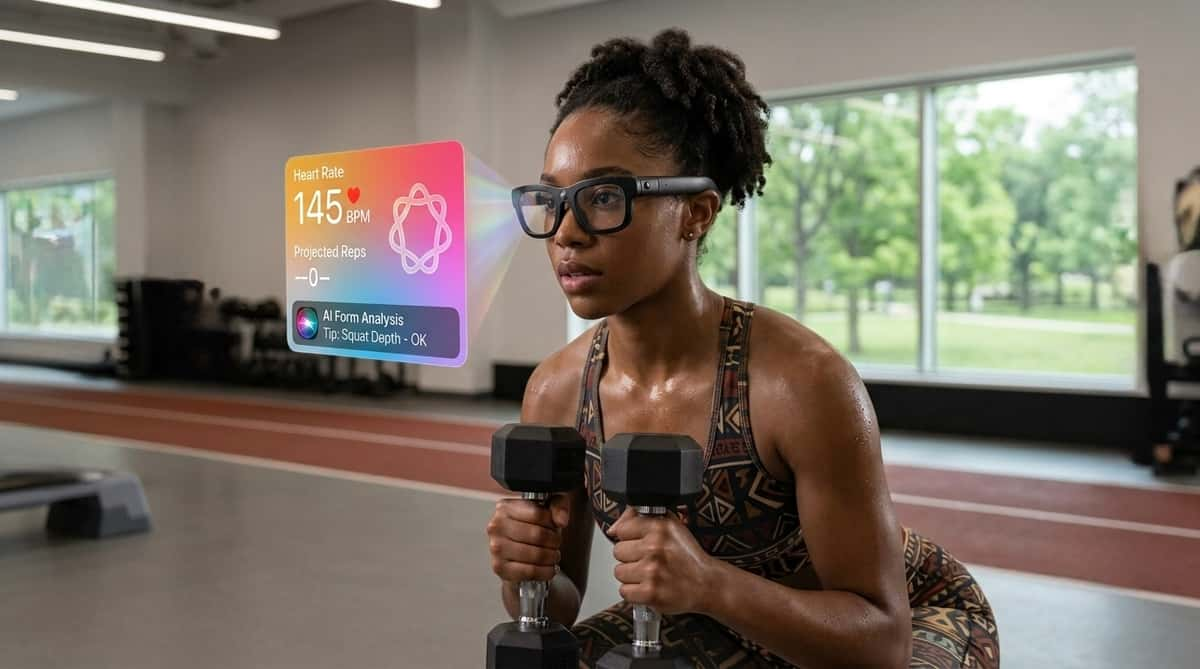
Specific features such as a virtual trainer correcting your squat technique haven't been announced. Still, cameras and motion sensors combined with AI create some interesting possibilities.
Imagine starting a workout while wearing Apple glasses. The glasses recognise that you're exercising. Your Apple Watch records heart rate and workout data. The glasses contribute information about movement and surroundings. Your AirPods provide private audio feedback. Apple Intelligence interprets information from those devices.
Instead of constantly looking at your Watch or iPhone, coaching could be delivered through audio.
That's not a confirmed Apple feature. It's an example of why glasses could become valuable to Apple's existing health ecosystem rather than functioning as an isolated health tracker.
The Apple Watch May Be More Important Than Putting Heart-Rate Sensors in Glasses
The original version of this article suggested Apple's glasses could directly monitor heart rate. We'd be more cautious about that now.
Current reporting supports movement sensing and future health functionality, but there isn't enough evidence to treat built-in heart-rate monitoring as a confirmed glasses feature. Apple also doesn't necessarily need to duplicate every sensor already available elsewhere.
The Apple Watch can already collect extensive health and fitness information.
That creates a more interesting possibility: use different Apple devices for what each does best
The Watch understands what's happening on your wrist and inside your body. The glasses understand more about what you're seeing and doing.
The iPhone provides processing, connectivity and access to applications.
AirPods provide private audio. Apple Health brings the information together.
That could be considerably more useful than simply turning the glasses into another step counter.
Apple Already Has a Huge Health Ecosystem
Apple isn't entering digital health from scratch. Apple Watch already supports capabilities including heart-rate monitoring, workout tracking, sleep features and ECG functionality on supported hardware and in supported regions.
Apple Health provides the software layer where information from different sources can be organised.
Fitness+ adds exercise content. The potential importance of smart glasses is therefore not that Apple needs another device capable of recording workouts.
It's that glasses can add a new type of context. A Watch knows your heart rate increased. Glasses could potentially help provide contextual information about what you were doing when it happened.
That combination could eventually make Apple's health platform more intelligent.
Siri AI Could Be Central to the Experience
The timing is also interesting because Apple has now substantially expanded Siri's capabilities. The new Siri AI has personal-context understanding, broader knowledge, onscreen awareness and deeper application actions.
For smart glasses, voice interaction becomes especially important because the first generation reportedly won't have a display.
There's nothing to tap. You would need to communicate primarily through voice, gestures and perhaps physical controls.
The glasses' cameras could feed information about the surrounding environment into Apple's visual-intelligence systems, allowing Siri to respond to questions about what you're seeing. That makes the glasses less interesting as standalone hardware and more interesting as a physical interface for Apple Intelligence.
Battery Life Could Determine How Ambitious Apple Can Be
There's a practical problem with putting cameras, AI, wireless connectivity and multiple sensors into something people expect to look like ordinary glasses:
power consumption. Current reporting indicates battery capacity is one reason Apple is keeping the first product relatively simple.
Features such as integrated displays, LiDAR and more advanced imaging hardware consume additional power and require larger batteries. Apple reportedly wants the glasses to remain slim and lightweight, forcing compromises in the first generation.
Health sensing creates the same engineering challenge. The more frequently cameras and sensors operate, the more energy they consume. So even if Apple has ambitious ideas for health monitoring, some may have to wait for better chips, batteries and sensor efficiency.
Could Apple Glasses Replace the Apple Watch?
We don't think that's the most useful way to look at the product. A pair of glasses and a smartwatch occupy completely different positions on the body.
The Watch is already extremely well positioned for continuous physiological sensing.
Glasses have access to vision, audio and head movement. Instead of replacing the Watch, smart glasses could make it more useful. Imagine your Watch recognising that you've started exercising while your glasses understand the environment and activity around you.
Information from both devices could then contribute to a more complete picture inside Apple Health. That kind of device cooperation is where Apple's ecosystem becomes particularly important.
The First Generation Will Probably Be Much Simpler
Anyone expecting a futuristic health coach from Apple's first pair of smart glasses should temper those expectations. The latest reports suggest the initial product will concentrate on functionality such as:
Cameras
Audio
Calls
Siri
Visual intelligence
AI assistance
Interaction with an iPhone
Health and fitness capabilities are described as something Apple could add over time, rather than a defining launch feature.
Even augmented reality appears to be a longer-term ambition. That suggests Apple may be taking a familiar approach:
build the wearable platform first, then expand what its sensors and software can do over subsequent generations.
Apple Is Entering an Already Competitive Smart-Glasses Market
Apple won't be creating this category from scratch. Meta's Ray-Ban smart glasses have already demonstrated demand for lightweight eyewear combining cameras, speakers and AI.
Apple's reported first-generation approach sounds similar in several respects, although deeper integration with the iPhone, Siri and Apple Intelligence could become a major differentiator.
Health could eventually become another one. Apple has already demonstrated with the Watch that a product can begin as a general-purpose technology accessory and gradually develop into a much more serious health platform.
Smart glasses could follow a similar path. But that's a possibility—not something Apple has confirmed.
When Could Apple Smart Glasses Launch?
The timeline has shifted. Earlier reports pointed toward an introduction around late 2026 or early 2027.
More recent reporting from Bloomberg's Mark Gurman indicates Apple is now targeting late 2027, following development delays.
Timing could still change. Apple hasn't officially announced the glasses, given them a product name or published specifications.
For now, everything about the device outside Apple's publicly released products should therefore be treated as reporting about an unreleased project rather than confirmed specifications.
Frequently Asked Questions
Will Apple's smart glasses have a display?
Current reporting indicates the first generation won't have an integrated display. It is expected to rely on cameras, microphones, speakers, sensors and AI instead.
Will Apple glasses track workouts?
Apple is reportedly exploring health and fitness capabilities for future versions, including using sensors to capture movement information. Those features aren't currently expected to define the first-generation product.
Will the glasses measure heart rate?
There isn't enough reliable information yet to present direct heart-rate measurement as a confirmed feature. A future Apple health-glasses ecosystem could potentially combine information from other devices such as Apple Watch, but Apple hasn't announced how this would work.
Will Apple glasses replace Apple Watch?
There's currently no indication that they're intended to. The two devices could ultimately complement each other because glasses and watches can collect very different types of contextual information.
When will Apple smart glasses launch?
Apple hasn't announced a launch date. The latest reporting points toward late 2027, although development schedules for unreleased products can change.
Final Thoughts
The most interesting thing about Apple's smart-glasses project may not be taking photographs or asking Siri what you're looking at. It's what the product could become after Apple establishes another wearable platform.
The first generation appears likely to be relatively straightforward: display-free glasses built around cameras, audio, sensors and AI.
Health and fitness could come later. And that's where the idea becomes much more interesting.
Apple already has a device capable of monitoring your wrist, an iPhone carrying enormous amounts of personal context, AirPods providing private audio and an increasingly capable AI layer connecting its ecosystem.
Smart glasses could add something those devices don't naturally have:
a first-person understanding of what you're doing and what's happening around you.
That doesn't mean your glasses will immediately correct your workout technique or replace your Apple Watch. Those capabilities remain speculative. But movement sensing, computer vision and AI could eventually make glasses useful for more than recording what you see.
They could help Apple's health ecosystem understand what you're doing while your other devices measure how your body responds.
If Apple eventually makes those pieces work together, its smart glasses may become far more interesting as a health device than they initially appear.
Read more: Ray-Ban Meta Smart Glasses Review: Price, Specs, Features and Use Cases

Author
Adebayo JohnsonSenior tech editor with over 4 years of experience covering mobile and gadget technology. Explore author & articles





