Are Students Getting Worse at School — Is Technology to Blame?
Test scores are falling as teenagers spend more time on phones, social media and AI. Could technology be weakening learning in Africa, and what should parents do?

Are teenagers growing dimmer? That provocative question from The Economist captures an uncomfortable trend emerging across education: teenagers are performing worse on some of the world's most important academic assessments.
The latest OECD Programme for International Student Assessment (PISA), which evaluates 15-year-olds, found reading performance at its lowest level since testing began in 2000. Across the countries examined, average reading scores fell from a peak of 501 in 2012 to 466 in 2025. Mathematics and science have also declined. The OECD considers roughly 20 PISA points equivalent to about one year of schooling, meaning some of these losses are educationally substantial.
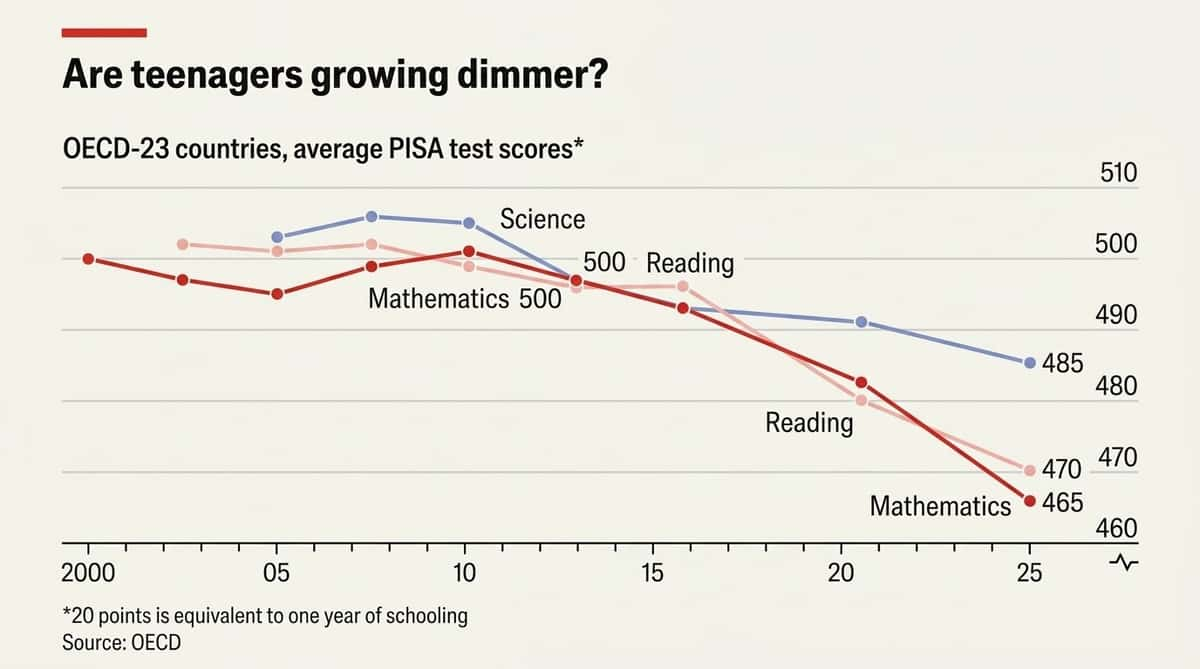
COVID-19 disruption undoubtedly contributed, but it cannot explain everything. OECD analysis had already detected declining reading and science performance before the pandemic. Its earlier PISA research also found that students distracted by classmates using digital devices during mathematics lessons scored 15 points lower, even after socioeconomic differences were considered.
The 2025 results have intensified the technology question. The OECD linked worsening reading performance with increased screen use and declining reading for pleasure. Students spending more than five hours daily on digital devices performed considerably worse, while heavy dependence on AI tools was also associated with weaker results, particularly in science.
For Africa, this should be a warning rather than an invitation to conclude that smartphones are making every child less intelligent.
Nigeria's examination results demonstrate why the picture is complicated. The 2025 UTME generated unusually widespread complaints about poor results, prompting JAMB to begin a technical review and bring in computer professionals, university leaders and assessment experts. JAMB subsequently acknowledged technical problems affecting some candidates and ordered remedial examinations.
WAEC has faced its own challenges. Reporting on examination performance between 2022 and 2026 points to declining pass rates alongside examination malpractice and operational problems. Interestingly, WAEC's introduction of computer-based testing in 2026 reportedly contributed to a 1.11-percentage-point reduction in malpractice.
That illustrates an important contradiction:
technology can damage learning when it becomes a distraction, but technology can also improve education when deployed deliberately.
Cambridge examinations do not provide evidence of a universal African academic collapse either. Cambridge International reported growing participation in its June 2025 IGCSE and O Level examinations, including across sub-Saharan Africa, with nearly 740,000 IGCSE entries globally—5% more than the previous year. Nor should professional and clinical assessments such as OSCEs be mixed directly with secondary-school examinations. They measure different populations and competencies. There is currently insufficient evidence to claim a continent-wide deterioration across JAMB, WAEC, Cambridge and OSCE examinations caused by technology.
The stronger concern is how technology is changing the way young people learn.
A Nigerian study involving 271 university students examined recreational and educational screen use against academic performance, reflecting growing interest in this relationship locally. Globally, UNESCO says evidence remains mixed: properly designed technology can improve learning, while excessive or poorly controlled use introduces distraction and can reduce meaningful interaction. Studies using PISA data have found performance worsening after ICT use passes a moderate threshold.
Then there is AI. A student can now ask ChatGPT or another AI assistant to summarise a novel, solve mathematics, generate an essay or answer homework questions within seconds. Used correctly, this can become extraordinary personalised tutoring. Used as a substitute for thinking, it creates a different possibility: students may submit increasingly sophisticated work while developing weaker underlying skills.
Governments are beginning to intervene. By March 2026, 114 education systems worldwide had national restrictions on mobile phones in schools, compared with fewer than one-quarter of countries in 2023. Australia has gone further. Since December 10, 2025, major social-media platforms have been required to take reasonable steps to prevent Australians under 16 from creating or maintaining accounts.
The technology companies themselves are under increasing scrutiny. Meta is currently defending a landmark US lawsuit brought by 29 states, which accuse the company of designing Facebook and Instagram in ways that addict children and harm their mental health. Meta denies the allegations and argues there is insufficient evidence establishing that social media causes poor adolescent mental health. The dispute also connects to a broader issue we previously examined in Afritech Connect's analysis of growing data-privacy concerns as AI advances. Children are not merely consuming digital platforms; their attention, behaviour and personal information increasingly interact with algorithmic systems designed to predict what will keep them engaged.
Africa does not necessarily need Australia's blanket approach, but doing nothing would be equally unwise.
Schools could establish phone-free lessons while retaining supervised access to computers and educational technology. Governments should develop clear policies governing AI-assisted schoolwork, protect children's educational data and invest in teacher training rather than simply buying more devices. Reading programmes, libraries, textbooks and foundational mathematics should remain priorities alongside digital skills.
Parents have an equally important role. Children need periods without notifications, short-form videos and social media, particularly during homework and before sleep. Reading books for sustained periods should be encouraged precisely because it exercises something today's digital environment constantly competes for: attention.
Most importantly, African education policy should avoid turning technology into the villain. Technology helped maintain education during crises. UNESCO highlights a programme using mobile phones and radio during Nigeria's Boko Haram crisis that supported 22,000 disadvantaged children and recorded improvements in literacy and numeracy. AI can explain difficult concepts, provide practice questions and expand access to educational material that many African schools could never otherwise afford.
The real question, therefore, may not be whether technology is making African students less intelligent. It is whether young people are learning to use technology as a tool for thinking or allowing technology to do the thinking for them.
As test scores fall elsewhere and smartphones, social media and AI become even more embedded in childhood, Africa has an opportunity to act before the consequences become much harder to reverse.

Author
Azeez LiadiAzeez is an AI Engineer, Data Scientist, founder, and Senior Tech Writer at Afritech Connect. A top 1% graduate of Lagos State University, he has worked with international startups and… Explore author & articles