ContiSX Phone: Nigerian-Made ₦550,000 Smartphone, Specs and Limitations
Nigeria's ContiSX Phone costs ₦550,000 and uses a proprietary blockchain operating system. Explore its features, security claims and major app limitations.
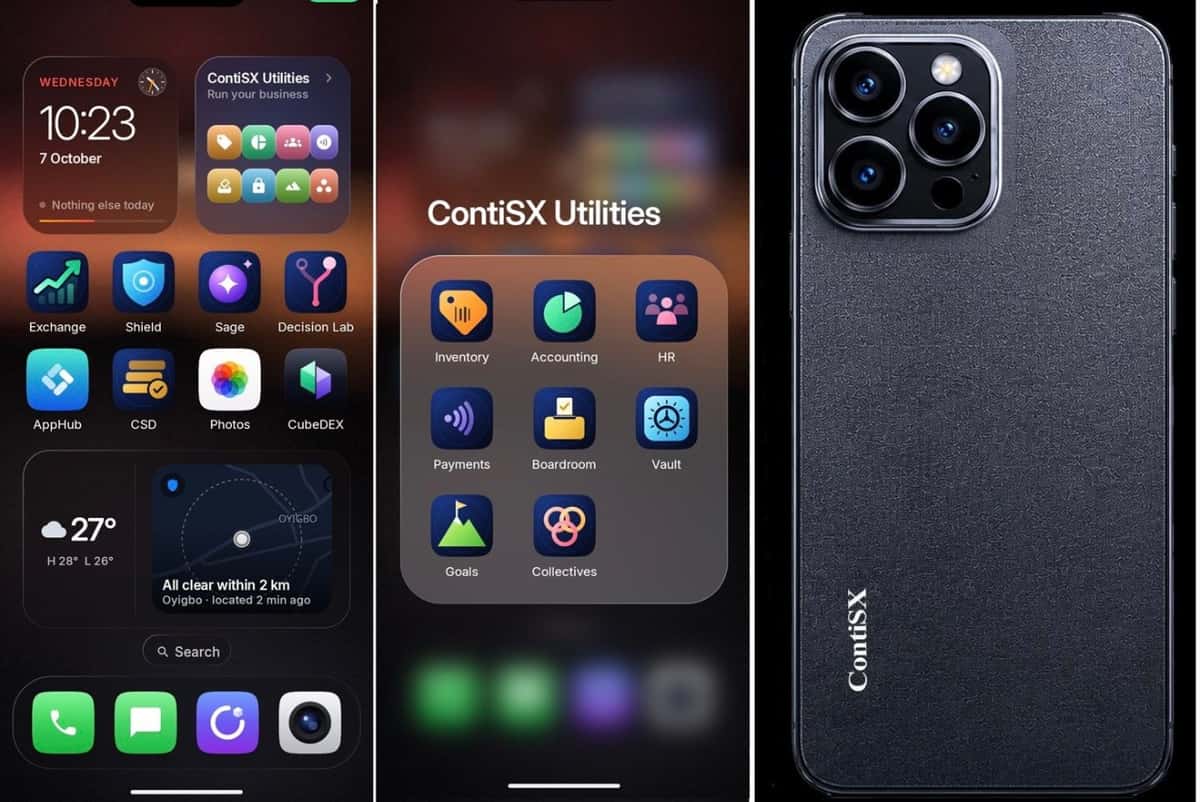
Nigeria's smartphone industry has a new entrant, and it is attempting something considerably different from the Android devices that dominate the country's mobile market.
The ContiSX Phone, developed by a Nigerian technology venture associated with Professor Ndubuisi Ekekwe, has entered the market at a reported price of ₦550,000. The company, headquartered in New Owerri, Imo State, is positioning the device as a secure smartphone for business communication, digital identity and financial transactions rather than a conventional entertainment-focused handset.
According to the company, the device combines encrypted communication with access to ContiSX's planned financial-market ecosystem. Independent reporting has identified its launch price as ₦550,000. But there is something prospective buyers must understand before placing an order.
The ContiSX Phone does not run Android or iOS, and users should not expect familiar applications such as WhatsApp, Instagram or Facebook to work on it.
That limitation could become either the device's defining strength or its biggest commercial challenge.
From Owerri to customers across nine countries
In an October 8 update published through Tekedia, Ekekwe thanked Nigerian influencers and technology enthusiasts for the attention the phone received following its announcement. He said the product briefly became the leading trending topic on X and attracted orders from nine countries, including the United Kingdom, Switzerland, the United States and South Africa.
The company also announced that shipping had started, with some Nigerian deliveries expected immediately and the first batch of international orders targeted for completion the following week. These are company-reported developments. Independent figures confirming the number of phones sold, shipped or delivered have not yet been published. Still, the international interest is notable.
Nigerian technology companies are increasingly building products for customers beyond the country's borders. ContiSX is attempting to extend that ambition into smartphone hardware and its underlying software ecosystem.
The important question is whether initial enthusiasm will translate into sustained adoption.
What makes the ContiSX Phone different?
Most smartphones sold in Nigeria run Android, while Apple's iPhones use iOS. These operating systems give customers access to extensive application ecosystems covering messaging, banking, entertainment, navigation, shopping and productivity.
ContiSX is taking a different route. Its phone is built around a proprietary blockchain-oriented software ecosystem and a ContiSX Smart Account. According to the company, the Smart Account acts as a digital identity that connects users to communication, payment, investment and other services across the ContiSX platform. The device is intended to provide encrypted voice calls, video communication, messaging and email while giving individuals or institutions greater control over their digital identities and encryption keys.
ContiSX also promotes features such as a hardware secure enclave, biometric authorization, encrypted storage and institutional control over device access.
For organizations handling sensitive information, these capabilities could be attractive. Banks, government agencies, security organizations and businesses may value devices that separate their internal communication systems from conventional consumer applications.
However, these benefits must be evaluated against the company's actual security implementation. Using blockchain technology does not automatically make a smartphone impossible to hack or its communications immune to interception.
Security depends on the operating system, cryptographic implementation, hardware, update mechanisms and how the complete system is configured and maintained. ContiSX promises strong protection, but publicly available independent security testing is still needed to substantiate its most ambitious claims.
ContiSX Phone specifications and price in Nigeria
The company has published the following specifications on its official website.
Specification | ContiSX Phone |
|---|---|
Price in Nigeria | ₦550,000 (reported launch price) |
Display | 6.7-inch AMOLED |
Resolution | 2412 × 1080 pixels |
Refresh rate | 120Hz |
Processor | Octa-core, 5nm chipset |
RAM | 8GB |
Storage | 256GB |
Rear camera | 50MP triple-camera array |
Video recording | Up to 4K at 60fps |
Battery | 5,000mAh |
Charging | 33W fast charging |
Connectivity | 5G, Wi-Fi 6, NFC |
SIM support | Dual SIM and eSIM |
Security | Secure enclave, biometric authentication |
Operating system | Proprietary ContiSX ecosystem |
Available colours | Graphite, Ocean Blue, Silver |
On paper, the device offers hardware features associated with contemporary mid-range smartphones. A 120Hz AMOLED display, 5G connectivity, 8GB RAM and 256GB storage are useful specifications. But specifications alone do not establish real-world performance.
The company has not provided enough independently verified information to determine how the phone compares with similarly priced Samsung, Xiaomi, Tecno or other Android devices in camera quality, processor performance, battery endurance and software reliability.
That makes independent hands-on testing especially important.
Why the absence of Android apps matters
For many Nigerian smartphone buyers, this could be the deciding factor. Imagine buying a ₦550,000 phone and discovering that you cannot install WhatsApp, your preferred banking application, Instagram or other familiar Android services.
For most consumers, that would be a serious limitation. People rely on smartphones for everyday communication, work, financial transactions, social media, navigation and access to essential services.
ContiSX is effectively asking users to adopt an alternative software environment. Instead of downloading ordinary Android applications, buyers are expected to use the services built into the ContiSX ecosystem. The company lists applications and services covering secure messaging, payments, asset custody, markets, governance and AI-assisted financial interpretation.
That may be sufficient for some business or institutional users. But it is unlikely to replace the flexibility of Android or iOS for the average consumer without a much broader range of compatible applications.
This creates a classic technology problem. Developers generally want to build applications for platforms with users. Consumers generally want to buy devices that already have the applications they need. Breaking that cycle requires substantial investment, partnerships and a compelling reason to switch.
ContiSX will have to demonstrate that its security and financial services are valuable enough to justify those limitations.
A smartphone built around a financial exchange
The ContiSX Phone is closely connected to the company's broader ambition of developing financial-market infrastructure. ContiSX Securities Exchange is working toward a platform intended to support securities trading, custody, payments and other financial services. The company says its phone will provide direct access to parts of this ecosystem through a unified digital identity. This explains why the handset differs from an ordinary consumer smartphone.
ContiSX is not merely trying to sell hardware. It wants the device to become a gateway to its financial and communication services. The company has also promoted complimentary access to its communication network and educational programmes, including the Tekedia Mini-MBA and capital-market training. It also states that Nigerian buyers receive one year of complimentary ContiSX communication services and zero-metered data usage for designated exchange and central securities depository services.
However, prospective buyers should understand that some exchange-related functionality remains dependent on regulatory approvals. Ekekwe has acknowledged that certain services will remain inactive until the necessary licensing processes are completed. An Approval-in-Principle from a regulator should not be confused with permission to begin unrestricted exchange operations.
This distinction matters because the financial ecosystem is central to the phone's value proposition.
Is the ContiSX Phone really made in Nigeria?
The phrase Nigerian-made smartphone deserves careful examination. ContiSX is a Nigerian-led venture with its headquarters in Owerri, and its founder describes the phone as a product of the company's technology-development efforts.
That is a meaningful Nigerian contribution. But there is a difference between a phone that is Nigerian-designed or developed, one that is assembled locally, and one whose major components are manufactured domestically. At present, the publicly available information reviewed does not establish where the phone's processor, display, camera modules and other major components are manufactured or where final assembly takes place.
Consequently, it would be premature to describe the handset as fully manufactured in Nigeria. That does not diminish the potential significance of a Nigerian company developing its own mobile software ecosystem. It simply means readers deserve clarity about what made in Nigeria actually represents in this case.
Can a ₦550,000 phone succeed in Nigeria?
ContiSX is entering a highly competitive and price-sensitive smartphone market.
WeeTracker's September analysis, citing industry market data, reported that Nigeria's average smartphone selling price was approximately $134 in the first quarter of 2026, while devices priced below $150 accounted for more than 60% of sales volume. At ₦550,000, the ContiSX Phone is clearly not designed to compete primarily on affordability. Its most promising market may be specialized buyers who place a high value on secure communication, institutional control and integrated financial services. But even those customers will expect dependable software, technical support, security updates and clear assurances about how their information is protected.
A proprietary operating system can offer greater control over the user experience. It also means the company bears more responsibility for maintaining the platform and attracting an application ecosystem. That is an expensive and technically demanding undertaking.
What ContiSX means for Nigerian technology innovation
The most interesting aspect of the ContiSX Phone may not be the camera, battery or screen. It is the ambition behind the device.
For years, much of Africa's technology ecosystem has focused on building applications and services on top of platforms developed elsewhere. ContiSX is attempting to move further down the technology stack by combining hardware, identity, secure communication and financial infrastructure into a single environment.
That is a more difficult challenge than developing another mobile application. It also creates greater commercial and technical risk. For the product to succeed, ContiSX must prove that its proprietary operating system works reliably, that its security claims withstand independent scrutiny, and that enough customers genuinely need the ecosystem it is building. Early orders and social-media attention are encouraging, but they are not substitutes for long-term product adoption.
The ₦550,000 price will naturally attract attention, particularly when buyers cannot install their familiar Android or iOS applications. But judging the device solely against ordinary smartphones may miss its intended purpose.
ContiSX is trying to sell a secure financial and communication ecosystem that happens to come inside a smartphone. Whether Nigerians and international buyers will find that proposition compelling remains to be seen.
For now, the launch represents an ambitious Nigerian technology experiment—one that deserves attention, independent testing and careful evaluation rather than either automatic celebration or dismissal.

Author
Dolapo AnifowosheTech enthusiast and technical data scientist who loves to play with numbers. Explore author & articles