

Samsung Galaxy Watch Ultra 2 vs Galaxy Watch 9: Price & Comparison Nigeria 2026
Samsung Galaxy Watch Ultra2 vs Galaxy Watch9 compared in Nigeria. We examine current prices, battery, display, health tracking, LTE, durability and which features justify the Ultra premium.

Samsung's 2026 smartwatch lineup creates an unusual buying decision.
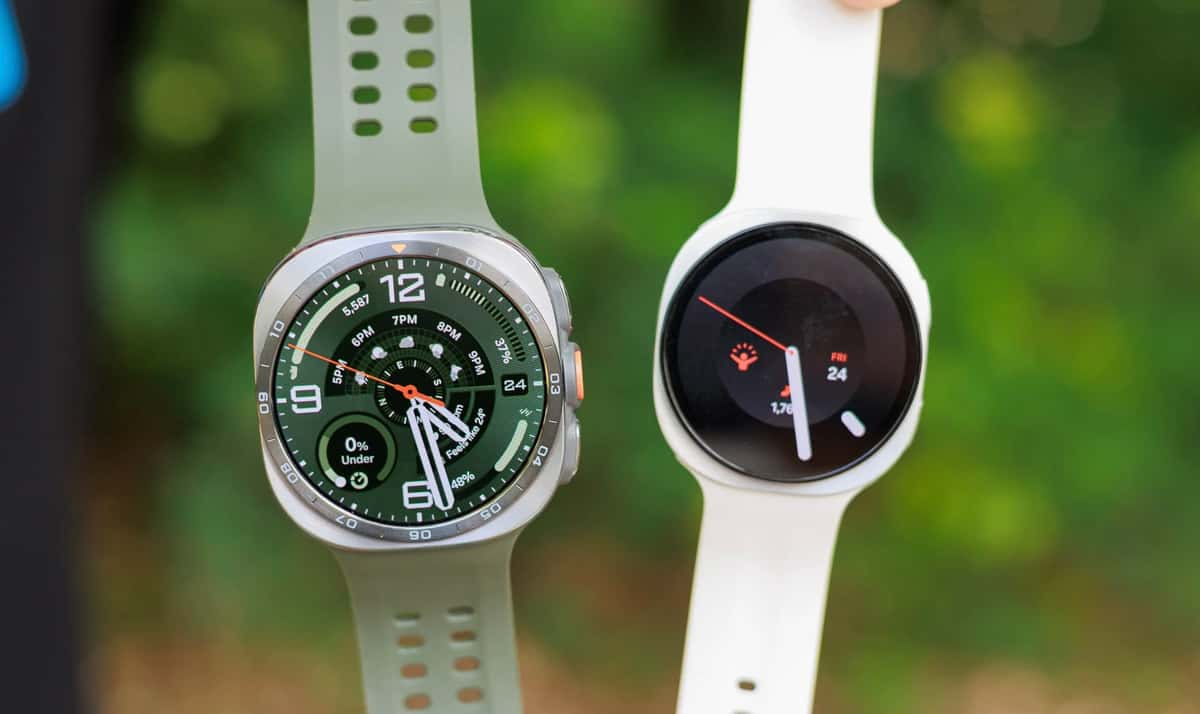
The Galaxy Watch Ultra2 is clearly the more capable watch. It has an enormous 800mAh battery, 5,000-nit display, titanium construction, LTE, 64GB storage, 10ATM water resistance and more serious outdoor hardware.
But after comparing it closely with the Galaxy Watch9, we found something equally important: you're not paying nearly twice as much to get twice the everyday smartwatch.
Both use the same Snapdragon Wear Elite platform. Both have 2GB RAM. They share Samsung's core BioActive health sensors, dual-frequency GPS technology and much of the same new health software.
The Ultra2's extra money therefore buys something more specific: endurance and rugged capability.
For Nigerian buyers, where our current market check puts the Watch9 from roughly ₦430,000 and the Ultra2 around ₦800,000–₦900,000, that's the difference we'd examine before spending the extra money.
Galaxy Watch Ultra2 vs Watch9: Specs
Feature | Galaxy Watch9 | Galaxy Watch Ultra2 |
|---|---|---|
Sizes | 40mm / 44mm | 47mm |
Display | 1.34 / 1.47-inch Super AMOLED | 1.52-inch Super AMOLED |
Peak brightness | 3,000 nits | 5,000 nits |
Processor | Snapdragon Wear Elite | Snapdragon Wear Elite |
RAM | 2GB | 2GB |
Storage | 32GB | 64GB |
Battery | 390mAh / 445mAh | 800mAh |
GPS | Dual-frequency | L1+L5 dual-frequency |
Water resistance | 5ATM + IP68 | 10ATM + IP69K |
Durability | MIL-STD-810H | MIL-STD-810H + EN13319 |
Weight | 31.5g / 34g | 61.5g |
Connectivity | Bluetooth/Wi-Fi; LTE variants available | LTE + Bluetooth + Wi-Fi |
US price | From $379.99 BT / $429.99 LTE | $699.99 |
Nigeria price | ₦429,500–₦498,000+ | ₦801,000–₦900,000 |
That last row matters. The Ultra2 isn't a small step above the Watch9 in Nigeria.
It's potentially another ₦300,000–₦470,000. So the question isn't simply which watch has better specifications. It's whether you'll actually use what that additional money buys.
Nigeria Price: The Gap Is Smaller Than ₦1.3 Million Suggests
We wouldn't use ₦1 million–₦1.3 million as the normal Ultra2 buying range anymore.
Our September 2026 market check found considerably lower prices. We found the Galaxy Watch9 40mm at approximately ₦429,500 through a Nigerian Samsung-focused retailer. A 44mm GPS model was listed around ₦498,000 in Lagos.
For the Ultra2, our checks found: ₦800,960 at one Nigerian electronics retailer,
₦889,200 at another, and around ₦899,000–₦900,000 through current Jumia listings.
So we'd currently budget approximately: Galaxy Watch9: ₦430,000–₦500,000+
Galaxy Watch Ultra2: ₦800,000–₦900,000
with LTE Watch9 variants potentially costing more.
These aren't permanent prices. They're our market snapshot, and Nigerian electronics pricing can change quickly with stock, exchange rates and import costs.
Internationally, the Watch9 starts at $379.99 for 40mm Bluetooth, while Samsung's US LTE models currently start at $429.99. The Ultra2 is $699.99 in its 47mm LTE configuration.
That gives us a useful buying threshold: if an Ultra2 is approaching ₦900,000 while a Watch9 is around ₦430,000–₦500,000, make sure you're buying it for Ultra features rather than simply because it's Samsung's most expensive watch.
Design: 61.5g vs 31.5g Changes the Experience
The Ultra2 isn't simply a larger Watch9. Samsung uses a titanium case and sapphire crystal with a 47mm body measuring 47.4 × 47.1 × 10.7mm.
It weighs 61.5g without the strap. The Watch9 is much smaller. The 40mm model weighs 31.5g, while the 44mm is 34g. Both are only 8.6mm thick. That means the Ultra2 is nearly twice the body weight of the 40mm Watch9.
You will notice that difference more than most processor specifications.
For hiking, cycling or outdoor training, we can understand the Ultra's larger construction because the battery and durability are part of the purpose.
But for sleeping?
Office work?
Wearing a watch continuously for health tracking?
The smaller Watch9 has an advantage that doesn't show up in a benchmark: you may simply forget you're wearing it more easily.
Samsung has reduced the Ultra2's thickness by 12% compared with its predecessor, which helps, but it remains a substantial watch.
For someone with a smaller wrist, we'd try the 47mm Ultra2 physically before spending ₦800,000+.
Display: 5,000 Nits Is Impressive, But Who Needs It?
This is one area where the Ultra2 genuinely pushes ahead. Its 1.52-inch 498 × 498 Super AMOLED display can reach a quoted 5,000 nits peak brightness.
The Watch9 reaches up to 3,000 nits. The 40mm model has a 1.34-inch 438 × 438 panel, while the 44mm gets a 1.47-inch 480 × 480 display. All use sapphire crystal.
On paper, 5,000 versus 3,000 sounds enormous. In practice, we'd frame it differently.
Three thousand nits is already extremely bright for a smartwatch. The Ultra2's extra headroom becomes more interesting when you're:
Running under intense afternoon sun
Cycling
Hiking
Working outdoors
Following navigation
Checking workout information quickly
Using the watch around reflective water
That's particularly relevant under strong Nigerian sunlight. For someone spending most of the day indoors, however, we'd struggle to justify hundreds of thousands of naira based on display brightness alone.
The Ultra2 has the better outdoor screen. The Watch9's display is already more than capable for ordinary use.
Battery: This Is Where We'd Spend the Extra Money
The biggest hardware difference isn't the titanium. It's the battery.
The Watch9 has:
390mAh: 40mm
445mAh: 44mm
Samsung rates the Watch9 for up to around 40 hours with Always-On Display off, with the 44mm model rated around 30 hours with AOD enabled.
The Ultra2 jumps to: 800mAh
That's almost twice the capacity of the 44mm Watch9. It's also 35% larger than the previous Galaxy Watch Ultra battery. This changes how we'd evaluate the Ultra2 for Nigeria. Smartwatch charging becomes annoying when you're trying to track: daytime activity + workouts + heart rate + overnight sleep
Because charging the watch means losing tracking time. A larger battery gives you more flexibility over when that charging happens.
For travellers, outdoor athletes and people who spend long periods away from reliable electricity, we'd consider this the Ultra2's strongest argument.
Not titanium. Not the Ultra branding. Battery.
The Ultra2 Also Charges Faster
There's another battery difference that's easy to miss. The Ultra2 introduces higher-frequency fast charging, with Samsung reporting up to 40% in around 30 minutes.
The Watch9 uses Samsung's standard WPC-based wireless charging. That's useful because a huge battery can otherwise become frustrating if recharging takes too long.
A quick top-up while showering or preparing for work could provide enough power to continue tracking through the day.
Again, this is the type of improvement we'd consider more useful than another decorative watch face.
Performance: This Is Why the Watch9 Is Such a Strong Alternative
Here's where the comparison becomes particularly interesting.
Both watches use the same: Qualcomm Snapdragon Wear Elite / SW6100
It's a 3nm penta-core platform running at up to 2.1GHz.
Both also have: 2GB RAM.
That means paying almost twice as much for the Ultra2 doesn't buy you a higher-tier processor.
For opening apps, navigating One UI Watch, reading notifications, starting workouts and interacting with the interface, we'd expect the core experience to be much closer than the price difference suggests.
The Ultra2 does double storage:
Watch9: 32GB
Ultra2: 64GB
That matters if you store lots of offline music, apps or other content directly on the watch.
But if your priority is simply:
“I want the fast new Samsung watch.”
the Watch9 already gives you Samsung's latest Snapdragon platform. That's one of the strongest arguments for saving the money.
Health Tracking: Don't Buy the Ultra2 Just for Heart Rate
Another misconception we'd avoid is treating the Ultra2 as though it has an entirely different health system.
Both watches use Samsung's BioActive Sensor platform, combining optical bio-signal, electrical heart-signal and bioelectrical-impedance measurements.
They also share sensors for:
Heart rate
ECG
Body composition
Skin temperature
Activity
Sleep
Blood oxygen-related tracking
Workout tracking
Samsung's 2026 software adds experiences including Vitals, Heart Health Score, Fitness Index and Daily Cardio Load across the lineup.
So if your main reason for buying a Galaxy Watch is: sleep + workouts + heart rate + general wellness
The Watch9 already provides most of the experience we'd care about. The Ultra2 becomes more compelling once your activities move beyond ordinary health tracking.
Blood Pressure and ECG Need More Explanation in Nigeria
We'd also be careful with health-feature. Having the necessary sensor doesn't mean every health feature will work identically on every phone and in every country.
Samsung Health Monitor features such as ECG and blood-pressure measurement can depend on country availability, regulatory approval and compatible Samsung Galaxy hardware/software.
So we wouldn't buy either watch in Nigeria solely because a retailer's specification list says:
Blood pressure.
Before paying, we'd verify whether the particular health function you care about is currently enabled for your device and region.
And these watches should be treated as wellness/health-monitoring tools rather than replacements for professional medical diagnosis.
Outdoor Tracking: This Is Where “Ultra” Starts Making Sense
The Ultra2 begins separating itself once you move away from everyday smartwatch use.
It includes:
L1 + L5 dual-frequency GPS
LTE
10ATM water resistance
IP69K
MIL-STD-810H durability
EN13319 certification
The Watch9 also has dual-frequency positioning and MIL-STD-810H durability, but water resistance drops to: 5ATM + IP68.
For jogging around Lagos or tracking gym sessions, the Watch9 is already well equipped.
For trail running, serious hiking, open-water activities or situations where navigation and ruggedness matter more, the Ultra2's hardware begins earning its premium.
That's an important distinction. The Ultra2 isn't simply the watch for someone who wants “better fitness tracking.”
It's the watch we'd look at when the environment itself becomes demanding.
Diving: One Feature the Watch9 Can't Really Match
The Ultra2's EN13319 certification makes another difference. It's designed to support recreational diving functionality, including integration that can provide information such as depth, dive duration and water temperature.
The 10ATM water-resistance rating also doubles the Watch9's 5ATM rating.
That's genuine differentiation. But we'd keep it in perspective. Most buyers in Nigeria aren't recreational divers.
If you never dive, paying extra for dive functionality gives you no practical return.
It's a great capability for the person who needs it and largely irrelevant to the person who doesn't.
That's a recurring theme throughout this comparison.
LTE: Check the Exact Watch9 Before Comparing Prices
The Ultra2 comes as an LTE-focused premium model. The Watch9 is available in Bluetooth and LTE configurations. This matters when comparing Nigerian prices.
A ₦430,000 Bluetooth Watch9 shouldn't be compared directly against a ₦850,000 LTE Ultra2 without acknowledging that connectivity difference.
With LTE and appropriate carrier support, a smartwatch can handle more tasks away from your phone, including calls, messages and data-dependent functions.
But we'd verify local eSIM/carrier compatibility before buying an imported LTE watch specifically for standalone cellular use.
Don't pay an LTE premium and assume every Nigerian network setup will work exactly as it does in the watch's original market.
Android Compatibility: iPhone Users Should Stop Here
Neither watch is intended as an iPhone companion. Samsung lists compatibility with Android 13 or newer and at least 1.5GB RAM, with activation requiring a smartphone that supports Google Mobile Services.
Some features also work best—or exclusively—within Samsung's Galaxy ecosystem.
If you're already carrying a Galaxy S-series or Fold, the integration makes considerably more sense.
If you're using an iPhone, we'd look elsewhere rather than buying one and accepting a compromised experience.
What Does the Extra ₦300,000–₦470,000 Actually Buy?
This is the question we think matters most. Our Nigerian market research currently puts the Watch9 around ₦430,000–₦500,000 and the Ultra2 around ₦800,000–₦900,000.
So where does that additional money go? Not into a faster processor. Both already have Snapdragon Wear Elite. Not into dramatically different everyday health sensors. There's substantial overlap there too.
Instead, the Ultra2 premium primarily buys:
800mAh battery
Faster charging
5,000-nit display
64GB storage
Titanium construction
LTE as standard configuration
10ATM resistance
IP69K protection
EN13319 diving capability
More serious outdoor positioning
Rugged 47mm construction
Once we looked at it this way, the buying decision became much easier.
Which One Would We Buy for Everyday Use?
For ordinary smartwatch use, we'd start with the Galaxy Watch9.
Not because the Ultra2 isn't better. It clearly is in several measurable areas.
But imagine your typical day consists of:
WhatsApp notifications
Walking
Gym workouts
Heart-rate monitoring
Sleep tracking
Music controls
Google Maps
Calendar reminders
Samsung Health
Occasional runs
The Watch9 already handles the core experience with the same processor platform, a bright 3,000-nit AMOLED display and Samsung's current health ecosystem. And it's much lighter.
Saving roughly ₦300,000–₦470,000 becomes difficult to ignore.
Who Should Actually Buy the Ultra2?
The Ultra2 makes considerably more sense if you can point to the features you'll use.
We'd consider paying the premium if: Battery anxiety is a major problem.
The 800mAh capacity is the clearest advantage. You spend a lot of time outdoors.
The 5,000-nit display, rugged build and navigation capabilities become more valuable.
You train seriously. Long workouts and outdoor tracking make additional endurance useful.
You dive. Then EN13319 and 10ATM aren't meaningless specification numbers.
You want LTE and more independent watch use.
The Ultra2 is built around that experience. You need 64GB storage. That's double the Watch9.
If none of those statements describes you, the Ultra2 becomes much harder to justify purely on value.
Frequently Asked Questions
How much is the Galaxy Watch9 in Nigeria?
Our latest market check found the 40mm Galaxy Watch9 around ₦429,500, while a 44mm listing was approximately ₦498,000. Prices depend on size, Bluetooth/LTE configuration and seller.
How much is the Galaxy Watch Ultra2 in Nigeria?
We found current Nigerian listings around ₦800,960–₦900,000, with several offers clustering close to ₦890,000–₦900,000. That's the range we'd currently use for budgeting rather than assuming ₦1 million–₦1.3 million is necessary.
Does the Ultra2 have better health tracking than the Watch9?
There is substantial overlap. Both use Samsung's current BioActive Sensor system and share many of the same health and fitness experiences. The Ultra2's bigger advantages are in endurance, outdoor use, ruggedness and diving rather than basic heart-rate or sleep tracking.
How long does the Galaxy Watch9 battery last?
Samsung rates the Watch9 for up to around 40 hours with Always-On Display disabled, although actual endurance varies with GPS, LTE, workouts, screen use and health monitoring. We'd treat that as a controlled manufacturer rating rather than our own measured battery result.
Is the Galaxy Watch Ultra2 waterproof?
We wouldn't describe any smartwatch as simply “waterproof.” The Ultra2 carries 10ATM and IP69K ratings and is also EN13319 certified for relevant diving use. Those are considerably stronger protections than the Watch9's 5ATM/IP68 combination, but usage should still stay within Samsung's specified conditions.
Can Galaxy Watch9 work without a Samsung phone?
Yes, it supports compatible Android phones meeting Samsung's requirements, but some Samsung-specific health functions and ecosystem features can have additional device or regional requirements.
Can I use Galaxy Watch Ultra2 with an iPhone?
No. Samsung lists the current watches for compatible Android devices rather than iPhone use.
Final Thoughts
After comparing Samsung's two 2026 watches, the most important thing we discovered is that the Galaxy Watch Ultra2 isn't really a faster Galaxy Watch9.
They share the Snapdragon Wear Elite platform.
They share 2GB RAM.
They share much of Samsung's health-tracking foundation.
And for everyday tasks—notifications, workouts, sleep, heart-rate tracking, apps and general smartwatch use—the experience is closer than the price difference initially suggests.
What Samsung has done with the Ultra2 is take that foundation and build considerably more hardware around it.
An 800mAh battery instead of 390/445mAh
A 5,000-nit display instead of 3,000 nits
64GB instead of 32GB
Titanium
LTE
10ATM
IP69K
EN13319 diving support
And a much larger 47mm body designed to survive more demanding outdoor use
That changes our recommendation. At the roughly ₦430,000–₦500,000 prices we found for the Watch9, it would be our starting point for someone who simply wants Samsung's best current everyday smartwatch experience without overspending.
At approximately ₦800,000–₦900,000, we'd buy the Ultra2 only when its additional hardware solves something specific.
For someone running long outdoor sessions, travelling frequently, diving, relying heavily on GPS/LTE or simply tired of charging a smartwatch constantly, the Ultra2's premium becomes easier to defend.
But for someone sitting in an office, going to the gym, tracking sleep and reading notifications? Spending another ₦300,000–₦470,000 doesn't suddenly give you twice the smartwatch.
That's the real difference between the Galaxy Watch9 and Galaxy Watch Ultra2: the Watch9 covers everyday life; the Ultra2 earns its extra cost when everyday life isn't what you're buying it for.
Read more: Apple Watch Series 12 vs Ultra 4: Which Should You Buy?
Read more: Samsung Galaxy Watch Ultra 2 vs Apple Watch Ultra 3: Which Premium Smartwatch Should You Buy in Nigeria?
Read more: Apple Watch Ultra 4 Review: Better Battery and Health Tracking, But Who Should Buy It?

Author
Adebayo JohnsonSenior tech editor with over 4 years of experience covering mobile and gadget technology. Explore author & articles





