

Tecno AI Glasses Review: Features, Price in Nigeria and What to Know
Tecno AI Glasses combine a 50MP camera, Ella AI, open-ear audio and smart recognition. Here's what Nigerians should know about price and features.

Smart glasses are gradually moving beyond experimental technology, and TECNO's first attempt is particularly interesting because it approaches the category differently from a conventional AR headset.
The TECNO AI Glasses combine familiar-looking eyewear with a 50MP camera, speakers, microphones, Ella AI, Wi-Fi and Bluetooth. Rather than putting a screen directly in front of your eyes, the standard model concentrates on hands-free photography, audio and voice-based AI assistance.
TECNO originally unveiled the AI Glasses series at MWC Barcelona in March 2025. There are two versions: TECNO AI Glasses and TECNO AI Glasses Pro.
The difference matters. The regular AI Glasses have no visual AR display. The Pro model adds a MicroLED display using resin waveguide optics, allowing information such as navigation, translations and teleprompter text to appear in the wearer's field of view.
After examining TECNO's specifications, we think the standard model is better understood as a camera, audio and AI assistant that you wear rather than a replacement for your smartphone.
For Nigerian buyers, however, three questions matter most:
What can the glasses actually do? How much will they cost in Nigeria? And are they practical enough to justify carrying another connected device?
Tecno AI Glasses Price in Nigeria
This remains the biggest unanswered question. As of our latest check, we couldn't verify an official Nigerian retail price for either the standard TECNO AI Glasses or AI Glasses Pro from TECNO's Nigerian retail channels.
TECNO's current global product pages provide detailed specifications for both models, but they don't publish a Nigerian recommended retail price. Independent reporting following the original MWC unveiling also noted the absence of confirmed pricing and broad retail-release details.
Because of that, we wouldn't attach a speculative ₦200,000–₦350,000 figure to the standard model and present it as a meaningful market estimate.
There simply isn't enough verified retail information to support such a narrow range.
Model | Nigeria Price |
|---|---|
TECNO AI Glasses | Not officially confirmed |
TECNO AI Glasses Pro | Not officially confirmed |
Retail availability | Check before buying |
That could change quickly if TECNO expands retail distribution. TECNO already has an established retail and after-sales network in Nigeria, including official/exclusive outlets across Lagos and other major cities, but the existence of that network doesn't mean the AI Glasses are stocked locally.
For now, we'd verify actual availability before trusting an online Nigerian listing.
What Are TECNO AI Glasses?
The standard model looks much closer to conventional eyewear than a bulky mixed-reality headset. TECNO uses an aviator-style design, and the glasses weigh approximately 37g, according to its laboratory specifications.
Inside that relatively small frame are:
50MP camera
TECNO Ella AI
Open-ear speaker system
Microphones
Bluetooth 5.4
Wi-Fi 6
AI recognition
Information summaries
Tourist information
AI-generated social captions
250mAh battery
The absence of a display is actually important. You won't see Google Maps-style arrows floating in front of your eyes on the standard model. Instead, interaction is predominantly based around audio, voice commands, photography and the connected smartphone.
Buyers who specifically want information displayed in their field of view need the AI Glasses Pro.
The 50MP Camera Is the Headline Feature
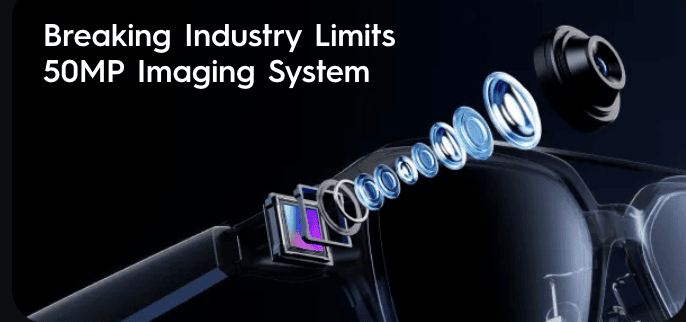
Photography is arguably the most technically interesting part of the glasses. TECNO uses a 50MP OV50D sensor measuring 1/2.88 inch, paired with an f/2.4 aperture, six-element lens and wide 100-degree field of view.
The imaging system includes:
50MP OV50D sensor
1/2.88-inch sensor size
f/2.4 aperture
100° field of view
Six lens elements
AI noise reduction
AI HDR
ColorVisionary filters
TECNO also says the glasses use imaging technology derived from its CAMON smartphone work, including a dedicated image processor and AI processing. That's impressive hardware for something weighing 37g.
But we'd avoid assuming a 50MP specification automatically means better photographs than every competing pair of smart glasses.
Resolution is only one part of image quality. Sensor size, lens quality, exposure, dynamic range, processing and video performance matter too. Until we conduct controlled photography tests, we'd treat the 50MP figure as a strong specification rather than proof of superior real-world photography.
Why Would You Want a Camera on Your Glasses?
The appeal isn't necessarily image quality alone. It's perspective.
Instead of removing your phone, opening the camera and framing the scene, glasses can capture something closer to what you're actually seeing.
Imagine:
Walking through Balogun Market. Touring Lagos Island. Cooking while demonstrating a recipe. Cycling. Attending an event. Opening a new gadget. Recording part of a trip. The glasses potentially let you document those experiences while keeping both hands free.
For creators, that first-person perspective may be more useful than simply having another 50MP camera.
There is also an important social consideration: people around you may not immediately realise they're being photographed or recorded.
Responsible use matters, particularly in private environments and situations where people reasonably expect privacy.
AI Can Understand What You're Looking At
The camera isn't limited to taking pictures. TECNO combines visual input with its Ella AI assistant, allowing the glasses to recognise objects and provide contextual information.
Confirmed functions include AI recognition, information summaries, tourist information and AI-generated social-media captions. This changes the purpose of the camera.
Instead of: See something → photograph it → search manually
the intended experience is closer to: See something → ask Ella about it → receive information through the glasses.
That could make smart glasses genuinely useful rather than simply becoming another wearable camera.
Translation Could Be Particularly Useful for Travellers
TECNO's MWC material highlighted real-time translation covering more than 100 languages through Ella.
For someone travelling outside Nigeria, that could be one of the most useful AI functions.
You could encounter:
Menus
Signs
Tourist information
Products
Conversations
Directions
Unfamiliar text
And use the AI system to help interpret information. But there's an important difference between the two models.
On the regular AI Glasses, you don't have an AR display showing translated text directly in front of you.
The AI Glasses Pro is the model designed for visual translation because its MicroLED display can place information within your field of view. That makes the Pro substantially more interesting for frequent international travellers.
TECNO AI Glasses Pro Is a Very Different Product
The two models shouldn't be treated simply as different storage configurations. The Pro changes how you interact with the glasses. It incorporates a MicroLED display with resin waveguide optics, approximately 1,500 nits of brightness and a 30-degree field of view.
That display enables:
AI navigation
Visual real-time translation
Information prompts
Teleprompter functionality
AI voice assistance
The Pro weighs around 48g, compared with approximately 37g for the standard model.
For presenters and creators, the teleprompter function is especially interesting. Imagine recording a presentation while your talking points appear within your view rather than having to position another phone beside the camera. That could have genuine productivity value.
Built-In Speakers Mean You May Not Need Earbuds
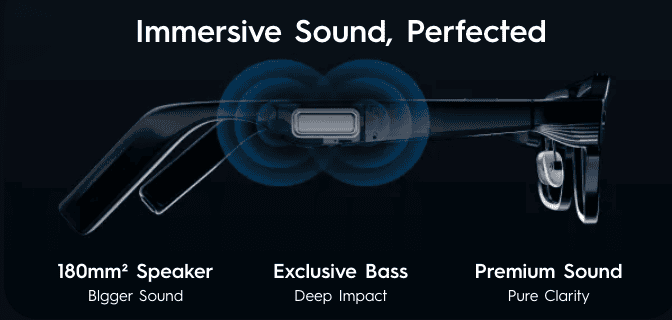
TECNO has also integrated open-ear audio into the frame. The company specifies a 180mm² speaker system and promotes bass enhancement, clear audio and technology designed to reduce sound leakage.
The glasses can therefore handle functions such as:
Music
Calls
AI responses
Voice interaction
Audio information
without requiring conventional earbuds. There is a trade-off. Open-ear audio can be more convenient and keeps your ears physically open to surrounding sounds, but it won't necessarily provide the same isolation or bass experience as good in-ear headphones.
Privacy also matters. TECNO specifically promotes anti-sound-leakage technology, but we'd want to test how well that works in quiet rooms before discussing sensitive information through the glasses.
Battery Life: Good on Paper
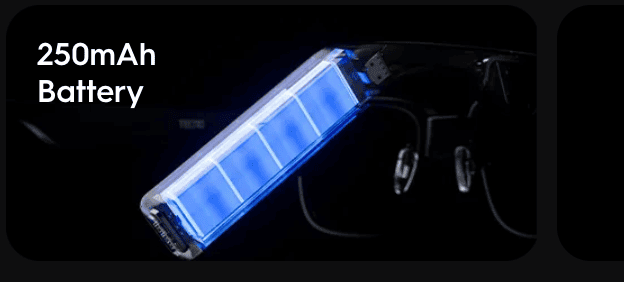
Both models use a 250mAh battery.
TECNO rates them for: More than 11 hours of music playback and Around 8 hours of mixed use.
Those are laboratory figures rather than measurements from our own testing.
And that's an important distinction. Playing audio is much less demanding than repeatedly taking 50MP photographs, using Wi-Fi, processing AI requests and keeping microphones active.
So someone primarily listening to music shouldn't expect exactly the same battery behaviour as a traveller constantly using visual recognition and translation.
TECNO also states that these endurance figures can be achieved after approximately 30 minutes of charging. Until we independently test them, we'd treat eight hours as a manufacturer mixed-use benchmark rather than guaranteed all-day endurance.
Bluetooth 5.4 and Wi-Fi 6
Connectivity is relatively modern.
TECNO lists:
Bluetooth 5.4
Wi-Fi 6
and
HiFi 5
For the standard glasses. The glasses aren't intended to completely replace your phone. Instead, the smartphone remains an important part of the system for connectivity, managing information and companion-app functions.
TECNO's original launch information described a compatible Android application supporting Android 8.0 and later.
However, we'd verify compatibility with your exact phone before buying, particularly if you're importing the glasses. We also wouldn't assume complete iPhone support without TECNO explicitly documenting it for the retail version.
One Concern: What Happens Without Internet?
AI glasses are only as useful as the software behind them. Some basic functions such as camera capture and audio don't inherently need generative AI, but services involving online information, advanced recognition or cloud-based assistance may depend on a connected phone or internet access.
That's particularly relevant in Nigeria. If you're somewhere with weak mobile data, some of the smart features that make the product interesting may be less useful.
So we'd want to evaluate these glasses under ordinary Nigerian network conditions rather than judging them solely from a controlled MWC demonstration.
Privacy Is the Bigger Conversation
There's another issue worth considering before buying any camera-equipped smart glasses. Privacy. A camera sitting on someone's face creates a different social situation from a smartphone held visibly in front of them.
Users need to consider where recording is appropriate and whether people around them know they're being captured.
Businesses, offices, schools, events and private properties may also establish their own rules around wearable cameras.
This isn't a problem unique to TECNO. It's something the entire smart-glasses category has to address as wearable cameras become less conspicuous.
For us, that deserves just as much attention as the megapixel count.
Should You Buy TECNO AI Glasses in Nigeria?
We wouldn't recommend importing them purely because the specification sheet looks impressive.
The product itself is genuinely interesting. A 37g pair of glasses combining a 50MP camera, open-ear audio, Ella AI, object recognition, translation-related functions and smartphone connectivity represents a much more ambitious wearable than a conventional Bluetooth headset.
But Nigerian buyers should first establish three things: actual retail price, local availability and compatibility with their phone.
After-sales support also matters more here than with ordinary glasses because the frame contains a battery, camera, speakers, connectivity hardware and electronics. If the final Nigerian price is competitive, we can see obvious appeal for travellers, creators, technology enthusiasts and people who want hands-free photography.
If it becomes expensive enough to compete with established smart-glasses ecosystems, the buying decision becomes considerably harder.
Frequently Asked Questions
How much are TECNO AI Glasses in Nigeria?
We couldn't verify an official Nigerian retail price at the time of our latest research. We'd avoid treating speculative online prices as confirmed TECNO pricing.
Do TECNO AI Glasses have a camera?
Yes. The standard and Pro models use a 50MP OV50D sensor with an f/2.4 aperture and 100-degree field of view.
Do TECNO AI Glasses have a display?
The standard model does not have an AR display. The AI Glasses Pro adds a MicroLED display using resin waveguide optics.
Can TECNO AI Glasses translate languages?
TECNO demonstrated real-time translation support for more than 100 languages through its AI platform. The Pro model can additionally display translated information through its visual interface.
How long does the battery last?
TECNO's laboratory figures claim more than 11 hours of music playback and approximately eight hours of mixed use from the 250mAh battery. Real-world endurance will depend on usage.
Can I use TECNO AI Glasses with my phone?
Yes. Smartphone connectivity is central to the experience. TECNO's original launch information referenced a companion Android application compatible with Android 8.0 and later.
How much do the glasses weigh?
TECNO lists approximately 37g for the standard AI Glasses and 48g for the AI Glasses Pro.
Final Verdict
After researching the TECNO AI Glasses more closely, the 50MP camera isn't actually the feature we find most important. It's the attempt to combine that camera with AI in a wearable form that still weighs only around 37g.
Taking a photo without reaching for your phone is useful. Being able to look at something, ask an AI assistant about it and receive contextual information has the potential to be considerably more useful.
The standard model combines the 50MP OV50D camera, Ella AI, speakers, recognition features, Wi-Fi 6, Bluetooth 5.4 and a 250mAh battery in a relatively conventional-looking pair of glasses.
The Pro is arguably the more ambitious device because its MicroLED waveguide display adds visual navigation, translation and teleprompter functionality. But there's still a gap between an impressive MWC technology demonstration and a product we'd confidently tell Nigerians to buy.
We need a confirmed local price, clear retail availability, dependable phone compatibility and more evidence of how the camera, battery, Ella AI and audio perform outside controlled demonstrations.
That's why we wouldn't retain the speculative ₦200,000–₦350,000 price range or give the glasses a numerical score yet.
Our researched assessment: TECNO's AI Glasses are one of the company's more interesting attempts to move AI beyond smartphones, particularly because the standard model keeps the hardware relatively lightweight while offering a 50MP camera and hands-free AI. But for Nigerian buyers, price and actual retail availability still need to catch up with the technology before we can properly judge their value.
Read more: Ray-Ban Meta Smart Glasses Review: Price, Specs, Features and Use Cases

Author
Dolapo AnifowosheTech enthusiast and technical data scientist who loves to play with numbers. Explore author & articles





