

Twitter Is Back But This Time, It Is Fighting Elon Musk’s X in Court
Operation Bluebird has launched Twitter.now, reviving the Twitter name and bird logo while arguing that Elon Musk’s X abandoned the trademarks. But the legal battle is far from over.

Twitter is back. At least, that is what a Virginia startup called Operation Bluebird wants the internet to believe. The company has launched a new social network called Twitter.now, bringing back the familiar Twitter name, bird branding and even the concept of posting short messages known as "tweets." But there is a major catch.
Elon Musk's X Corporation is suing the startup. Operation Bluebird believes Musk's decision to replace Twitter with X created an opportunity to reclaim the abandoned brand. X Corporation disagrees. And now the dispute has moved from a trademark filing to a live social network with actual users.
A startup is bringing back Twitter
Operation Bluebird launched Twitter.now this week after months of waiting for the legal dispute with X to develop. The startup was founded by several people connected to Twitter's earlier history, including Stephen Coates, who previously served as Twitter's general counsel and now holds the same position at Operation Bluebird.
Coates told Ars Technica that the company had investors and a product ready to launch, and after waiting for months decided it would move forward rather than wait indefinitely.
The result is Twitter.now. And visually, the idea is immediately recognizable. It looks much closer to the Twitter many users remember than the platform now known as X. There are replies, retweets and short-form posts. But Operation Bluebird insists it is not simply trying to recreate Musk's old Twitter. It wants to build something different.
Why did Twitter become X in the first place?
When Elon Musk acquired Twitter in 2022 for approximately $44 billion, he eventually replaced the company's famous Twitter identity with the letter X. The transformation included the removal of the iconic blue bird branding and the company's shift away from the Twitter name.
That rebrand created an unusual question:
What happens to trademarks that a company stops actively using?
Operation Bluebird's entire strategy is built around that question. The startup argues that X abandoned important intellectual-property rights associated with the Twitter brand after Musk's rebrand. It subsequently sought to cancel X's trademarks and use the name itself. Ars Technica reported in December 2025 that Operation Bluebird had filed a petition with the U.S. Patent and Trademark Office as part of that effort. X Corporation responded with a lawsuit.
X tried to stop the new Twitter from launching
X Corporation sued Operation Bluebird in late 2025 and asked a federal judge in Delaware to prevent the startup from launching a competing social network under the Twitter name. That would seem like a major obstacle. But something unexpected happened during an April 2026 hearing. U.S. District Judge Colm Connolly indicated from the bench that X appeared to have given up certain intellectual-property claims involving the word "tweet" and the Twitter bird logo, and potentially the word "Twitter" itself.
However, this distinction is extremely important:
The judge has not issued a final written ruling deciding that X abandoned the trademarks.
Ars Technica reported that the April comments were a tentative view from the bench, not a final judgment. Operation Bluebird nevertheless interpreted those comments as sufficient reason to move ahead. That is why Twitter.now exists today.
The legal battle is not over
This is where headlines about "Twitter returning" can become misleading.
Twitter.now has launched. But that does not mean Operation Bluebird has legally won the Twitter trademark. The central dispute remains unresolved. Operation Bluebird says X abandoned the relevant trademarks. X Corporation maintains its legal position and previously sought to stop the startup from launching.
The judge had still not issued a written order on X's request for a preliminary injunction when Twitter.now launched. So the startup has effectively decided:
Let the court battle continue while we build the product.
That makes the launch unusually bold.
Twitter.now wants to solve one of social media's biggest problems
There is another interesting part of this story. Operation Bluebird is not simply bringing back the blue bird. It is attempting to build a different kind of social network. The company says its goal is to create a public square built around trust, transparency and user choice rather than simply maximizing viral engagement.
That philosophy is built into one of its most interesting features: AI-powered fact checking.
Meet VERA, Twitter.now's AI fact checker
Twitter.now uses an AI system called VERA to analyze posts. The system is designed to evaluate claims, provide context and sources, and assign posts a trust score. The company says users will eventually be able to choose how much credibility they require before content appears in their feeds. That is a significant change from the traditional social-media model. Most major platforms use recommendation algorithms to decide which content receives more visibility.
Twitter.now is proposing something different:
Let users decide how much misinformation and low-confidence content they want to see.
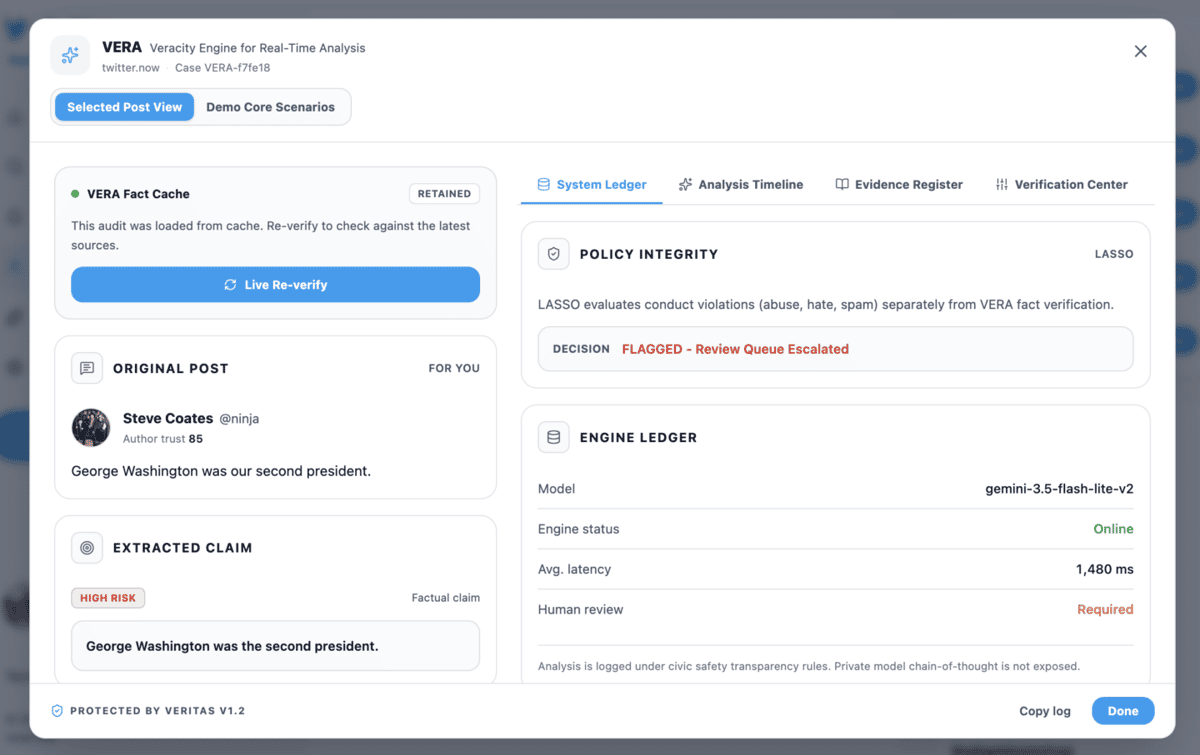
The company describes the philosophy as "freedom of speech, not freedom of reach." In other words, people can still post something controversial or potentially false, but the platform can provide additional context and allow users to control how much of that content reaches their feeds.
Could this actually be better than the old Twitter?
That is the interesting startup question. The original Twitter became one of the world's most influential communication platforms because it was incredibly simple.
Write something.
Post it.
Other people see it.
Reply.
Retweet.
Repeat.
Over time, however, the platform became increasingly dominated by questions surrounding misinformation, harassment, moderation, political polarization and algorithmic amplification. Musk's acquisition and subsequent transformation of Twitter into X intensified debates around those issues. Twitter.now appears to be trying to preserve the simplicity of Twitter while changing the mechanics underneath it.
Instead of simply asking:
What content will get the most engagement?
it wants to ask:
How trustworthy is this content, and does the user actually want to see it?
That could become an interesting experiment.
But AI fact-checking has its own problems
VERA sounds promising. But building a reliable AI system capable of evaluating millions of posts in real time is extremely difficult. Consider a simple example.
Someone posts:
This company just announced a new product.
Is that true?
The system would need to identify the company, determine which product is being discussed, locate reliable evidence and determine whether the information is current.
Then consider satire.
Or breaking news.
Or political claims.
Or scientific disputes.
Or information that is technically true but presented without important context.
An AI system can make mistakes. And if a platform gives that system the power to determine how much reach a post receives, the consequences of those mistakes could become significant. That means Twitter.now may eventually face the same fundamental problem as every other large social network:
Who decides what people see?
The difference is that Twitter.now wants to give users more control over that decision.
The platform is starting small
Twitter.now is currently in its early stage. The network had only hundreds of users at launch. There is also a report that the platform was in testing and that early access currently costs $20. That means Twitter.now is nowhere near competing with X on scale. And scale is one of the hardest problems any social network faces. A social network needs users because users create content. Content attracts users. More users create more content. That creates a network effect. A startup entering the market therefore faces a huge chicken-and-egg problem.
Why would users join if nobody they know is there? And, why would creators post if there are no users?
Twitter.now will need to solve that problem before the trademark battle even becomes its biggest concern.
The irony is impossible to ignore
There is something almost surreal about this story. A company called Operation Bluebird is attempting to revive Twitter after Elon Musk replaced the platform's identity with X.
Its leader is a former Twitter lawyer. The new platform uses the Twitter name. It has brought back the bird. It uses tweets and retweets. And it is simultaneously fighting the company that now owns the former Twitter business in federal court. It sounds like something from a technology satire. But it is happening.
This could become bigger than a trademark dispute
The most interesting part of the story may ultimately have nothing to do with the Twitter name. The real experiment is whether a new social network can combine the simplicity that made Twitter popular with a fundamentally different approach to trust and content distribution.
If VERA works well, Twitter.now could position itself around a simple proposition:
You decide what deserves your attention.
That is a compelling idea in an internet increasingly overwhelmed by AI-generated content, misinformation, rage-bait and algorithmic recommendations. But if VERA gets things wrong, the company could find itself facing an entirely different controversy. Because the moment an AI system starts assigning trust scores to people's speech, users will inevitably ask:
Who decides whether the AI is trustworthy?
The biggest challenge may not be Elon Musk
The legal fight will certainly attract attention. But Twitter.now has an even harder problem: Building a social network people actually want to use.
It needs creators.
It needs communities.
It needs reliable infrastructure.
It needs moderation.
It needs an effective business model.
And most importantly, it needs a reason for people to leave platforms where their friends and audiences already exist. The Twitter name can generate enormous publicity. But a famous name cannot manufacture a network effect.
Final thoughts
Twitter may have disappeared as a brand when Elon Musk transformed the platform into X. But apparently, someone was not ready to let the name die. Operation Bluebird has now launched Twitter.now, betting that Musk's rebrand created an opening for a new company to revive the name and build a different kind of social network. The startup is making an unusually aggressive bet. It is fighting a trademark lawsuit while launching the product at the centre of that lawsuit. And it is not merely copying the old Twitter.
It is trying to combine Twitter's familiar short-form conversation with AI-powered trust signals and greater user control over what reaches their feeds. Whether Operation Bluebird actually has the legal right to use the Twitter name remains unresolved. Whether Twitter.now can attract enough users to become a serious social network is an even bigger question.
But one thing is already clear:
Elon Musk changed Twitter into X. Now a startup is betting that the Twitter name was never really gone.
And the court, not the logo may ultimately decide who gets to use it.

Author
Dolapo AnifowosheTech enthusiast and technical data scientist who loves to play with numbers. Explore author & articles





