

Apple Watch Series 12 Review: Smarter Health Tracking
Apple Watch Series 12 review covering its new health sensors, Readiness score, S11 chip, battery life, price and whether you should upgrade.

The Apple Watch Series 12 doesn't dramatically change what an Apple Watch looks like. Instead, Apple has concentrated many of this generation's biggest improvements underneath the watch.
A redesigned Health Sensing System, more frequent heart-rate measurements, deeper HRV tracking, a new Readiness score and the S11 chip make Series 12 particularly interesting for people who want to understand recovery and daily health trends rather than simply count steps. Apple announced Series 12 on September 9, with availability beginning September 18, 2026. The international starting price remains $399 in the US.
For Nigerian buyers, however, early prices are considerably higher.
Apple Watch Series 12 Specs and Price
Specification | Apple Watch Series 12 |
|---|---|
Launch Date | September 18, 2026 |
International Price | From $399 (US) |
Nigeria Price | ₦780,000–₦1.07m |
Sizes | 42mm / 46mm |
Case Materials | Aluminum / Titanium / Ceramic |
Display | Always-On Retina, wide-angle OLED, LTPO3 |
Peak Brightness | 2,000 nits |
Processor | Apple S11 |
Battery | Up to 24 hours |
Low Power Mode | Up to 38 hours |
Fast Charging | 0–80% in about 30 minutes |
Water Resistance | WR50 |
Dust Resistance | IP6X |
GPS | Precision L1 GPS |
Cellular | Optional, 5G capable |
Software | watchOS 27 |
Compatibility | iPhone 11 or newer / iPhone SE 2nd gen or newer with iOS 27 |
Apple offers the watch in aluminum, titanium and a returning ceramic option, with aluminum colours including dark bronze, black, light gold and space gray. Ceramic comes in pearl white and night blue.
The New Health Sensing System Is the Real Upgrade
The biggest change is on the back of the watch. Apple redesigned both the optical and electrical sensors and introduced larger, more power-efficient green LEDs. The new system can take background heart-rate measurements as frequently as every five seconds. That's far more important than it initially sounds. More frequent measurements provide additional data for heart-rate variability, recovery and fitness analysis. Series 12 also introduces Recovery HRV, designed to provide a clearer picture of how your body is responding after activity.
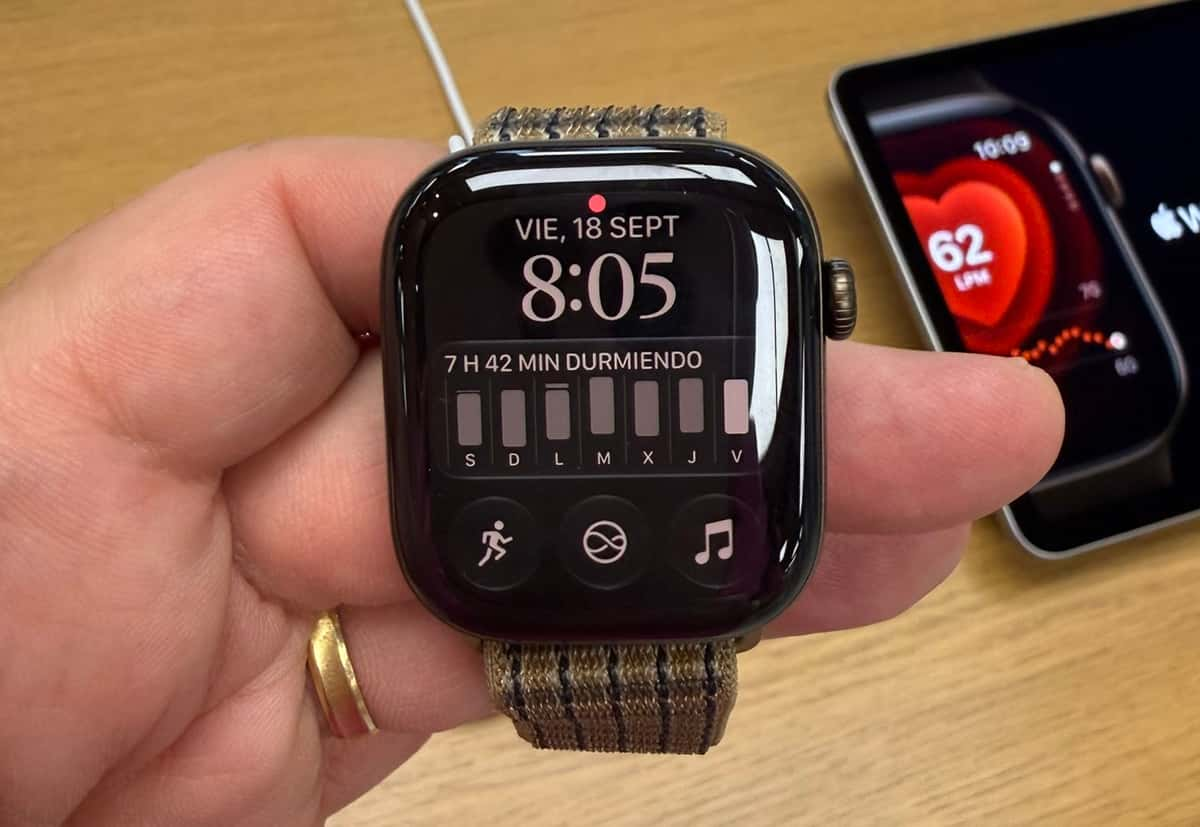
Apple says Series 12 provides its most accurate heart-rate sensing in a wearable to date. That is Apple's claim rather than an independent medical conclusion, but early testing has also highlighted the much higher frequency of readings compared with Series 11.
Existing features remain, including ECG, high and low heart-rate notifications, irregular rhythm notifications, wrist-temperature sensing, sleep tracking, sleep score and sleep-apnea notifications. Availability of some health features varies by country. These features are useful for tracking trends and wellness information, but an Apple Watch isn't a substitute for professional medical diagnosis.
Readiness Score Finally Arrives
Perhaps the most useful everyday addition is the new Readiness score. Rather than simply telling you what happened during yesterday's workout, Series 12 tries to answer a more practical question: Should you train hard today or recover?
Apple combines signals including sleep, activity, heart-rate variability and other health information to produce a readiness assessment.
For runners, gym users, cyclists and athletes, that makes Apple Watch more competitive with wearables that have emphasized recovery metrics for years.
We found the Readiness score and improved heart-rate monitoring among the most significant changes in its Series 12 review.
For someone primarily using an Apple Watch for notifications and checking the time, however, this upgrade will matter much less.
S11 Brings AI to Your Wrist
Inside is Apple's new S11 chip. It powers the Health Sensing System while enabling new intelligence features. With watchOS 27 and a compatible Apple Intelligence-enabled iPhone, Siri AI can provide more contextual assistance directly from the wrist.
Apple is also introducing Audio Intelligence features, although some are arriving later in 2026. These include capabilities designed to help users remember relevant moments from conversations and recognize important sounds.
There are legitimate privacy questions around always-available audio features. Apple says the new capabilities are built with privacy protections, while Tom's Guide notes that the audio features are opt-in.
Display and Durability
Series 12 comes in familiar 42mm and 46mm sizes. The Always-On Retina display uses wide-angle OLED and LTPO3 technology, reaches 2,000 nits peak brightness and can drop to 1 nit.
Aluminum models now use Ceramic Shield 2, which Apple says is 60% tougher than the Ion-X glass used on previous aluminum models. Titanium and ceramic versions use sapphire front crystal.
There's also IP6X dust resistance and WR50 water resistance. Apple says the watch can be used for swimming and recreational snorkeling down to 6 metres, aided by its depth gauge and water-temperature sensor.
It's therefore more than capable enough for normal workouts and swimming, although people involved in serious diving or rugged outdoor activities should look toward the Apple Watch Ultra 4.
Battery Life Remains the Biggest Limitation
Battery life is still up to 24 hours of normal use. Low Power Mode extends that to approximately 38 hours, while Apple rates outdoor workout tracking at up to 10 hours. Those numbers are adequate, but they don't fundamentally solve one of Apple Watch's longest-standing weaknesses.
The improvement is charging. Series 12 can reach 80% in approximately 30 minutes, while 15 minutes of charging provides up to 12 additional hours of normal use. Five minutes can provide enough power for up to 10 hours of sleep tracking.
That makes overnight health tracking much easier if you charge the watch while showering or getting ready.
Apple Watch Series 12 Price in Nigeria
Apple's official US starting price remains $399. Nigeria doesn't have an equivalent official Apple naira MSRP, so local prices depend heavily on importers, configurations and retailer margins. iConnect Nigeria currently lists Series 12 between ₦780,000 and ₦930,000.
Another Nigerian retailer lists:
42mm GPS — ₦809,970
42mm GPS + Cellular — ₦1,012,970
46mm GPS — ₦870,870
46mm GPS + Cellular — ₦1,073,870
Imported listings can be higher still, so compare the exact size, case material, connectivity and warranty before purchasing.
Buying Guide: Which Apple Watch Series 12 Should You Buy?
For most people, the 42mm or 46mm aluminum GPS version offers the best value.
Choose 42mm if you prefer a smaller watch or have a smaller wrist. Choose 46mm if display space and readability matter more.
The Cellular version makes sense if you genuinely need calls, messaging or connectivity away from your iPhone. Otherwise, paying the substantial Nigerian premium may not provide much practical benefit.
Titanium and ceramic models are primarily premium material choices. They don't suddenly make the core health experience dramatically better than aluminum.
And remember: Apple Watch still requires an iPhone. Android users should look elsewhere.
Should Series 11 Owners Upgrade?
Probably not solely for everyday smartwatch functions. Series 12 looks broadly familiar, and Series 11 remains capable.
The upgrade becomes more compelling if you specifically want higher-frequency heart-rate sensing, Recovery HRV, the new Readiness system or S11-powered intelligence features.
Owners of considerably older Apple Watches will notice a much larger cumulative improvement in display technology, performance, health tracking, charging and software features.
Final Verdict
The Apple Watch Series 12 is an excellent smartwatch whose most meaningful improvements are largely invisible.
The redesigned Health Sensing System, five-second background heart-rate measurements, Recovery HRV and Readiness score push Apple further from basic fitness tracking toward actionable recovery information. The S11 also lays the groundwork for more intelligent wrist-based features.
Battery life remains the obvious weakness. 24 hours isn't impressive, particularly compared with fitness-focused wearables capable of lasting several days.
Nigeria presents another problem: price. At roughly ₦780,000–₦1.07 million, Series 12 costs considerably more locally than its $399 US starting price might suggest.
For a first-time Apple Watch buyer with a compatible iPhone, the aluminum GPS model is the configuration we'd investigate first. Series 11 owners can comfortably wait unless the new health and recovery features matter to them.
For fitness-focused iPhone users who want Apple's newest health technology without paying for the more rugged Ultra 4, however, Series 12 is now the Apple Watch to consider.
Read more: Apple Watch Could Be Heading for Its Biggest Redesign Yet

Author
Adebayo JohnsonSenior tech editor with over 4 years of experience covering mobile and gadget technology. Explore author & articles





