Are LinkedIn Ads Worth It for B2B Businesses? What the Data Reveals About ROI and Sales
Are LinkedIn Ads worth the investment? Dreamdata's 2026 report reveals a 272-day B2B buying journey, 121% ROAS and why businesses must rethink advertising.
Imagine spending $5,000 on LinkedIn advertising, generating dozens of clicks and several enquiries, but closing almost no deals in the first month.
For many B2B marketers, that would be enough to question whether the campaign was worth running. But what if some of those buyers are still researching your product, comparing competitors and waiting for their companies to approve a purchase? That is one of the central findings of Dreamdata's LinkedIn Ads Benchmarks Report 2026.
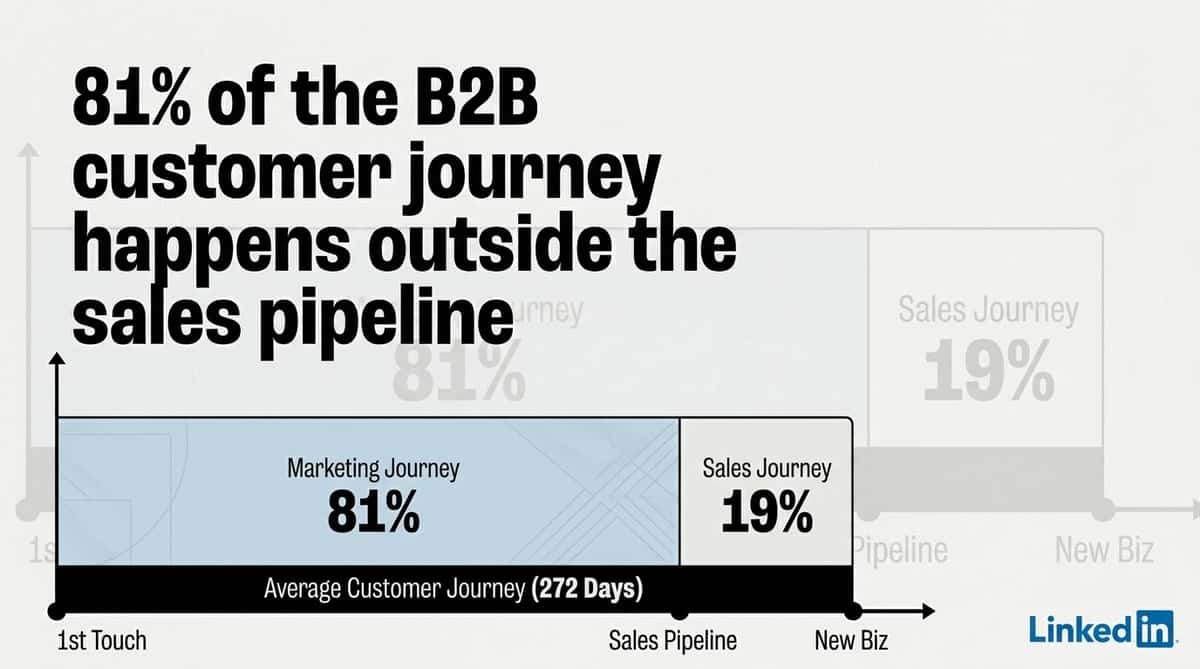
The report, released in March, analyzes more than 66 million sessions across over 3.5 million B2B customer journeys. Its findings suggest that companies may be evaluating LinkedIn advertising using the wrong expectations and measurement windows. According to Dreamdata, the average B2B customer journey now lasts 272 days, up from 211 days in its previous benchmark. Yet the time buyers spend in the formal sales pipeline has decreased. The implication is significant: businesses may need to influence potential customers for months before those customers are ready to speak with sales.
B2B buyers are taking longer to decide, not necessarily longer to buy
Dreamdata reports that approximately 81% of the average B2B customer journey happens before the formal sales pipeline. A prospective customer might first encounter a cybersecurity company through an employee's LinkedIn post.
Several weeks later, they read an industry report mentioning the company. Months afterward, their employer begins reviewing cybersecurity vendors. By the time they request a demonstration, they may already know which companies they want to evaluate. This helps explain why B2B advertising should not be judged exclusively by immediate leads.
However, it does not mean every business must wait nine months for a sale. Buying cycles differ substantially between small businesses, enterprise software, consulting services and other industries. The more useful lesson is to match your marketing expectations to your customers' actual purchasing process.
LinkedIn Ads generated 121% ROAS — but what does that actually mean?
One of the report's most widely discussed findings is LinkedIn's attributed return on advertising expenditure. Dreamdata reports the following results across advertising platforms in its dataset:
Advertising platform | Reported ROAS |
|---|---|
LinkedIn Ads | 121% |
Google Search | 67% |
Meta Ads | 51% |
A 121% ROAS means the attribution model assigned approximately $1.21 in revenue for every $1 spent on advertising. It does not mean a business earned 121% profit.
For example, if a company spends $10,000 on LinkedIn Ads and achieves the same attributed ROAS, the model would assign $12,100 in revenue to those advertisements. That is before accounting for employee salaries, software subscriptions, sales commissions, service-delivery costs and other expenses.
The benchmark also should not be interpreted as proof that LinkedIn will outperform Google or Meta for every business. A company selling accounting software to chief financial officers may find LinkedIn's professional targeting valuable.
A business selling inexpensive consumer accessories might obtain better results elsewhere. The channel must fit the audience.
Why LinkedIn Ads may influence more revenue than clicks reveal
Another finding deserves attention. Dreamdata reports that incorporating LinkedIn advertising engagement data into its attribution model resulted in 7.7 times more revenue being attributed to LinkedIn Ads. This does not mean advertising suddenly produced 7.7 times more sales. It means the measurement system recognized additional interactions that its previous reporting could not adequately account for.
Consider a procurement manager who engages with an advertisement but does not submit a form. Two months later, another employee from the same company visits the advertiser's website. Eventually, the company's finance director approves a purchase.
A last-click attribution system may credit only the final website visit. A broader account-level attribution model can recognize that several marketing interactions contributed to the customer journey. This is particularly relevant in B2B markets, where purchasing decisions often involve multiple employees. But attribution remains a model of contribution, not definitive proof that an advertisement caused a sale. Businesses should combine attribution reports with experiments, customer interviews and pipeline analysis before increasing budgets.
Your LinkedIn Company Page may matter more than its engagement suggests
Another interesting finding is that nearly one in five closed deals in Dreamdata's dataset involved a LinkedIn Company Page view during the customer journey. This challenges a common assumption about company pages. A business may publish content that receives few reactions or comments and conclude that its page has little commercial value.
But prospective buyers do not always engage publicly. They may visit a company page simply to check whether the business appears legitimate. They may review its description, employees, industry expertise and recent activities before requesting a demonstration. This suggests that a LinkedIn Company Page should function as more than a place to repost promotional announcements. It should clearly communicate what the company does, who it serves and why buyers should trust it.
Nevertheless, the finding demonstrates an association between page visits and closed deals. It does not establish that visiting a company page directly caused those purchases.
How B2B companies should structure their LinkedIn advertising
Rather than treating every LinkedIn campaign as an immediate sales campaign, businesses can organize advertising around three distinct customer needs.
1. Help potential buyers understand the problem
At the beginning of the buying journey, customers may not be ready to purchase. Educational content can help them understand a problem and explore possible solutions. A cloud-security company might publish a guide explaining common infrastructure vulnerabilities. A payroll startup might share research on compliance challenges for companies operating across multiple countries. The immediate objective is relevance and credibility, not forcing a sales meeting.
2. Demonstrate why your solution deserves consideration
As buyers become familiar with a problem, they begin comparing possible approaches. This is where product demonstrations, case studies, customer stories and technical explanations become valuable. LinkedIn's professional targeting can help companies distribute this material to relevant industries, job functions and organizations. However, advertising should be supported by genuine evidence. A case study showing measurable customer outcomes is more persuasive than unsupported claims about being an industry leader.
3. Make it easy for interested buyers to take action
When a company is ready to evaluate vendors, the advertising objective can shift toward conversion. This might involve promoting a product demonstration, consultation, pricing discussion or trial. At this stage, landing pages should clearly explain the offer and remove unnecessary barriers. A campaign that reaches the right decision-makers but sends them to a confusing website may still waste money.
What should B2B businesses measure?
Clicks and impressions remain useful, but they are not enough to establish commercial success. A more complete measurement framework should include:
Audience quality: Are advertisements reaching companies and decision-makers that match your ideal customer profile?
Account engagement: Are relevant organizations returning to your website or interacting with your content?
Qualified opportunities: Are those organizations progressing into genuine sales conversations?
Pipeline value: How much potential revenue is associated with qualified opportunities?
Closed revenue: Which opportunities become paying customers?
Acquisition economics: Does the expected customer value justify the combined advertising and sales costs?
For smaller businesses, sophisticated attribution software may be unnecessary initially. A properly configured CRM, campaign tracking and consistent sales records can provide a useful starting point.
The important thing is to measure business outcomes rather than celebrating inexpensive clicks that never produce customers.
Should African B2B startups invest in LinkedIn Ads?
For startups in Nigeria, Kenya, Ghana and South Africa, LinkedIn can be useful when selling to identifiable professional audiences.
Examples include enterprise software, recruitment services, cybersecurity, business consulting and financial infrastructure. But the platform's advertising costs can be challenging for early-stage companies operating with limited budgets.
A Nigerian SaaS startup selling to international enterprise customers may find that a single successful contract justifies substantial customer-acquisition spending. A startup selling a low-cost subscription to local small businesses may struggle to recover the same advertising costs.
African founders should therefore begin with a clearly defined customer profile, strong organic content and small, measurable advertising experiments. They should also account for currency exposure when advertising costs are billed internationally while customer revenue is earned locally.
The goal is not to imitate the advertising budgets of well-funded American software companies. It is to discover whether LinkedIn can acquire profitable customers for the business's particular market.
Are LinkedIn Ads worth paying for in 2026?
Dreamdata's findings offer a useful challenge to the way businesses evaluate B2B advertising. A campaign that fails to produce immediate conversions may still influence future purchasing decisions. But the opposite is also true: a campaign generating impressions and engagement may contribute little to actual revenue.
The distinction requires disciplined measurement. LinkedIn offers a valuable environment for reaching professional audiences, but its effectiveness depends on the quality of the offer, the targeting, the buying cycle and the economics of customer acquisition.
The central lesson is not that every B2B business should spend more on LinkedIn.
It is that businesses should stop expecting every advertisement to close a sale immediately and start measuring whether their marketing helps the right customers move toward a purchase. For companies selling complex products with long buying cycles, that shift in thinking may be more valuable than any single advertising benchmark.
Read more: How to Get Your First 50 Customers as an Early-Stage Startup in Africa
Read more: 5 Work-From-Anywhere Remote Jobs Hiring Now in 2026
Read more: Your Competitor Just Raised Millions, What Should an African Startup Founder Do Next?
Read more: African Startups Have Raised $2 Billion in 2026 But Where Is the Money Actually Going?

Author
Azeez LiadiAzeez is an AI Engineer, Data Scientist, founder, and Senior Tech Writer at Afritech Connect. A top 1% graduate of Lagos State University, he has worked with international startups and… Explore author & articles