

How to Get Your First 50 Customers as an Early-Stage Startup in Africa
Building a startup is only half the battle. This practical guide explains how African founders can find their first 50 paying customers through communities, direct outreach, demos, referrals and founder-led sales.

You have identified a problem. You spent months building a solution. The website is live. Your payment system works. Your product looks good. You post:
We are excited to announce the launch of…
Then nothing happens. A few friends congratulate you. Some people visit the website. Perhaps 300 people register for free accounts. But nobody pays.
This is where building a startup becomes a different job.
How do you find your first 50 real customers?
There is something African founders can learn from the way some of today's fastest-growing AI startups found their earliest customers: many didn't simply launch and wait for strangers to arrive. They went looking for the people who had the problem.
Your First Customer Should Exist Before Your Marketing Strategy
Before discussing LinkedIn, WhatsApp, cold emails or advertising, answer this: Who has a problem painful enough to pay you to solve it?
Not:
African businesses.
That's too broad.
Try:
Independent pharmacies in Lagos that repeatedly lose sales because they don't know which medicines are running out across their branches.
Or:
Small logistics companies managing more than 20 delivery riders through WhatsApp and spreadsheets.
Now you have someone to find. Y Combinator's long-standing advice to startups is to launch, talk directly to users and “do things that don't scale” before attempting premature growth. It specifically recommends getting early customers even through manual processes that would become impossible at hundreds or thousands of customers. That is exactly how we would approach the first 50.
At this stage, you don't need 50,000 impressions. You need 50 people with the problem.
Start With 10 People You Can Actually Reach
Your first acquisition channel is probably already inside your phone.
Friends
Former colleagues
University classmates
NYSC contacts
Previous customers
Professional associations
LinkedIn connections
WhatsApp communities
People you've previously worked with
Don't send everybody a generic sales message. Instead, identify people who either experience the problem or can introduce you to someone who does.
If you're building accounting software for small businesses, a friend who owns a fashion store is more useful right now than a technology influencer with 100,000 followers.
And don't begin with:
Please support my startup.
Ask about the problem.
I'm building something that helps small retailers automatically track which products are running low. How are you currently managing your inventory?
The conversation gives you information even when it doesn't produce a sale. Ten conversations might reveal that the problem you spent three months solving isn't actually the problem businesses care about most. Discovering that at customer number zero is painful. Discovering it after spending ₦20 million on marketing is worse.
Go Where Your Customers Already Gather
One striking finding in the 50-company analysis studied by Afritech Connect was the importance of communities. In the dataset provided to us, community was the single largest primary channel, accounting for 11 of the 50 companies. Viral demos/building publicly and founder networks followed with eight companies each, while only five were attributed primarily to a public launch or PR stunt.
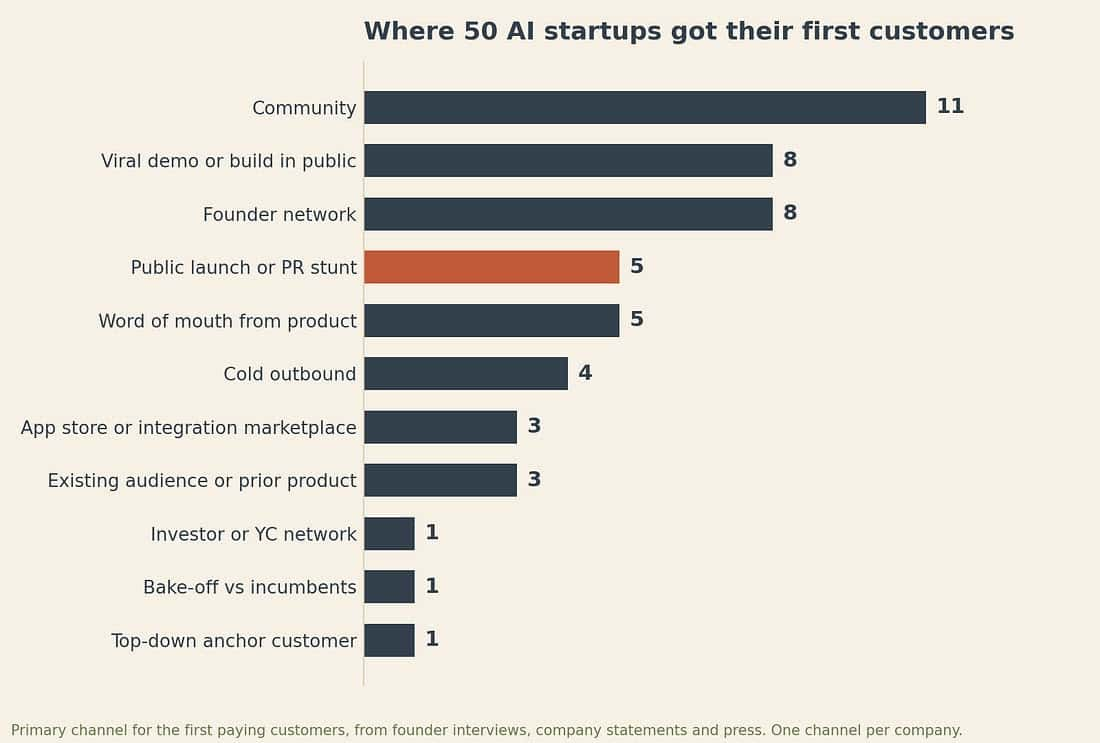
That dataset is a useful directional sample rather than a scientific representation of every AI startup. But its underlying lesson is worth examining: Don't always build an audience from zero. Find the audience that already exists.
For an African founder, that could mean a WhatsApp community for Nigerian developers, a Facebook group for restaurant owners, a Telegram cryptocurrency community, an industry association, LinkedIn groups and conversations, an X community, a university alumni network or a physical trade gathering.
There is even anecdotal evidence from Nigerian founders describing early customers emerging from friends, family and founder WhatsApp groups. Example from Nigerian SaaS founder Razaq Ahmed
But don't join a community and immediately post:
BUY MY PRODUCT! 20% DISCOUNT!!!
Become useful first
Answer questions
Share knowledge
Understand complaints
Then when someone describes exactly the problem your product solves, you have a natural reason to talk.
Customers 1–10: Founder Network and Community
For your first ten customers, forget scale. Do things manually. Let's imagine you've built software that helps Nigerian restaurants manage online orders from multiple channels.
Make a spreadsheet and list 50 restaurants that fit your target customer profile.
Add: Business | Decision maker | Contact | Current process | Problem observed | Contacted? | Demo? | Result | Follow-up date
Then start talking
Walk into restaurants if appropriate
Send Instagram messages
Ask friends for introductions
Find managers on LinkedIn
Call businesses
Join hospitality communities
Your objective isn't: How many people saw my advertisement?
It is: How many target customers did I speak with this week?
Your founder network helps you cross the initial trust barrier. After that, the product has to earn the relationship.
Customers 11–20: Start Cold Outreach
Eventually your friends run out. Now you find out whether strangers care.
Suppose you sell fraud-detection software to Nigerian fintech companies. Search for people responsible for fraud, risk, compliance, payments or engineering.
Don't send:
Dear Sir/Madam,
We are a revolutionary AI-powered company leveraging next-generation artificial intelligence to disrupt...
Nobody needs that paragraph.
Try:
Hi Ada, I noticed you lead payment operations at [Company]. We're building a system that flags unusual transaction patterns before manual review. We're testing it with payment teams and I'd like to show you a 10-minute demo using sample transactions. Would Tuesday work?
Short, Specific and Relevant.
The goal of cold outreach isn't to explain your entire company. It's to earn the next conversation.
Customers 21–30: Show, Don't Tell
This is especially important for AI startups. One reason AI startups can struggle with sales is that everybody now claims to have AI.
“AI-powered” isn't proof.
Demonstrate the result.
Cursor provides an interesting example. Bloomberg reported in 2025 that Cursor had reached around one million users without spending money on marketing, with word of mouth playing an important role in its growth.
The product itself was demonstrable: developers could use the editor and immediately decide whether it improved their programming workflow.
Decagon took this concept further in enterprise sales. Its founders surveyed dozens of startups before settling on AI customer support as a problem companies would pay to solve. When selling the resulting product, prospective customers frequently conducted bake-offs, putting Decagon's agents against competing customer-support systems on actual tasks. CEO Jesse Zhang told Forbes that these head-to-head evaluations became part of winning customers. Forbes on Decagon's customer acquisition strategy
That's an important lesson. Create a situation where customers can judge your product by what it does rather than what you promise.
If you built an AI bookkeeping tool, give it 100 anonymised transactions
If you built logistics software, demonstrate one real delivery route
If you built an agricultural disease-detection application, test it on real images
If you built customer-support AI, give it historical support questions and compare the results
If you built software that reduces invoice processing from two hours to ten minutes, record both workflows
Proof reduces the amount of trust an unknown startup needs.
Don't Confuse a Launch With Customer Acquisition
This is one of the most important lessons from the dataset studied by Afritech Connect. Only five of the 50 companies in that sample primarily acquired their first paying customers through public launch or PR. That doesn't mean Product Hunt, X, LinkedIn, TechCabal coverage or a launch event is useless.
Launches can generate attention.
But: Attention ≠ customers
And: Signups ≠ revenue
You could launch and receive 2,000 registrations while discovering that almost nobody is willing to enter their debit-card details. Conversely, an enterprise startup could have only six customers and already have a meaningful business.
The correct metric depends on your product. Your launch should amplify something that is beginning to work—not compensate for something nobody wants.
Customers 31–40: Turn Early Customers Into Your Sales Team
Once ten or twenty customers genuinely like the product, ask: Who else has this problem?
This is where referrals become powerful. Suppose your first customer owns a pharmacy. After several weeks of successful use, ask whether they know two other pharmacy owners who struggle with the same issue.
An introduction from:
I use this and it works
is radically different from:
Hello, I found your number online.
Make referrals easy. You could offer account credit, a free month, additional usage or another sensible benefit where appropriate. But the strongest referrals often happen because the product produces an outcome worth talking about.
The 50-company dataset we studied separates community and word of mouth from product, and together those mechanisms accounted for a substantial share of the observed first-customer stories.
The objective therefore isn't merely getting customers. It is creating customers who bring another customer.
Customers 41–50: Double Down on What Actually Worked
By now, you should have data. Where did each paying customer come from?
Create a table:
Channel | Conversations | Demos | Customers | Revenue |
|---|---|---|---|---|
Founder network | 20 | 12 | 7 | ₦... |
LinkedIn outreach | 70 | 15 | 8 | ₦... |
WhatsApp communities | 25 | 11 | 9 | ₦... |
Referrals | 15 | 12 | 10 | ₦... |
Paid ads | 300 clicks | 4 | 1 | ₦... |
Now you know something advertisements couldn't tell you at the beginning. You know how your market buys.
If referrals work, build a referral programme
If LinkedIn works, improve outbound
If WhatsApp communities work, deepen community relationships
If demonstrations convert, publish more demonstrations
If customers consistently arrive from one industry, consider narrowing your target market
Your first 50 customers aren't merely revenue. They are market research you get paid to conduct.
Consumer Startups Need a Different Playbook
Not every founder should start cold emailing executives. The chart below shows meaningful differences between segments.
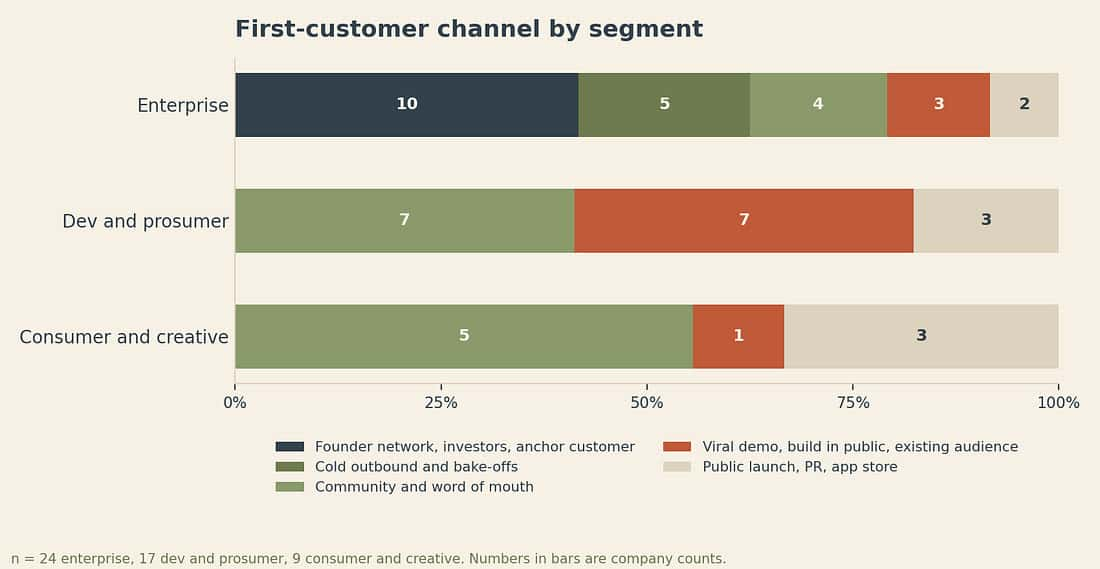
Enterprise startups in the sample used a mixture of founder networks, investors/anchor customers, outbound, bake-offs, community, viral demonstrations and launches.
Developer/prosumer products leaned more heavily toward community and viral/build-in-public channels.
Consumer and creative products were even more dependent on community and word of mouth, with viral demonstrations and public launches also appearing.
That makes intuitive sense. If you're selling enterprise cybersecurity software worth millions of naira annually, you may need ten meetings and a pilot.
If you've built a photo application costing ₦3,000 per month, nobody wants a 45-minute sales presentation.
The lower the purchasing friction, the more the product itself can become the salesperson
For consumer products, demonstrate something people immediately want to try.
Before → after
Slow → fast
Difficult → one click
Boring → remarkable
Make sharing effortless
Africa Gives Founders an Acquisition Channel Silicon Valley Often Underestimates: WhatsApp
For many African businesses, WhatsApp isn't merely where people chat. It's where business happens.
Customers ask questions there
Sellers send pictures
Invoices arrive
Orders are negotiated
Communities operate
Referrals happen
This makes WhatsApp particularly useful for founder-led customer acquisition.
One recent founder account describes using WhatsApp from the validation stage onward—placing a WhatsApp call-to-action on the landing page and personally talking to prospective customers rather than treating messaging as a passive support channel. Founder account of using WhatsApp for early African customers
Don't spam 5,000 numbers. Make it incredibly easy for an interested customer to talk to a human being. Your first 50 customers may actually appreciate discovering that the founder answers.
Charge Earlier Than Feels Comfortable
Free users can tell you:
This is amazing.
A paying customer tells you something much more important:
Solving this problem is worth money.
Your first price doesn't have to be your permanent price.
You can offer an early-customer plan
You can manually onboard customers
You can provide more support than you'll eventually provide at scale
But there should come a point where you ask people to pay. YC's advice similarly emphasises finding a small number of customers who genuinely love the product before prematurely scaling technology and processes. Twenty thousand people saying “cool idea” can be less useful than ten people repeatedly paying ₦20,000.
Don't Spend Your Way Out of a Product Problem
Early founders often think:
We need marketing.
Sometimes you do. Sometimes what you actually need is a better product.
If 100 carefully selected prospects see your solution and almost nobody wants it, buying Facebook or Google ads won't necessarily solve the fundamental problem.
You may simply pay to discover rejection faster. Ask why people aren't buying.
Is the problem unimportant?
Is the product too expensive?
Are you targeting the wrong customer?
Does onboarding take too long?
Does the customer already have a good enough alternative?
Does your product require behavioural change they don't want?
Do they trust you with their data?
Is the person you're speaking to unable to approve the purchase?
These conversations are why founder-led sales matter so much.
You're not merely selling. You're learning why people say no.
A Practical 30-Day First-Customer Plan
If I were launching an early-stage African startup today, I would spend the next month like this.
Week one: Define one extremely specific ideal customer. Build a list of 100 potential customers. Speak with at least 10 before changing the product.
Week two: Contact people in your existing network and relevant communities. Start personalised cold outreach. Aim for conversations rather than impressions.
Week three: Run demonstrations and onboard early customers manually. Watch them use the product. Ask where they get confused. Ask what nearly stopped them from paying.
Week four: Ask satisfied users for introductions and testimonials. Calculate which channel produced actual paying customers. Stop spending time on channels producing vanity metrics and increase effort on those producing revenue.
And keep the spreadsheet. At customer 50, you should be able to explain exactly where customers 1 through 49 came from.
Your First 50 Customers Should Teach You How to Find the Next 500
The first 50 customers are difficult because your startup has almost none of the advantages established businesses possess.
Nobody knows your name.
There are few reviews.
There is little word of mouth.
You may have no case studies.
Nobody wants to be the first company trusting an unknown startup with an important operation.
So don't behave like a giant company. Don't hide behind automated email sequences and dashboards.
Talk to people
Join communities
Ask for introductions
Send cold messages
Demonstrate the product
Manually onboard customers
Visit businesses where appropriate
Ask why people reject you
Turn successful customers into referrals
And above all, make the product prove itself
The emerging AI companies in the dataset studied by us reinforce that point. Their paths differed—community, founder relationships, demonstrations, outbound, word of mouth, public launches and competitive evaluations but most didn't simply publish a website and wait.
Decagon CEO Jesse Zhang described the distinction particularly well when discussing his crowded AI customer-support market: the company focused aggressively on what customers wanted and where they would obtain value, which he contrasted with merely building a flashy AI demonstration.
That's the mentality African founders should adopt. Your first 50 customers probably won't arrive because the entire internet suddenly discovers your startup.
They may come one by one.
A former colleague
A WhatsApp introduction
A LinkedIn message
A cold email
A live demonstration
A community member
A customer referral
Then another
That can feel painfully slow when you're dreaming about millions of users. But those first 50 people are doing something much more valuable than increasing the number on your dashboard.
They are proving that the problem you decided to solve is important enough for somebody to pay you to solve it.
Read more: How Founders and Students Can Build Businesses With Coding Agents
Read more: Andrew Ng’s AI Skills Map: 6 Skills African Should Learn to Build Real AI Products Part 2

Author
Azeez LiadiAzeez is an AI Engineer, Data Scientist, founder, and Senior Tech Writer at Afritech Connect. A top 1% graduate of Lagos State University, he has worked with international startups and… Explore author & articles





