

Shuttlers Pod Takes on Bolt and inDrive After Uber's Nigeria Exit
Shuttlers Pod will pick Lagos commuters up from different homes and drop them at individual destinations. Can shared door-to-door rides work where Uber exited?
After Uber's Exit, Shuttlers Is Betting Nigerians Will Share Their Next Ride
Uber's departure from Nigeria has created an opening in one of Africa's biggest urban transport markets. Bolt and inDrive are trying to capture riders left behind, but Nigerian mobility company Shuttlers is attempting something more unconventional.
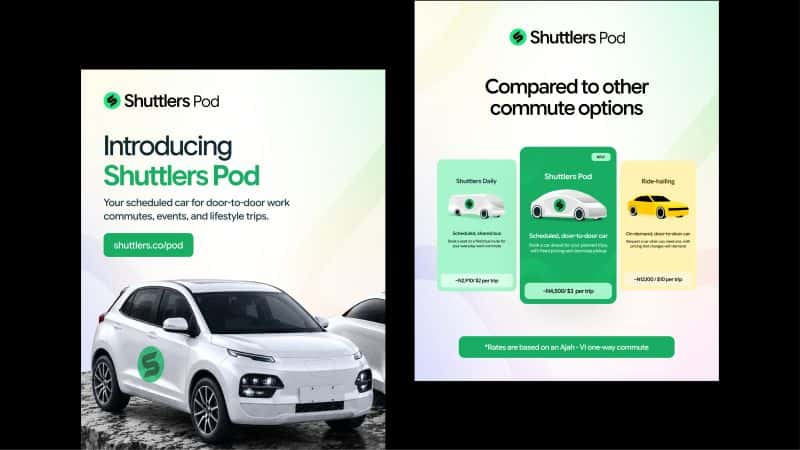
On September 25, Shuttlers will launch Shuttlers Pod in Lagos, a scheduled car service that can pick up as many as four commuters from different homes and drop each passenger at their individual destination. It sounds like ride-hailing, but there is an important difference.
A conventional Bolt or inDrive journey generally involves one booking travelling from its pickup point toward one destination. Pod is trying to digitise something Nigerians already understand socially: several people going roughly the same direction sharing a vehicle, even though they don't all live or stop at exactly the same place.
The big question is whether that familiar behaviour can become a profitable technology business.
Shuttlers Isn't Trying to Rebuild Uber
Uber ended its Nigerian operations on September 2 after 12 years. The company said the decision followed a review of its operations but did not provide a detailed reason. Nigeria's ride-hailing industry has nevertheless been dealing with rising fuel costs, inflation, currency volatility and increasingly difficult economics for drivers and platforms.
We examined what its departure means for the market in Uber Is Leaving Nigeria After 12 Years — And Bolt and inDrive Are Ready to Take Its Riders.
Bolt and inDrive largely offer alternatives to the familiar model Uber leaves behind.
Shuttlers Pod doesn't. A passenger enters a home address and destination in the Shuttlers app and chooses an available departure time. Shuttlers then attempts to match that passenger with other commuters in the same geographical cluster travelling at roughly the same time. A group Pod generally needs at least three riders to operate, while someone who doesn't want to share can book the entire vehicle.
Shuttlers says Pod fares are expected to be around 50% cheaper than typical ride-hailing fares. That discount could be its biggest attraction—and its biggest challenge.
The Economics Depend on Strangers Wanting the Same Ride
Suppose four professionals live around Chevron, Lekki and are travelling toward Victoria Island in the morning.
Instead of four separate cars making broadly similar journeys, one vehicle could collect the passengers sequentially and carry them along a shared corridor before dropping them at their respective destinations.
There is obvious efficiency in that idea. But the mathematics becomes difficult when one person wants to leave at 6:30 a.m., another at 7:15 a.m., another lives significantly outside the route and the fourth cancels. Shuttlers is trying to control that uncertainty by making Pod scheduled rather than purely on-demand.
Customers must book in advance, commit to at least two trips per week and stay within geographical clusters. The company says it will not, for example, combine someone in VGC with a Chevron Pod simply because both passengers ultimately work in the same area. That restriction matters because every extra detour adds fuel, time and frustration.
The technology therefore has to solve a complicated optimisation problem:
Put enough people in each car to make the fare attractive without making the journey so indirect that passengers would rather pay more for Bolt or inDrive
Shuttlers Has Actually Tried This Before
This is perhaps the most important part of the story.
Pod isn't Shuttlers' first experiment with doorstep transportation. CEO and co-founder Damilola Olokesusi says Shuttlers originally started with a doorstep-to-doorstep model before moving to bus-stop-to-bus-stop transportation because coordinating individual pickups was difficult without sufficient technology. After several months, the company also discovered that the original model wasn't profitable.
Shuttlers eventually found traction with fixed buses, routes and schedules. The company now says it operates more than 430 buses daily, serves more than 11,000 daily riders and has completed over 10 million journeys.
Ten years later, it is returning to the doorstep. The difference is that Shuttlers now has technology, historical commuter data, an established customer base and years of experience understanding where professionals travel.
More than 1,000 people had reportedly joined the Pod waitlist ahead of launch, with their requests already revealing ten popular routes. The September 25 launch will test whether those advantages are enough to make an old idea work under new conditions.
Why Pod Could Fit Lagos Better Than Conventional Ride-Hailing
Lagos transportation has always involved sharing. Danfo buses, BRT, staff buses and informal car-sharing all rely on putting people travelling in approximately the same direction into the same vehicle.
Pod effectively tries to take part of that behaviour and add technology, air conditioning, advance booking, doorstep pickup and predictable pricing. That could create a middle category between mass transit and private ride-hailing.
A commuter might not want to stand at a crowded bus stop every morning but may also be unwilling to pay ₦10,000 or more for an individual ride to work.
Pod's proposition is essentially:
share the car and get closer to the economics of public transport without giving up doorstep convenience.
That could be especially attractive as transport costs rise. Lagos' BRT system itself has faced capacity pressure, with commuters reporting long queues and significant waiting times.
But Pod Has Some Difficult Problems to Solve
The first is route density. Shared transportation works best when many people are travelling from similar places to similar destinations at similar times. Shuttlers may find that easy along busy Lekki–Victoria Island or Mainland–Island commuting corridors and considerably harder elsewhere.
The second is punctuality. If the first passenger is seven minutes late, everyone downstream can be affected. A private ride doesn't have that dependency.
Then there is privacy and social comfort. Nigerians regularly share buses with strangers, but sharing a four-seat car is more intimate. Some passengers may be uncomfortable having strangers collected from their neighbourhoods or knowing parts of their daily routine.
Cancellations create another problem. If three passengers make the economics of a Pod work and one pulls out shortly before departure, who absorbs the difference?
And above everything sits Nigeria's difficult transport economics: fuel, vehicle financing, maintenance, insurance and driver earnings.
Uber's departure is a reminder that having plenty of potential passengers doesn't automatically make a mobility business profitable.
If It Works, Shuttlers Could Create a New Category
Pod doesn't necessarily need to defeat Bolt or inDrive. It needs to occupy the space between them and buses.
That could be significant. Instead of choosing between a cheap but less convenient mass-transit journey and an expensive private car, commuters could gain a third option: scheduled, shared and semi-private transportation.
Success could also give Shuttlers something conventional ride-hailing platforms struggle to obtain—predictability. If passengers commit to recurring trips, Shuttlers knows roughly where demand will exist before cars leave their bases. Vehicles can be allocated ahead of time instead of roaming Lagos waiting for someone to request a ride. Shuttlers says a vehicle can be assigned around 24 hours before a new Pod journey. That changes the business from purely reacting to ride requests toward planning transportation around known demand.
September 25 Will Start the Real Experiment
Uber's exit certainly creates useful timing for Shuttlers, but it doesn't prove Pod will work. Bolt and inDrive already have established networks, drivers and familiar on-demand behaviour. Riders know they can open an app and request a car immediately.
Shuttlers is asking Lagos commuters to make a trade:
plan earlier and share your vehicle in exchange for potentially paying considerably less.
That is a very Nigerian transportation idea wrapped inside a technology platform. And perhaps that is precisely why it deserves attention.
For years, African technology companies have sometimes adapted business models originally developed for cities with very different incomes, infrastructure and transportation behaviour. Shuttlers is attempting the reverse: start with how Lagos residents already move and build technology around it.
If enough people living near one another are willing to coordinate their journeys, Pod could create an interesting new layer in Nigeria's mobility market. If they aren't, Shuttlers may rediscover the same lesson that forced it away from doorstep transportation years ago.
Either way, September 25 isn't simply the launch of another ride-hailing service. It is a real-world test of whether shared Nigerian commuting behaviour can be turned into a scalable technology business.
Read more: Uber Is Leaving Nigeria After 12 Years And Bolt and inDrive Are Ready to Take Its Riders
Read more: Uber Moves to Take Over Glovo in Africa: What the $14.8 Billion Delivery Hero Deal Means for Nigeria

Author
Dolapo AnifowosheTech enthusiast and technical data scientist who loves to play with numbers. Explore author & articles





