

Andrew Ng's AI Skills Map: 4 Skills African Youth Should Learn Now
Andrew Ng's new AI Engineering Skills Map highlights four skills developers and African youth should learn to stay competitive in the AI-driven technology economy.

AI Is Changing What It Means to Be a Software Developer
Artificial intelligence is changing the way software is built. A few years ago, learning to code meant spending significant time writing software manually, debugging it and building applications line by line. Today, AI coding tools can generate code, explain errors, create interfaces and help developers build working prototypes in a fraction of the time. But that does not mean young people should stop learning software development. In fact, AI may make strong engineering fundamentals even more important.
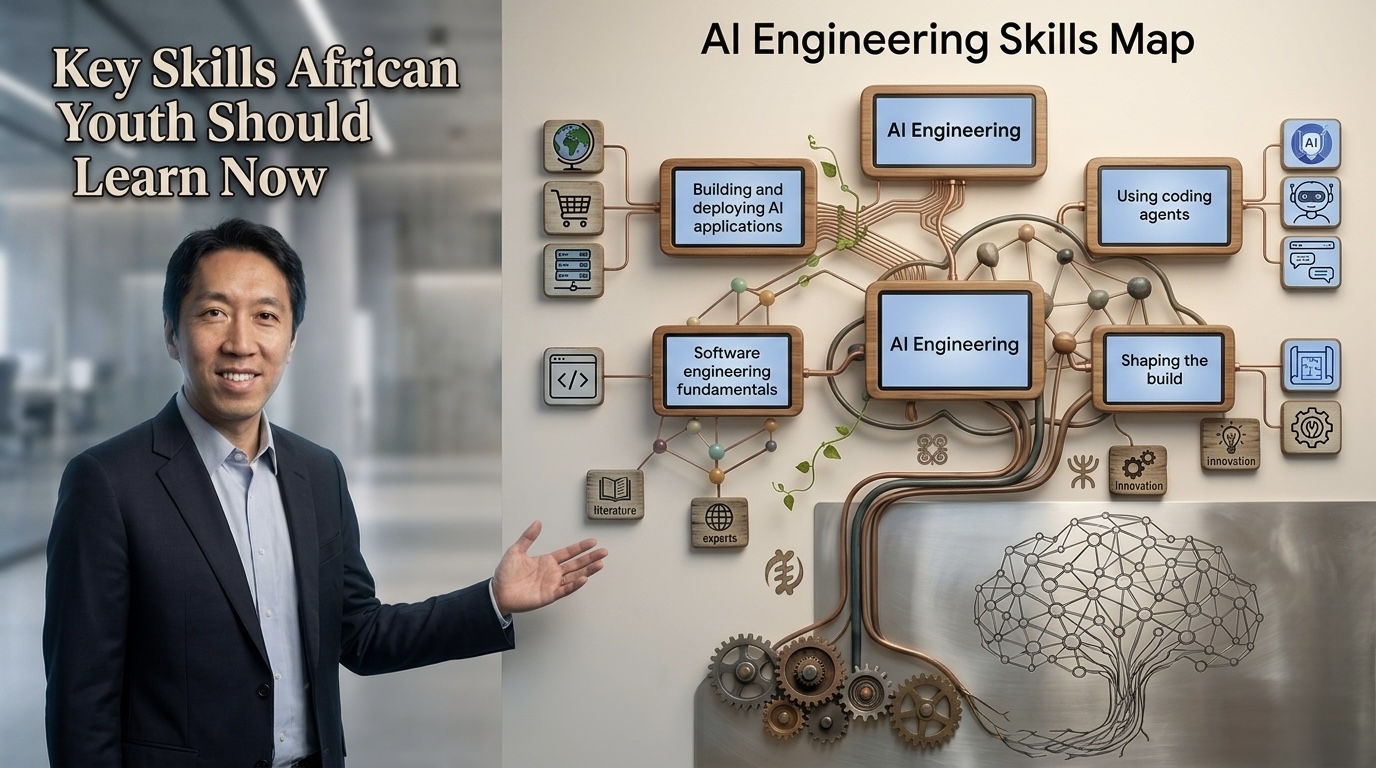
Andrew Ng, one of the most influential figures in AI education and the founder of DeepLearning.AI, has outlined an AI Engineering Skills Map designed to identify the capabilities developers will increasingly need as AI changes software development.
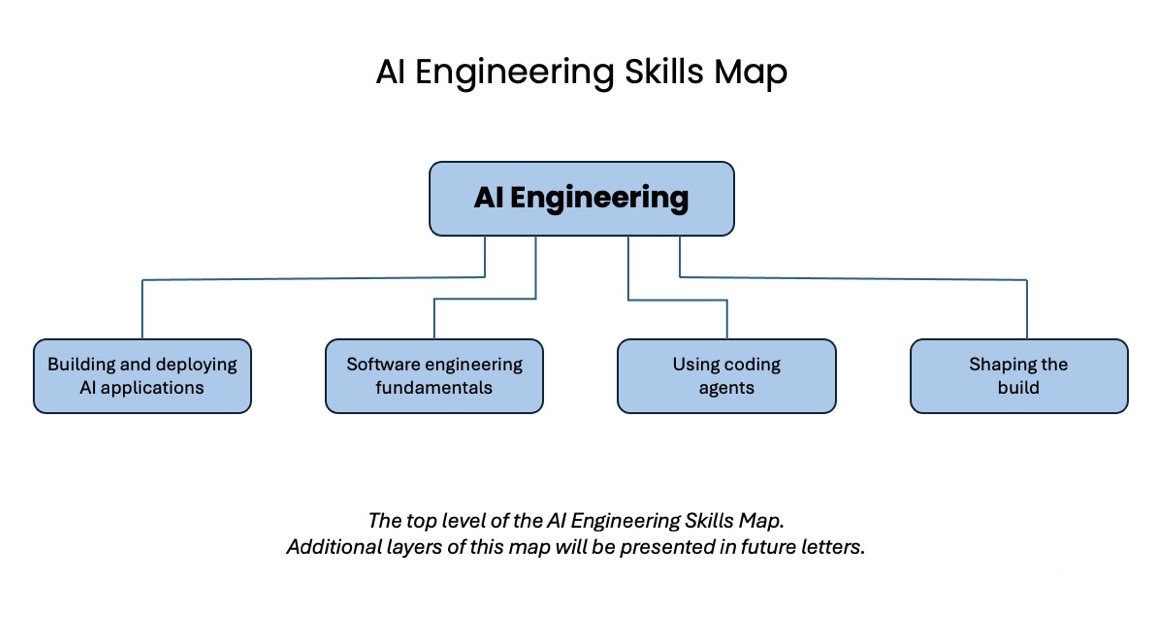
Ng says the framework was developed using analysis of more than 10,000 job postings, interviews with AI experts, hiring managers and recruiters, surveys and other data. The framework identifies four major areas:
Building and deploying AI applications
Software engineering fundamentals
Using coding agents
Shaping the build
For young people across Nigeria and Africa, the message is important: the opportunity isn't simply to learn AI—it is to learn how to build with AI.
Why African Youth Should Pay Attention
Africa has one of the world's youngest populations, and millions of young people are entering the workforce every year. At the same time, AI is reducing the amount of time required to create software prototypes and digital products. This creates an interesting opportunity.
A young developer in Lagos, Nairobi, Accra, Kigali or Cape Town can now use AI coding tools to experiment with products that previously would have required a larger development team. But there is a catch.
Knowing how to ask an AI to generate code is not the same as knowing how to engineer software.
AI can produce a functioning prototype while simultaneously introducing security vulnerabilities, poor architecture, unnecessary complexity or scalability problems. That is why Ng's framework places software engineering fundamentals alongside AI-specific skills. DeepLearning.AI is also increasingly emphasizing hands-on AI development, coding agents, agentic systems, context engineering, reliability and production deployment through its developer-focused programmes and events.
1. Learn How to Build and Deploy AI Applications
The first major skill is perhaps the most obvious:
Learn how to actually build AI-powered applications.
This goes beyond knowing how to use ChatGPT or Gemini. Developers increasingly need to understand how AI systems are incorporated into real products. That includes technologies and concepts such as:
Large language models
APIs
Retrieval-Augmented Generation (RAG)
Context engineering
AI agents
Machine learning
Deep learning
Evaluation systems
AI application deployment
Data pipelines
But building the application is only half the job. AI systems can produce unpredictable results. A traditional application might return the same output when given the same input, while an AI application can produce different responses and occasionally make mistakes. That means developers need to understand evaluation and error analysis.
You shouldn't simply ask:
Does my AI application work?
You should also ask:
How often does it fail, why does it fail, and how can I measure and improve it?
This distinction could become increasingly valuable for African developers building AI products for areas such as healthcare, education, agriculture, financial services and local-language applications.
2. Don't Abandon Software Engineering Fundamentals
This may be the most important lesson for young developers. AI coding tools can write thousands of lines of code quickly. But fast code generation does not automatically produce good software. Understanding software engineering allows you to evaluate what an AI coding agent has created.
You should still understand concepts such as:
Programming fundamentals
Data structures
Algorithms
Databases
APIs
System architecture
Authentication
Security
Testing
Version control
Cloud infrastructure
Scalability
Performance
Reliability
Why?
Because eventually someone has to make the decisions.
Should your application use PostgreSQL or MongoDB?
Should a particular process run synchronously or asynchronously?
Should your application store everything in one service or split it into multiple services?
How should authentication work?
What happens when 100,000 people use your application?
How do you prevent users from accessing another customer's information?
AI can help answer these questions, but a developer who understands engineering principles is in a much stronger position to judge those answers.
Ng's argument is essentially that software engineering knowledge allows developers to steer coding agents intelligently instead of blindly accepting whatever they generate.
3. Learn to Use Coding Agents
Coding agents could become one of the biggest changes in software development.
Instead of simply asking an AI:
Write this function.
Developers can increasingly give an AI agent a larger objective.
For example:
"Build a user authentication system, connect it to the database, create the API endpoints, add tests and fix any errors."
The agent can then plan, write code, inspect files, run commands, test its implementation and iterate.
DeepLearning.AI's 2026 AI developer programming similarly emphasizes coding agents capable of planning, writing, testing and iterating across the software development lifecycle. This means young developers should learn how coding agents think and where they fail.
You should understand:
How to provide context
How to break down large tasks
How to review generated code
How to provide precise instructions
When to intervene
When to let the agent continue
How to debug agent-generated code
How to control token usage
How to test the final result
The goal isn't to become someone who types code faster than AI. The goal is to become someone who can direct AI to build better software.
4. Learn How to "Shape the Build"
This is perhaps the most interesting part of the framework. AI makes it easier to build software. That means the bottleneck increasingly shifts from writing code to deciding what should be built and how it should work.
Imagine two developers using exactly the same AI coding tool.
Developer A says:
"Build me a social media app."
Developer B provides:
The target users
User journeys
Database structure
Authentication requirements
API architecture
Performance requirements
Security constraints
UI requirements
Testing strategy
Deployment architecture
Business objectives
They are using the same AI. But the second developer is likely to get a much better result. That's what makes shaping the build so important.
Young developers therefore need to become better at:
Product thinking
UX design
System architecture
Problem solving
Requirements gathering
Technical decision-making
Communicating with AI
Understanding users
Understanding business problems
In other words, AI makes product and engineering judgment more valuable, not less.
Skill | What You Should Learn | Why It Matters |
|---|---|---|
Build AI applications | LLMs, RAG, agents, APIs, evaluation | Build real AI products |
Software engineering | Architecture, databases, security, testing | Prevent fragile AI-generated software |
Coding agents | AI-assisted development and agent workflows | Build faster and more efficiently |
Shape the build | Product thinking, UX, architecture, requirements | Tell AI what should actually be built |
AI Skills Are Not Only for AI Engineers
One of Ng's important points is that AI engineering skills shouldn't be limited to people whose job title says AI Engineer. The same way developers today don't necessarily need to have "Cloud Engineer" in their job title to work with cloud technologies, AI capabilities are becoming useful across many software roles. That includes:
Frontend developers
Backend developers
Full-stack developers
Data engineers
DevOps engineers
Machine learning engineers
Product engineers
Startup founders
The boundaries between these roles are becoming increasingly blurred.
Don't Become Too Dependent on Vibe Coding
There is nothing wrong with using AI to generate code. In fact, refusing to use AI while everyone else adopts it could eventually become a disadvantage. The problem is blind vibe coding. Vibe coding can produce an impressive prototype very quickly.
But what happens when:
The application crashes?
The database becomes large?
A security vulnerability is discovered?
Users report inconsistent behaviour?
The AI-generated code becomes difficult to maintain?
Your monthly cloud bill suddenly increases?
You need to add a complicated feature?
If you don't understand the underlying system, you may struggle to fix it.
The better approach is:
Vibe code → understand → test → review → improve → deploy.
AI should increase your productivity without replacing your engineering judgment.
What African Students Should Learn in 2026
If you're starting from scratch, don't attempt to learn everything simultaneously. A practical progression could look like this:
Step 1 — Learn Programming
Start with a language such as:
Python, JavaScript or TypeScript.
Understand variables, functions, loops, data structures, modules and debugging.
Step 2 — Learn Software Engineering
Move beyond simple scripts. Learn:
Git
APIs
Databases
Authentication
Testing
Backend development
Frontend development
Deployment
Step 3 — Learn AI Fundamentals
Understand:
Machine learning
Neural networks
LLMs
Embeddings
RAG
Prompting
Context
AI agents
Evaluation
Step 4 — Start Using Coding Agents
Use modern AI development tools to build increasingly complex projects. Don't simply ask them to generate code. Ask them to explain:
Why did you choose this architecture?
Then review the answer.
Step 5 — Build Real Projects
This is where the learning becomes valuable. Build something people can actually use.
For example:
A Nigerian student assistant
An agricultural marketplace
A local-language chatbot
A healthcare information platform
A property search assistant
A business automation tool
The project doesn't need to become a billion-dollar startup. It needs to demonstrate that you can identify a problem and build a solution.
AI Could Be a Major Opportunity for Africa
There is a tendency to view AI primarily as a threat to jobs. There are legitimate concerns about automation, but there is another side of the story. AI dramatically lowers the cost of experimentation. A young developer who previously needed several specialists to build an early prototype may now be able to create the first version independently with AI assistance.
That could enable more African entrepreneurs to experiment with technology businesses. But the people most likely to benefit won't necessarily be those who simply know how to prompt an AI. They will be people who understand technology, users, business problems and engineering.
Frequently Asked Questions
Who is Andrew Ng?
Andrew Ng is an AI educator and entrepreneur who founded DeepLearning.AI, co-founded Coursera and has held senior AI roles in academia and industry. DeepLearning.AI describes him as its founder and Coursera co-founder.
What are the four AI engineering skills?
The framework identifies building and deploying AI applications, software engineering fundamentals, using coding agents and shaping the build as four major skill areas.
Should young people still learn coding when AI can write code?
Yes. Understanding programming and software engineering makes it easier to evaluate, correct and direct AI-generated code.
Is AI engineering only for professional AI engineers?
No. The skills are increasingly relevant to developers across different software disciplines.
Should African students focus on AI instead of traditional software engineering?
They should learn both. AI skills become considerably more useful when combined with strong programming, software engineering and problem-solving fundamentals.
Final Thoughts
Andrew Ng's AI Engineering Skills Map sends an important message to the next generation of developers.
Don't compete with AI at the things AI is becoming good at. Learn how to work with it.
For African youth, this could be particularly significant.The continent doesn't need millions of people who simply know how to use ChatGPT. It needs developers, entrepreneurs and engineers who can take AI technology and apply it to African problems.
Learn to build AI applications.
Learn software engineering.
Learn how to work with coding agents.
And most importantly, learn how to decide what should actually be built. The future may belong less to the person who can write the most code and more to the person who can combine engineering knowledge with AI to turn an idea into a reliable product. That is the opportunity African developers should be preparing for now.
Related Articles

Gemini Becomes Google’s Fastest-Growing Product Ever as It Hits 1 Billion Users
Google Gemini has reached 1 billion monthly active users, becoming the fastest Google product to hit the milestone. Here’s what is driving Gemini’s growth and what comes next.

WhatsApp Makes Parental Controls Easier on iPhone: What African Parents Need to Know
WhatsApp is making parent-managed accounts easier to set up on iPhone. Learn how WhatsApp parental controls work, what parents can monitor, and how Nigerian and African families can protect children online.

Jumia Raises $50 Million to Reach More Customers Across Africa
Jumia is raising $50 million to expand its e-commerce reach, improve delivery and bring more affordable products to customers across Africa.

Africa's New Unicorns: Why Moove's Rise Matters Beyond Fintech
Africa's unicorn club remains dominated by fintech, but Moove's $2.1 billion valuation signals growing opportunities for mobility, e-commerce and other tech sectors.

Moove Raises $250 Million: How a Lagos Startup Became a Global Mobility Powerhouse
Nigerian-founded mobility fintech Moove has raised $250 million at a $2.1 billion valuation. Here's how a startup that began in Lagos grew into a global mobility and autonomous vehicle company.
New AirPods Could Launch Next Month: Should Nigerians Wait Before Buying?
Glo Unveils “Gloria” AI Assistant as Telecom Giant Marks 23 Years in Nigeria
Glo has unveiled Gloria, an AI-powered virtual assistant integrated into Glo Café. Here’s what the new AI tool means for Glo subscribers in Nigeria.
Comments (0)
Leave a comment
Comments cannot be edited or deleted after posting. Please review your comment before submitting.
No comments yet. Be the first to share your thoughts!