

Part 2: Andrew Ng’s AI Skills Map: 6 Skills African Should Learn to Build Real AI Products
Andrew Ng’s second AI Engineering Skills Map focuses on six skills developers need to build and deploy reliable AI applications, from LLMs and RAG to AI agents, evaluation and production.

The AI Skills Developers Need Go Beyond Prompting
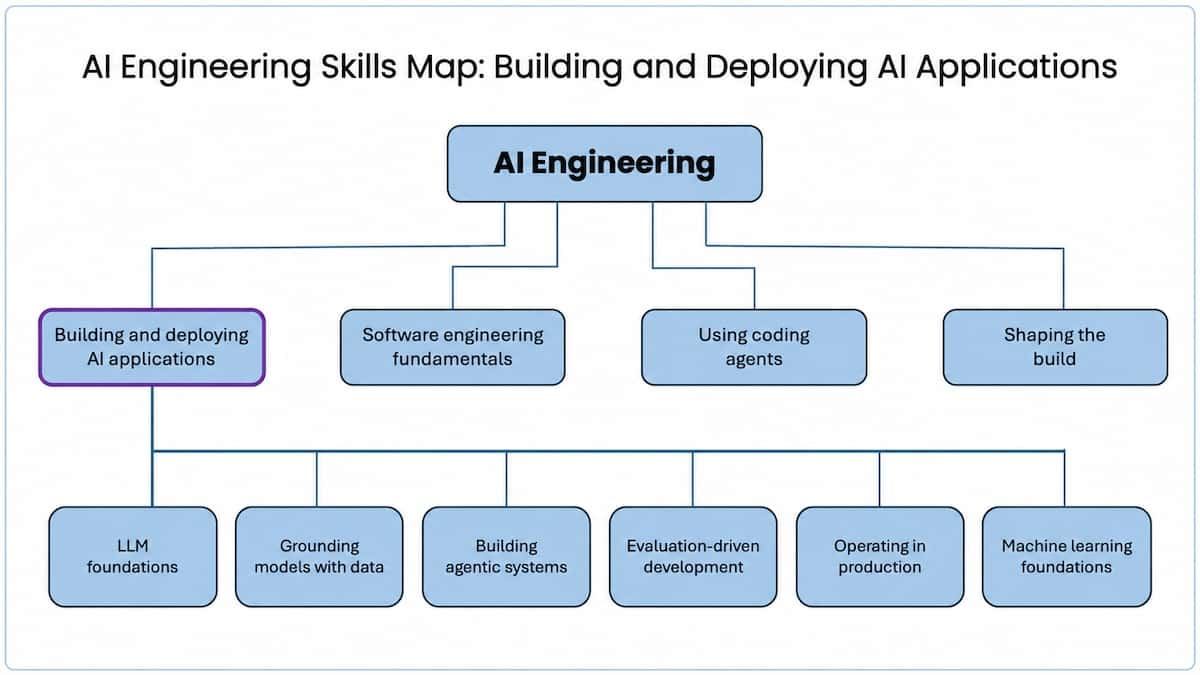
In the first part of Andrew Ng’s AI Engineering Skills Map, he identified four broad capabilities developers should develop as AI changes the way software is built:
Building and deploying AI applications
Software engineering fundamentals
Using coding agents
Shaping the build
In his latest discussion, Ng goes deeper into the first skill: building and deploying AI applications. According to Ng, becoming good at this requires understanding six important areas:
LLM foundations
Grounding models with data
Building agentic systems
Evaluation-driven development
Operating AI systems in production
Machine learning foundations
The ideas are particularly relevant to African developers because AI is lowering the barriers to building software, while creating demand for people who can turn AI models into reliable products.
1. Understand How Large Language Models Work
Knowing how to use ChatGPT is different from understanding how an LLM works. Ng argues that developers should understand the fundamentals behind how large language models process inputs and generate outputs. This includes concepts such as tokenization, context windows, sampling parameters, reasoning effort, knowledge cutoffs and tool calling.
Why does this matter?
Because developers need to understand when an AI model is appropriate for a particular task—and when it isn't. For example, building an application that needs to process images may require a multimodal model rather than a text-only model. Similarly, a system that needs current information may need access to external tools or data rather than relying entirely on the model's training knowledge.
Understanding these fundamentals also helps developers make better decisions about model selection, fine-tuning, self-hosting and the amount of information included in a model's context.
For African developers working with limited infrastructure budgets, these decisions can have a direct impact on the cost of running an AI application.
2. Learn How to Ground AI Models With Data
One of the biggest weaknesses of standalone LLMs is that they don't automatically know everything your application needs. A business chatbot, for example, may need access to:
Company documents
Product information
Customer records
PDFs
Websites
Databases
Internal knowledge bases
This is where grounding AI models with data becomes important. Retrieval-Augmented Generation, commonly known as RAG, became one of the popular ways of providing relevant information to LLMs. But Ng points out that developers now have a much broader set of options. Depending on the application, information could come from a vector database, knowledge graph or structured data layer.
Developers also need to transform raw information, including documents, PDFs, HTML pages and images—into formats AI systems can effectively use.
For a Nigerian startup building an AI assistant for real estate, healthcare or education, for example, simply connecting an LLM to an API may not be enough. The quality of the underlying data and the way that data is retrieved can have a major influence on the final response.
3. Learn to Build AI Agents
AI agents are becoming an increasingly important part of software development. An agent can range from a predefined workflow involving several AI calls to a more autonomous system where an AI model decides what action to take next. Developers therefore need to understand agent architecture.
That includes deciding:
Which tasks should use an LLM?
Which tasks should use traditional code?
Which operations can run simultaneously?
Which tools should the AI be allowed to access?
How should memory work?
How should long conversations be managed?
When should multiple agents be used?
Modern AI development is also expanding into areas such as voice agents, computer-use agents and generative interfaces. DeepLearning.AI's current course catalogue reflects this broader ecosystem, with dedicated learning areas covering agents, RAG, evaluation and monitoring, AI coding, vector databases, LLM operations and other AI engineering topics. But building an agent isn't simply about making it autonomous.
A production agent also needs guardrails, security and fallback mechanisms. If an AI agent has access to company databases, files or external tools, developers must consider what could happen if the system receives malicious instructions or makes an incorrect decision.
4. Evaluation May Be One of the Most Important AI Skills
This is arguably the most important lesson from Ng's latest framework. AI applications don't always behave predictably. A developer might change a prompt, model, retrieval strategy or agent workflow and unexpectedly make the application worse. That's why evaluation-driven development is essential. Instead of simply asking whether an AI application works, developers should continuously measure its performance.
For example:
How accurate are the responses?
What types of questions does the system get wrong?
Why did it fail?
Did the latest change improve performance?
Does the system perform differently for different types of users?
Developers can use several approaches, including code-based evaluations, LLM-as-a-judge systems and human evaluation. The results then feed back into development.
This creates a cycle: Build → Evaluate → Analyse errors → Improve → Evaluate again
That process is particularly important when developing AI applications for high-impact areas such as healthcare, finance and education.
5. Learn How to Operate AI in Production
Getting an AI prototype working on a laptop is one thing. Running it reliably for thousands or millions of users is another. AI applications introduce additional challenges because of their unpredictability, latency and operating costs. Developers need systems that can monitor what is happening after deployment.
This includes tracking things such as:
Model performance
Response quality
Latency
Cost
Failures
Data drift
Security incidents
Security is also increasingly important.
For example, developers need to consider threats such as prompt injection and attempts to manipulate an AI system into exposing sensitive information.
Cost optimization matters too. An application serving a few hundred users might work perfectly with an expensive model. But when usage increases dramatically, the same architecture could become financially unsustainable.
Developers may therefore need to consider techniques such as model selection, distillation, fine-tuning and simplifying agent workflows.
For African startups operating with limited venture funding, controlling inference and infrastructure costs could be especially important.
6. Don't Ignore Machine Learning Fundamentals
The rise of generative AI doesn't make traditional machine learning irrelevant. Ng argues that strong AI engineers should understand machine learning and deep learning at some depth. This includes understanding different models and the trade-offs between:
Accuracy vs speed
Training cost vs performance
Inference cost vs latency
Model complexity vs reliability
Developers should also understand how to prepare and evaluate data. Concepts such as bias, variance, error analysis and data engineering remain important because AI systems ultimately depend on data and statistical behaviour.
DeepLearning.AI's educational resources continue to emphasize foundational machine learning alongside modern generative AI and agent technologies.
The Six Skills at a Glance
Skill | What Developers Should Understand |
|---|---|
LLM foundations | Tokens, context, models, tools and generation |
Grounding with data | RAG, retrieval, databases and knowledge systems |
Agentic systems | Workflows, tools, memory and agent architecture |
Evaluation | Testing, metrics, error analysis and improvement |
Production AI | Monitoring, security, latency and cost |
Machine learning | Models, data, training, inference and evaluation |
What This Means for African Developers
The important message isn't that every young African developer needs to become a machine learning researcher. Instead, developers should increasingly learn how to combine existing AI models with good software engineering and useful data.
Imagine a Nigerian developer building:
An AI tutor for WAEC students.
The developer would need more than an LLM. They might need curriculum data, document retrieval, evaluation systems, user authentication, a database and production monitoring. Or consider an agricultural AI application.
It might combine an AI model with weather information, crop databases and local agricultural knowledge. The competitive advantage may not come from training a completely new foundation model. It may come from building a better application around existing models and solving a specific local problem.
Don't Just Build an AI Demo
One of the biggest differences between an AI experiment and a real product is reliability. A developer can connect an API to a chatbot in a few hours. But building something people can depend on requires much more.
You need to know:
What happens when the AI is wrong?
How do you measure quality?
Where does the information come from?
How much does every request cost?
What happens when 100,000 people use it?
Can users manipulate the system?
How do you monitor failures?
These are engineering questions, not simply prompting questions.
A Practical Learning Path for African Students
For someone starting today, trying to learn all six areas simultaneously can be overwhelming. A more practical approach is to build progressively.
Start with programming and software engineering fundamentals.
Then learn the basics of machine learning and understand how modern LLMs work.
After that, experiment with APIs, RAG and AI applications.
Once you're comfortable, move into agents and evaluation.
Finally, learn how to deploy and monitor AI systems in production.
The goal shouldn't be collecting certificates. It should be building increasingly sophisticated projects. DeepLearning.AI itself describes hands-on training and practical project development as part of its approach to preparing people for AI careers.
Why This Could Be a Major Opportunity for Africa
Africa doesn't need to build every AI technology from scratch to benefit from the AI economy. Developers can take existing foundation models and apply them to problems that are particularly relevant to African markets. That could include:
Local-language education
Healthcare information
Agricultural services
Financial inclusion
Logistics
Customer support
Government services
Small-business automation
The opportunity is to move from simply using AI tools to engineering AI-powered products
Final Thoughts
Andrew Ng's second AI Engineering Skills Map makes one thing clear: building AI applications is much more than prompting a chatbot. Developers need to understand the models, provide them with useful information, design reliable agent workflows, evaluate their outputs and operate them safely in production.
For African developers, this creates an interesting opportunity. The barrier to experimenting with AI products is falling, while the technical depth required to build reliable, useful and scalable systems remains significant. The developers who combine AI knowledge + software engineering + data + product thinking could be in a strong position as the technology ecosystem develops.
The goal shouldn't simply be to ask AI to build something. Learn enough to understand what AI is building and become good enough to make it reliable.
Read more: Andrew Ng's AI Skills Map: 4 Skills African Youth Should Learn Now
Read more: How to Choose a Tech Career in 2026: AI, Cloud, Data, Cybersecurity or Software?
Read more: How to Use AI to Improve Productivity at Work Without Creating More Work

Author
Azeez LiadiAzeez is an AI Engineer, Data Scientist, founder, and Senior Tech Writer at Afritech Connect. A top 1% graduate of Lagos State University, he has worked with international startups and… Explore author & articles





