Claude Code vs OpenAI Codex vs Qoder: Which AI Coding Tool Is Best for African Developers in 2026?
Claude Code vs OpenAI Codex vs Qoder — compare pricing, models, context windows, coding ability, frontend development, free trials and value for African developers and entrepreneurs.
You no longer need to be an experienced software engineer to turn an idea into a working website or prototype. With today's AI coding agents, you can describe what you want in plain English and have an AI agent create files, modify code, run commands, debug errors and build an entire application.
This has created a new style of development often called "vibe coding."
For African entrepreneurs and developers, however, there's another question that matters just as much as coding ability:
How much can I actually build without spending a fortune on AI credits?
Three interesting options are Claude Code, OpenAI Codex and Qoder.
They overlap considerably, but their pricing models and workflows are quite different.
1. Pricing: Which One Makes Sense for Africa?
Price is important when you're earning in naira.
At roughly ₦1,500–₦1,600/$1, a $20 subscription is approximately:
₦30,000–₦32,000 per month
That isn't insignificant for a student, freelancer or early-stage founder.
Qoder
Qoder from Alibaba currently offers a 14-day Pro trial with 300 credits.
Its Pro plan costs:
$20/month
and includes:
2,000 credits/month.
If you exhaust the credits, Qoder can fall back to basic models with limited daily usage, and users can also purchase additional credit packs.
This makes Qoder particularly interesting for someone who wants to test an AI coding environment before committing money.
OpenAI Codex
Codex is now included across OpenAI's Free, Go, Plus, Pro and other eligible plans, although the amount of usage varies considerably by plan and task complexity.
For individual developers, ChatGPT Plus is $20/month.
OpenAI has also moved Codex toward token-based flexible pricing, meaning your actual consumption depends on the model, task size and amount of work performed.
This is important:
Don't think of the $20 subscription as buying a fixed number of coding tokens. It's better understood as giving you a monthly allocation of agentic usage.
Claude Code
Claude Code is part of Anthropic's Claude ecosystem and can be used with paid Claude plans and other supported access methods. Claude Pro has historically been positioned at $20/month, while higher usage is available through more expensive plans.
Anthropic has also continued increasing Claude's coding and agentic capabilities, with newer models designed specifically for complex coding, tool use and long-running workflows.
3. Why Qoder's Credit System Is Interesting
Not every coding request needs an expensive frontier model.
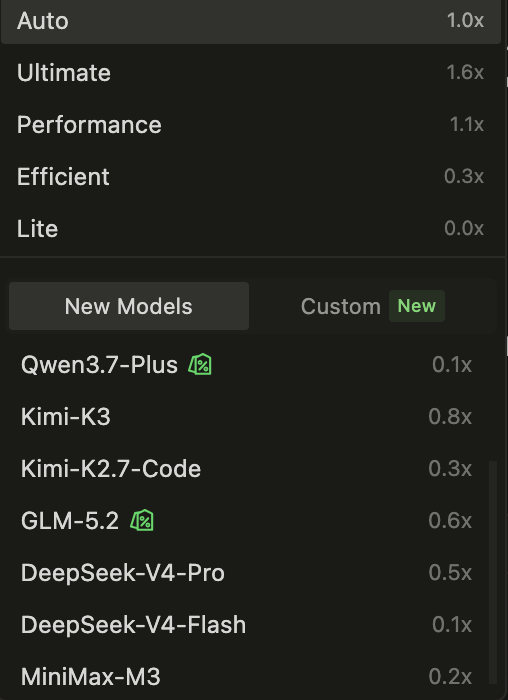
Qoder explicitly provides different model tiers.
For example, its current documentation lists approximate credit multipliers such as:
Ultimate: ~1.6×
Performance: ~1.1×
Auto: ~1.0×
Efficient: ~0.3×
Lite: free in supported contexts
Actual consumption varies according to the task and model.
That means you could theoretically reserve expensive reasoning for:
Design the architecture for my property marketplace.
and use a cheaper model for:
Change the button from blue to black.
That's a sensible approach when you're trying to stretch a ₦30,000/month AI budget.
4. Context Window
Context window matters enormously when you're building a real application.
Imagine you have:
100 React components
API routes
database schemas
authentication
Tailwind styles
configuration files
documentation
The more of that context an AI can effectively work with, the easier it becomes to make changes without repeatedly explaining your project.
Qoder currently exposes context options of:
200K → 400K → 1M tokens
for supported models.
That is particularly useful for larger projects.
Anthropic has also pushed aggressively into long-context coding. Sonnet 4.6, for example, introduced a 1M-token context window in beta, alongside context compaction capabilities.
With Codex, the practical context available depends on the model and task; OpenAI's usage documentation emphasizes that larger codebases and longer sessions consume more agentic usage.
Winner for advertised flexibility:
Qoder + Claude
But don't choose an IDE purely because it advertises a huge context window. The model's ability to actually use that context effectively matters just as much.
Which Is Best for Frontend Design?
This is where things get interesting for vibe coding.
Suppose you tell an AI:
Build a modern African fintech landing page using Next.js, TypeScript and Tailwind. Make it feel premium, use animations, responsive cards and a dark theme.
You don't just need code. You need design judgment.
Spacing.
Typography.
Responsive behaviour.
Component structure.
Animations.
Mobile UX.
And the ability to look at the result and iterate.
Claude Code
Claude has developed a strong reputation among developers for complex coding and frontend implementation.
Its newer models have specifically emphasized coding, agentic behavior and tool use.
Excellent choice for developers who care about code quality and detailed implementation.
Codex
Codex is particularly attractive if you're already inside the OpenAI ecosystem.
It can navigate repositories, edit files, execute commands and work through coding tasks. OpenAI also supports Codex across terminal, IDE and dedicated app workflows.
Very good for turning specifications into working applications.
Qoder
Qoder combines AI coding assistance with agentic workflows such as Quest, where developers can delegate longer multi-step tasks.
It also provides tools for searching the codebase, editing files, executing commands and working with web content.
Very attractive for entrepreneurs who want to describe a product and let an agent work through the implementation.
6. Which Is Best for Vibe Coding?
For someone who says:
I have an idea. I want an MVP.
I'd rank them differently.
Qoder
Because you can experiment with multiple models and have a relatively accessible trial.
Claude Code
Excellent if you already know what you're building and want a highly capable coding partner.
Codex
Excellent if you're already deeply invested in ChatGPT/OpenAI and want your coding workflow connected to that ecosystem.
7. What About African Developers With Low-Spec Laptops?
This is an important consideration.
You don't need a powerful RTX GPU to use any of these cloud-based coding agents.
Your laptop primarily needs to handle:
The IDE
Browser
Terminal
Node.js
Git
Local development server
The heavy AI computation happens remotely.
So someone with a relatively modest 8GB RAM laptop can still build a serious Next.js application with these tools.
However, if you're running local AI models simultaneously, that's a completely different situation.
8. Which Is Cheapest for a Nigerian Student or Founder?
Let's use a simple example.
Assume:
$20 ≈ ₦32,000
You have a monthly AI budget of:
₦35,000
You could choose:
Qoder Pro → about ₦32,000
or
ChatGPT Plus/Codex → about ₦32,000
Claude's $20-level subscription is similarly around that range, although your actual Claude Code usage depends on the plan and limits.
The interesting difference is what happens after you've used your included allowance.
Qoder gives you a clearly defined 2,000-credit Pro allocation and lets you buy additional credits.
Codex uses a token-based credit/rate system and allows eligible Plus/Pro users to add credits after reaching included usage.
9. Qoder's Secret Weapon: Bring Your Own Model
This is probably the biggest reason I'd recommend experimenting with Qoder.
Suppose you already have an API subscription or key for another provider.
Instead of being locked completely into Qoder's default model selection, its documentation supports custom model/BYOK configurations.
That opens up an interesting workflow:
Expensive model
→ architecture
Strong coding model
→ feature implementation
Cheap model
→ simple edits
Open-weight model
→ experimentation
For developers trying to control costs, this flexibility can be extremely valuable.
10. What I'd Choose for Different African Users
Student learning web development:
Qoder
The free trial gives you an opportunity to experiment before paying.
Startup founder building an MVP:
Qoder
Particularly if your priority is:
I have an idea and I want to get something working quickly.
Professional developer
Claude Code
Especially if you already understand software architecture and want an AI agent capable of handling complex coding tasks.
OpenAI/ChatGPT power user:
Codex
If you already pay for ChatGPT Plus and live inside the OpenAI ecosystem, Codex is a natural extension of that workflow.
Don't Let AI Build Your Business Without Understanding the Code
This is particularly important with vibe coding. AI can produce a beautiful website that looks finished but isn't production-ready.
Before launching, check:
Authentication
Database security
API keys
Environment variables
Supabase RLS
Input validation
Payment security
Error handling
SEO
Accessibility
Mobile responsiveness
Performance
Dependency vulnerabilities
Backup strategy
An AI agent can help you implement these things. But you are still responsible for verifying them.
Final Verdict
For African developers and entrepreneurs, the competition isn't simply about which AI writes the best code.
It's about:
Capability + price + model choice + context + computer requirements + flexibility.
And that's why Qoder is particularly interesting for the African market.
Its $20 Pro plan, 2,000 monthly credits, 14-day trial and ability to work with multiple model providers give budget-conscious developers considerably more flexibility.
Claude Code remains an excellent choice for developers who prioritize sophisticated coding and agentic workflows.
Codex is particularly compelling if you're already inside the ChatGPT ecosystem and want an agent that can work directly with your repositories and development environment.
If I had ₦35,000 to spend on AI development every month:
Beginner/Founder → Qoder
Experienced developer → Claude Code
Existing ChatGPT Plus user → Try Codex first
And if you're serious about building products, learn how to use all three rather than becoming dependent on one.
Advertisement
Responsive
Related Articles
iCloud Storage vs iPhone Storage: Why Paying for iCloud Doesn't Automatically Free Your Phone
Confused about iCloud and iPhone storage? Learn the difference, why buying iCloud doesn't automatically free your iPhone, and how to use Optimize iPhone Storage correctly.
Samsung Galaxy Watch Ultra 2 vs Galaxy Watch 9: Price & Comparison Nigeria 2026
JBL Live 770NC vs JBL Tune 780NC: Which JBL Headphones Should You Buy in Nigeria?
JBL Live 770NC vs JBL Tune 780NC — compare price, sound, ANC, battery life, Bluetooth, comfort and features to find the better JBL headphones for your budget in Nigeria.
AirPods vs Wireless Earbuds in 2026: Which One Should You Buy in Nigeria?
Thinking of buying AirPods or another wireless earbud? Compare Apple AirPods with Samsung Galaxy Buds, Nothing Ear, Redmi Buds and more. Find out which offers the best value for Nigerians in 2026.

Download Firefox 153.0.4
Firefox is a fast, secure, and privacy-focused browser with tracking protection, cross-device sync, and a highly customizable interface.
Redmi Note 15 Pro vs Redmi Note 17 Pro: Price & Specs in Nigeria 2026
Xiaomi Redmi Note 15 Pro vs Redmi Note 17 Pro — compare display, performance, cameras, battery, charging, durability and Nigerian prices to find the better Redmi phone for your money.
iPhone 17 Pro Max vs iPhone 18 Pro Max: Price & Specs Comparison in Nigeria
iPhone 17 Pro Max vs iPhone 18 Pro Max: compare price, display, cameras, battery, performance and features to see whether Nigerians should buy the 17 Pro Max or wait for the iPhone 18 Pro Max.
Advertisement
728x90
Comments (0)
Leave a comment
Comments cannot be edited or deleted after posting. Please review your comment before submitting.
No comments yet. Be the first to share your thoughts!