

Best Portable Power Banks for Laptop Charging in Nigeria (2026 Buyer's Guide)
Looking for a portable power bank that can charge your laptop and phone? Here are the best laptop-compatible power banks in Nigeria with current prices, features, and buying tips.
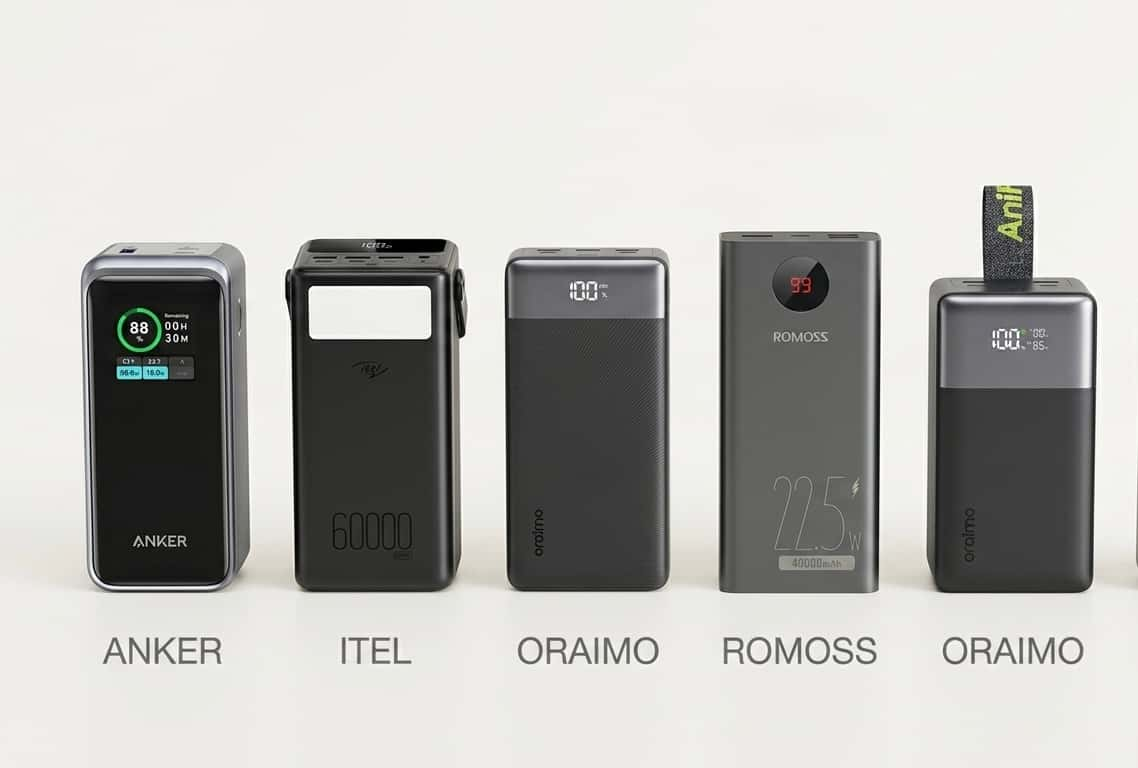
A laptop power bank makes considerably more sense in Nigeria than it does in many markets.
Electricity can disappear halfway through an online meeting, coding session, assignment or client project. An inverter or power station solves that problem at home, but neither is particularly convenient when you're working from a café, university, coworking space or travelling.
That's where high-output USB-C power banks come in. But after researching the current options, there's something buyers need to understand:
20,000mAh doesn't automatically mean a power bank can charge your laptop
The important specifications are capacity, USB-C Power Delivery, maximum output and whether your particular laptop accepts charging through USB-C. Here are the models we'd currently consider in Nigeria.
Our Top Picks
Power Bank | Capacity | Max Laptop Output | Current Price* | Best For |
|---|---|---|---|---|
Oraimo PowerJet 130 | 27,600mAh | 100W USB-C | ₦90k–₦97k | Best Overall |
Oraimo PowerJet 501 | 50,000mAh | Up to 85W | ₦65k–₦78k | Best Value |
Romoss PEA40 Pro | 40,000mAh | 65W USB-C PD | ₦65k–₦90k | Long Outages |
itel PowerPulse Turbo A1990 | 60,000mAh | 65W USB-C | ₦69k–₦75k | Maximum Capacity |
Anker Prime 20K | 20,000mAh | Up to 100W/port | ₦220k–₦250k | Premium/Portable |
Prices are based on Nigerian listings checked at publication time and can change with promotions, sellers and exchange rates.
Before Buying: Check Your Laptop Charger
Don't start with the power bank. Start with your laptop. Look at the wattage printed on its original charger.
A thin productivity laptop might use 30W, 45W or 65W. More powerful machines may require 90W, 100W, 140W or substantially more.
A 65W power bank can be excellent for something like a MacBook Air, ThinkPad, EliteBook or Latitude that supports compatible USB-C charging. Connect the same power bank to a high-performance gaming laptop expecting 180W or 230W and the situation changes completely.
The laptop may charge slowly, charge only while sleeping, drain its battery more slowly instead of gaining charge, or refuse USB-C charging altogether.
So before paying, confirm:
Your laptop supports USB-C charging
The required charging wattage
The power bank's single-port USB-C output
Your USB-C cable supports the required wattage
Total advertised output isn't necessarily what one laptop receives.
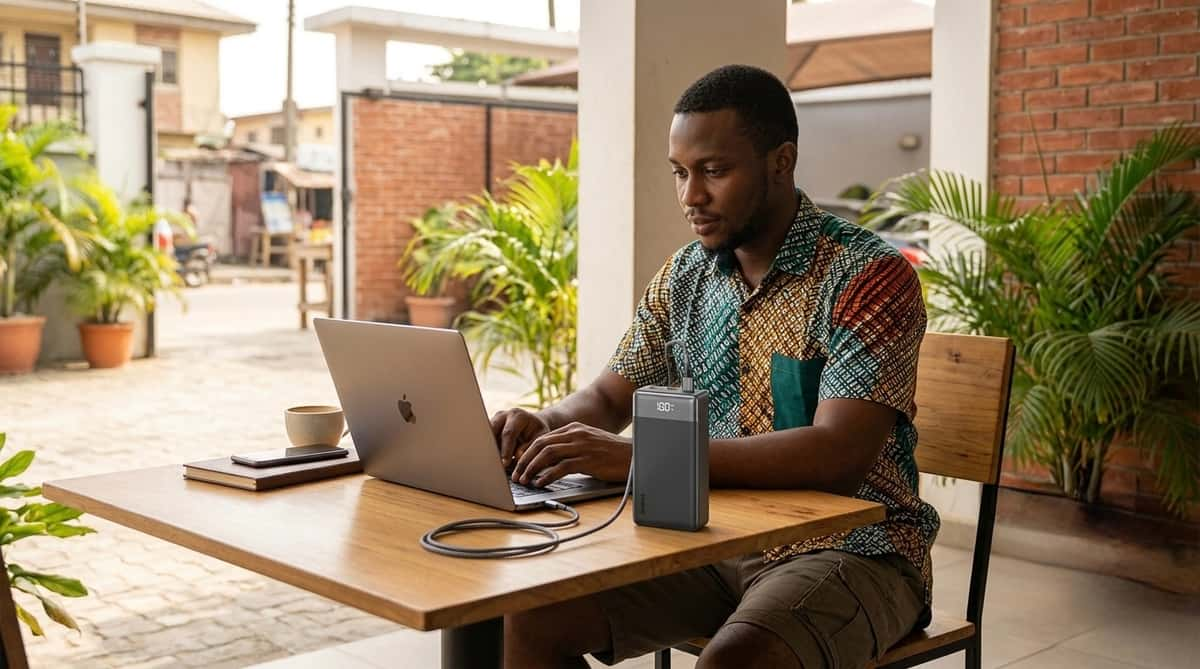
1. Oraimo PowerJet 130 — Best Overall
Current Price: ₦90,000–₦97,000
The PowerJet 130 is the most balanced option we've found for someone who actually intends to carry a power bank with a laptop.
It has a 27,600mAh/99.3Wh battery, with USB-C1 delivering up to 100W and USB-C2 up to 30W. Oraimo rates combined USB-C1 + USB-C2 output at 130W.
That distinction is important. The “130W” in the name doesn't mean your laptop receives 130W through one port.
Your primary laptop port tops out at 100W. That is still enough for a broad range of MacBooks and USB-C Windows laptops.
Oraimo also supports PD 3.0, PPS, QC 3.0 and several other charging protocols and includes a 100W USB-C cable. The power bank itself can recharge at up to 100W, although the required 100W wall charger isn't included.
Why we'd choose it
100W laptop output
27,600mAh capacity
Three-device charging
Digital power display
100W USB-C cable included
99.3Wh energy rating
That last specification makes it particularly interesting for travellers.
Best for:
Developers, business users, remote workers and creators who want enough output for a serious laptop without carrying a 50,000–60,000mAh brick.
Our pick: Best overall.
2. Oraimo PowerJet 501 — Best Capacity for the Money
Current Price: ₦65,500–₦78,000
The PowerJet 501 takes a different approach. Instead of prioritising portability, it gives you a huge 50,000mAh capacity with up to 85W fast charging.
Oraimo's Nigerian store currently lists it at around ₦65,500, although marketplace prices can be higher. That's considerably more stored energy than the PowerJet 130 for less money.
The trade-off is obvious: it's much bigger.
This is the model we'd look at for someone whose problem isn't merely getting through another hour of work. It's for someone dealing with a prolonged blackout.
Best for:
Working from home
Students
Programmers
Small offices
Long electricity outages
Laptop + phone charging
If portability matters more than maximum capacity, we'd still take the PowerJet 130. If runtime-per-naira matters more, the 501 becomes extremely attractive.
Our pick: Best value.
3. Romoss PEA40 Pro — Best for Long Outages
Current Price: ₦65,000–₦90,000
The Romoss PEA40 Pro combines a 40,000mAh battery with 65W USB-C PD charging.
Current Nigerian listings vary considerably: we found it around ₦64,600 at the lower end and roughly ₦89,500 from another seller. That price variation is exactly why we'd shop around before buying.
At around ₦65,000, it's compelling. At nearly ₦90,000, we'd start comparing it directly against the 100W PowerJet 130. The PEA40 Pro also has a digital display showing useful charging information and supports simultaneous charging of multiple devices.
Where 40,000mAh makes sense. Imagine NEPA takes power at 10 a.m. and you're working until late afternoon. A 20,000mAh unit may extend your session substantially, but 40,000mAh gives considerably more breathing room.
The compromise is weight. High-capacity power banks aren't pocket accessories.
Our pick: Best balance for extended outages.
4. itel PowerPulse Turbo A1990 — Best Maximum-Capacity Pick
Current Price: ₦69,000–₦75,000
This one is built for a very Nigerian problem:
There's no light and we don't know when it's coming back
The PowerPulse Turbo A1990 packs an enormous 60,000mAh capacity and supports up to 65W USB-C input/output. It has multiple USB and USB-C ports, a digital display and even an LED torch. Current Nigerian listings put it around ₦69,000–₦75,000.
That's remarkable capacity for the price. But we'd buy it for runtime, not portability. A 60,000mAh battery makes much more sense sitting beside your laptop during an outage than travelling around in your backpack every day.
It can also charge several devices, making it useful for a household where one backup battery may need to keep a laptop and multiple phones alive.
Best for:
Students, remote workers, small-business owners and households dealing with prolonged electricity outages.
Our pick: Maximum backup for the money.
5. Anker Prime 20,000mAh 200W — Best Premium Portable Option
Current Nigerian Price: ₦220,000–₦250,000
Anker takes almost the opposite approach to itel. Instead of maximum capacity for the lowest possible price, the Prime 20K concentrates high charging power into a much smaller battery.
The older Prime model commonly sold in Nigeria is marketed as a 20,000mAh/200W power bank with two USB-C ports and one USB-A port. Current Nigerian listings we found sit around ₦220,000–₦250,000.
So the previous ₦140,000–₦180,000 estimate is no longer realistic for the listings we checked.
And there's another wrinkle. Anker now has a newer Prime 20K rated for 220W total output, with up to 140W from a compatible USB-C connection.
Check exactly which generation you're buying. At Nigerian prices, Anker isn't our value recommendation. You're paying heavily for high power density, portability, build quality and the premium charging platform.
Best for:
Frequent travellers and professionals who care more about carrying a smaller high-output battery than getting maximum capacity per naira.
Our pick: Premium portable choice.
How Much Extra Laptop Runtime Should You Expect?
This is where advertised mAh figures can become misleading. You can't simply divide 20,000mAh by your laptop's battery capacity. Power banks lose energy through voltage conversion, heat, cables and charging circuitry.
Laptop workload matters too. A developer compiling software, creator exporting 4K video or gamer running a dedicated GPU consumes much more power than someone typing into Google Docs.
So we'd treat manufacturer “number of charges” figures as estimates rather than guarantees. A good 20,000–27,600mAh unit can provide a meaningful extension for an efficient ultrabook. A 40,000–60,000mAh model makes more sense when your goal is surviving several hours of unreliable electricity.
A Big Warning for Air Travel
Capacity matters for another reason. Bigger isn't always better if you fly frequently.
IATA says power banks must be carried in hand luggage rather than checked baggage, and batteries between 100Wh and 160Wh require airline approval.
That's one reason the PowerJet 130's specification is interesting: 27,600mAh / 99.3Wh.
It sits just below the 100Wh threshold.
By comparison, extremely large 40,000mAh, 50,000mAh and 60,000mAh batteries can cross important airline battery limits depending on their rated voltage/Wh specification.
If you plan to fly with one, check the Wh rating printed on the actual product and your airline's rules before travelling.
Don't assume a large power bank will be accepted simply because it fits inside your bag.
Which One Should You Buy?
For most laptop users, we'd start with the Oraimo PowerJet 130. Its combination of 100W USB-C output, 27,600mAh capacity and relatively manageable size makes more sense as an actual portable laptop power bank.
For home backup during longer Nigerian power outages, the calculation changes.
The PowerJet 501, Romoss PEA40 Pro and itel PowerPulse Turbo sacrifice portability for much larger batteries.
The itel is particularly attractive if maximum capacity per naira is your priority. The Anker Prime is the opposite: much less capacity than the itel, but high output in a smaller package.
Frequently Asked Questions
Can a normal power bank charge a laptop?
Only if it provides a charging standard and output your laptop supports. For modern laptops, that commonly means USB-C Power Delivery.
Is 65W enough for laptop charging?
For many mainstream ultrabooks and business laptops, yes. But don't treat 65W as universal. Check the wattage of your laptop's charger and its USB-C charging specifications.
Can I charge a gaming laptop with a power bank?
Sometimes, but this requires more caution. Many gaming laptops require considerably more power than mainstream USB-C power banks provide. Even when USB-C charging is supported, you may not receive enough power for unrestricted gaming performance.
Should I buy 20,000mAh or 50,000mAh?
Choose based on use. For daily carrying and travelling, we'd favour roughly 20,000–27,600mAh. For prolonged outages at home, 40,000–60,000mAh provides substantially more stored energy, at the expense of size, weight and potentially more restrictive airline rules.
Final Thoughts
After comparing the current options, we'd divide laptop power banks into two categories. Portable backup and blackout backup.
For portable backup, the Oraimo PowerJet 130 makes the strongest case. It delivers up to 100W to a laptop, stores 27,600mAh/99.3Wh and can simultaneously power additional devices.
For long outages, we'd sacrifice portability and look at the PowerJet 501, Romoss PEA40 Pro or 60,000mAh itel PowerPulse Turbo. And if compactness and high output matter much more than price, the Anker Prime remains the premium option—but at roughly ₦220,000–₦250,000 in the Nigerian listings we checked, you're paying a substantial premium.
Most importantly, don't buy based on mAh alone. Check your laptop's charging requirements first.
Then choose the smallest power bank that provides enough USB-C PD wattage and usable capacity for the amount of time you realistically need to stay working when electricity disappears.
Read more: Best Budget 10,000mAh Power Banks to Buy: Oraimo, itel and Infinix Compared
Read more: itel PowerPulse Turbo 60 Review: Is This ₦80,000 Power Bank Worth It for Laptop and Phone Users in Nigeria?
Read more: Anker Packs 150W Into a New 6-in-1 Travel Charging Station: Review and Buying Guide
Read more: Best Affordable itel Solar Generators in Nigeria: 3 Portable Options for Students and Remote Workers

Author
Nkechi OkaforMobile device specialist focused on smartphones, tablets, and wearables for the African market. Explore author & articles





