Can Solo Founders Raise Venture Capital? What Investors Want Before Writing a Cheque
Solo founders are building more startups than ever, but raising VC remains difficult. Learn what investors want, how to pitch alone and what African founders should know.
Starting a technology company once meant finding a technical co-founder, recruiting developers and raising enough money to build your first product. Artificial intelligence is changing that equation.
Today, a determined entrepreneur can use AI coding agents to develop an application, automate customer support, create marketing materials and launch a business with far fewer employees. But there is one challenge AI has not eliminated: convincing investors to fund a company whose success depends heavily on one person.
If you can build a startup alone, why do investors still hesitate to fund you alone?
The answer is not necessarily that venture capitalists dislike solo founders. It is that building a product and building an investable company are different challenges.
Solo founders are increasing, but funding hasn't caught up
According to Carta's 2026 Founder Ownership Report, approximately 36% of startups founded on its platform in 2025 had one founder, compared with 31% in 2024. The proportion has more than doubled over the past decade.
Stripe Atlas reported an even higher figure: 63% of US C corporations formed through its service so far in the second quarter of 2026 were established by solo founders. However, these datasets describe different groups of companies and should not be treated as worldwide startup statistics.
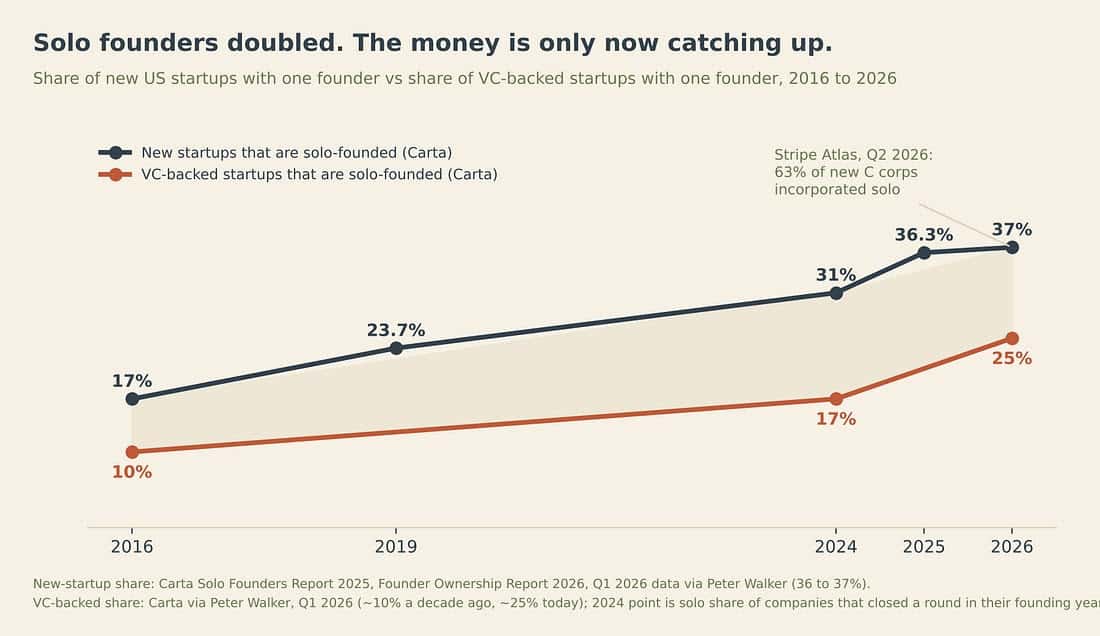
The funding gap remains significant. Carta's earlier research found that solo founders represented 35% of companies incorporated in 2024 but only 17% of that same founding cohort that secured venture funding before year-end. This does not prove that investors rejected every unsuccessful solo founder because of team size. Some companies never sought funding. Nevertheless, the difference suggests that starting alone is becoming more common faster than venture financing is adapting.
Why investors worry about a one-person company
An investor evaluating a solo founder is not simply asking whether that individual can write code or build an attractive application. They are evaluating the risks surrounding the business. Who manages customers when the founder is unavailable? Who handles technical failures? Can the company recruit experienced employees? What happens when product development, sales and fundraising all demand attention simultaneously?
These questions become more important as a company grows. A solo founder may be an excellent engineer but struggle with enterprise sales. Another may understand customers exceptionally well but lack experience managing infrastructure or financial controls. AI can assist with some of these responsibilities, but it does not automatically provide accountability, judgment or organizational resilience. The strongest response is not to pretend those limitations do not exist. It is to demonstrate how the company manages them.
The wrong way to explain why you're building alone
Imagine an investor asks why you don't have a co-founder.
A weak answer would be: I don't need anyone. AI can do everything, and I prefer making all the decisions myself.
That statement may raise concerns about leadership, collaboration and the founder's understanding of business complexity.
A stronger answer would be:
I started independently because I could validate the problem and build the first product efficiently. I've since established relationships with technical advisers, contractors and prospective hires. The funding will help expand the areas where the business needs dedicated expertise.
The difference is substantial. One response suggests isolation. The other demonstrates independence supported by a credible plan for growth.
What evidence can replace the confidence of having co-founders?
For solo founders, measurable progress can be more persuasive than an impressive pitch deck. Investors want evidence that customers need the product, that the business can acquire users efficiently and that its operations can expand.
Start with paying customers rather than downloads alone. Show retention, revenue growth, customer feedback and the costs involved in delivering the service.
If you operate a subscription business, explain recurring revenue and cancellations. If you run a marketplace, demonstrate completed transactions and repeat usage. If you build enterprise software, show pilot results and evidence that customers are willing to renew or expand contracts.
Stripe's analysis of solo-founded businesses found that top-performing companies tended to have stronger customer retention, broader international sales and a greater concentration in business-to-business markets. These are associations within Stripe's dataset, not guaranteed formulas for success.
For practical customer-acquisition strategies, read our guide on how to get your first 50 customers as an early-stage startup in Africa.
Who should a solo founder approach for funding?
Not every investor is appropriate for every business. For an early-stage founder with a working prototype and limited revenue, a large institutional venture fund may be a poor starting point.
Angel investors, relevant accelerators, strategic partners and smaller pre-seed funds may be more suitable. But selection should depend on investment criteria, not assumptions that every angel welcomes solo founders or every venture fund rejects them.
Research each investor's portfolio, typical cheque size, preferred sector, geography and stage. Then approach those whose investment history matches your company.
A founder building healthcare software should prioritize investors who understand healthcare delivery, regulation and enterprise procurement rather than sending identical pitches to hundreds of unrelated funds.
How much should you raise?
A funding target should come from a business plan, not from the amount a competitor recently announced. Suppose your company needs $8,000 monthly to operate and reach its next meaningful milestone within 18 months. That implies $144,000 in planned operating expenditure before contingency costs and any expected revenue offsets.
You might therefore seek a round sufficient to fund those milestones, with a justified buffer. Explain precisely how the money will be spent and what investors should expect the company to achieve. Raising more than necessary can introduce avoidable dilution and pressure. Raising too little can leave the company unable to reach its next milestone.
Does being solo mean accepting a lower valuation?
Not automatically. Valuation depends on traction, growth expectations, market conditions, investor competition and negotiating leverage. The source material accompanying this article argues that successful solo founders can receive comparable priced-round terms to multi-founder companies. However, that should not be interpreted as a universal guarantee that solo founders face no valuation disadvantage.
Carta's published research confirms that founder ownership and fundraising outcomes vary considerably across company types and financing stages. The practical lesson is to avoid negotiating against yourself simply because you lack a co-founder.
Present your company's commercial evidence and evaluate any investment offer on its actual terms.
What African solo founders should do differently
For entrepreneurs in Nigeria, Kenya, Ghana, South Africa and other African markets, fundraising introduces additional considerations. Investors may ask how the company handles local payment infrastructure, currency volatility, electricity reliability, regulatory requirements and expansion across different national markets.
A solo founder building a logistics platform in Nairobi, for example, needs more than an application that tracks deliveries. They must understand dispatch operations, transport costs, failed deliveries and customer support.
Similarly, a fintech founder must demonstrate an appropriate compliance strategy rather than assuming AI-generated code makes a financial product ready for deployment. Africa also has a funding-concentration challenge. Strong headline fundraising figures do not necessarily mean small companies can obtain capital easily. We explored that distinction in African Startups Have Raised $2 Billion in 2026 — But Where Is the Money Actually Going?.
African solo founders should consider revenue-funded growth, customer-financed pilots, grants, local angel networks and accelerators alongside traditional venture capital. Organizations such as MEST Africa, Founder Institute and VC4A provide different forms of entrepreneurial support and investor access, subject to their current programme requirements.
The objective should not be raising money at any cost. It should be finding financing that supports the business model without creating obligations the company cannot sustain.
A practical checklist before pitching investors
Before approaching investors, make sure you can answer these questions convincingly:
Can you demonstrate a real customer problem and evidence that people will pay to solve it?
Do you have measurable traction, financial records and a credible growth plan?
Can you explain how critical operations continue when you're unavailable?
Have you identified the advisers, contractors or employees needed to address your weaknesses?
Can you justify the amount you're raising and the milestones it will finance?
Have you researched investors who actually fund companies at your stage?
If several answers remain unclear, improving the business may be more valuable than immediately starting a fundraising campaign.
The future of solo entrepreneurship is not about doing everything alone
AI is lowering the cost of building software and experimenting with business ideas. That could allow more entrepreneurs to test products before raising substantial capital. But investors are not simply funding the ability to produce code. They are funding businesses capable of creating durable value.
A solo founder who understands customers, generates revenue, manages risk and knows when to recruit help may be more compelling than a larger founding team without those qualities. Equally, a talented individual who insists on controlling every function indefinitely may eventually become the company's biggest limitation.
The advantage of being a solo founder is that you can start without waiting for someone else. The challenge is proving that the company can grow beyond you. That is the question investors ultimately need answered.
Read more: How Founders and Students Can Build Businesses With Coding Agents
Read more: Your Competitor Just Raised Millions, What Should an African Startup Founder Do Next?
Read more: How to Build an App With AI: A Complete Guide for Beginners

Author
Azeez LiadiAzeez is an AI Engineer, Data Scientist, founder, and Senior Tech Writer at Afritech Connect. A top 1% graduate of Lagos State University, he has worked with international startups and… Explore author & articles