

How Founders and Students Can Build Businesses With Coding Agents
Coding agents are changing how software is built. Here is how African founders, students and entrepreneurs can use them to launch businesses faster and with fewer resources.

The next major technology company may not begin with a large engineering department, an expensive office or millions of dollars in funding. It may begin with one founder, a laptop and an AI coding agent. OpenAI CEO Sam Altman has previously predicted that the first one-person billion-dollar company could emerge because of artificial intelligence. In a conversation with Reddit co-founder Alexis Ohanian, Altman described a private betting pool among technology executives about when a single individual would build a billion-dollar business, something he said would have been unimaginable without AI.
The prediction does not mean that AI can replace every founder, engineer or employee. It means the economics of building software are changing. A person who previously needed to hire developers, designers, researchers, testers and operations staff may now be able to coordinate many of those tasks through coding agents. For African entrepreneurs operating with limited capital, unreliable infrastructure and small teams, that shift could be especially important.
Coding agents are more than chatbots
A traditional chatbot responds to questions. A coding agent can work through a larger task. It can inspect a codebase, create files, modify existing code, run commands, test features, identify errors and suggest or implement fixes. Tools such as OpenAI Codex, Qoder, Devin, Anthropic Claude Code and Cursor are part of this broader shift toward agent-assisted software development. The important difference is that the founder is no longer asking only:
Write this function.
The founder can instead ask:
Build a working appointment-booking platform for small clinics, including user registration, booking, payment status, an admin dashboard and automated tests.
The agent may handle much of the implementation, while the human remains responsible for deciding what should be built, checking whether it works and understanding the business problem. That is the real opportunity.
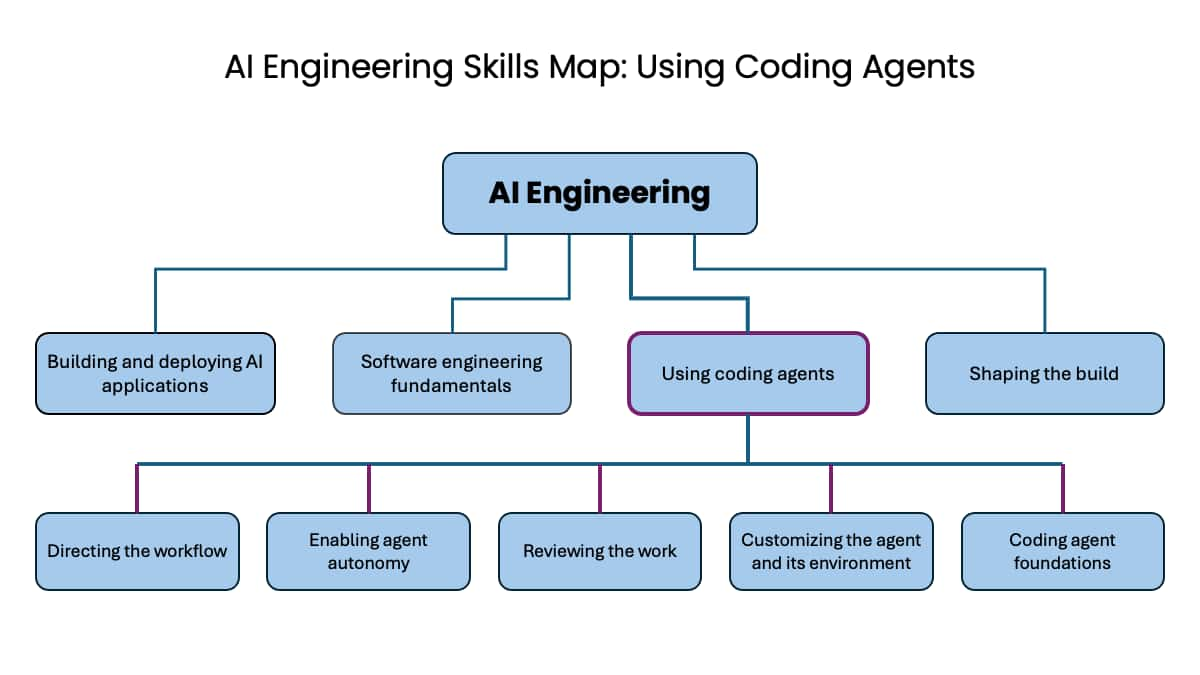
The founder’s job is moving from coding to directing
A recent AI engineering guide from DeepLearning.AI describes coding-agent work as a workflow involving planning, execution, verification, deployment and monitoring. It argues that developers increasingly spend less time writing code manually and more time deciding what to build, designing systems and checking the output. This does not make technical knowledge irrelevant. In fact, the most effective users still need to understand architecture, security, databases, APIs, testing and deployment. They simply use AI to carry out more of the implementation. The same guide identifies several essential skills: directing the workflow, enabling the right level of agent autonomy, reviewing the work, customising the agent’s environment and understanding how coding agents operate.
For a founder, this means the competitive advantage is becoming a combination of:
Understanding a real customer problem
Giving clear instructions
Making good product decisions
Testing the result
Finding customers
Improving the business continuously
The person who asks the best business questions may outperform the person who writes the most code.
What African founders can build
The biggest opportunity is not necessarily creating another general-purpose AI chatbot. It is building focused software for problems that are poorly served.
1. Tools for small businesses
Many African businesses still manage operations through WhatsApp messages, spreadsheets, notebooks and phone calls. A founder could use a coding agent to build software for:
Inventory management
School fee collection
Appointment scheduling
Restaurant ordering
Property management
Customer relationship management
Vehicle maintenance
Staff attendance
Invoice generation
Local delivery coordination
The product does not need to serve millions of users on its first day. It only needs to solve one painful problem for a specific group of customers. A student who understands how pharmacies operate, for example, may be better positioned to build pharmacy-management software than someone who only knows how to write generic code.
2. Local-language and African-market applications
Large technology companies often build products for global markets first. That leaves opportunities for entrepreneurs who understand local languages, regulations, payment methods and cultural behaviour.
Possible businesses include:
Customer-support tools for African languages
Voice interfaces for low-literacy users
AI assistants for local merchants
Agricultural advisory platforms
Legal-document tools adapted to specific jurisdictions
Educational applications for national curricula
Health-information systems for clinics
Financial tools designed around local payment systems
Coding agents can reduce the cost of building the first version of these products. But the real advantage comes from local knowledge. An agent can generate software. It cannot automatically understand the daily realities of a trader in Lagos, a farmer in Kano, a student in Accra or a clinic administrator in Nairobi.
3. Service businesses powered by software
Entrepreneurs do not have to launch a software startup immediately. A more practical route may be to use coding agents to improve an existing service business. For example, a small digital agency could use agents to deliver:
Business websites
E-commerce stores
Booking systems
Internal dashboards
Data-cleaning tools
Automated reports
Customer-support systems
Website maintenance
Workflow automation
The agency can then turn repeated work into a reusable product. This is important because many successful software businesses begin by solving a problem manually for customers before turning the solution into a platform.
Students can use coding agents to move beyond tutorials
For students, coding agents create an opportunity to build real projects instead of spending years only completing tutorials.
A student studying accounting could build a small financial-management application.
A medical student could create a research-data dashboard.
An engineering student could develop a maintenance-tracking tool.
A business student could build a market-research or customer-survey platform.
The objective should not be to submit an impressive-looking project generated entirely by AI. It should be to understand the problem, inspect the code, test the system and explain why the product works. Students who learn to direct coding agents while developing foundational technical knowledge may become more capable builders than students who only memorise programming syntax.
Sam Altman has also argued that students should become highly capable with AI tools as the workplace changes, comparing the importance of learning AI tools with the importance his generation placed on learning to code.
Start with a narrow problem, not a huge platform
One of the biggest mistakes new founders make is asking an AI agent to build an enormous application immediately. A better process is:
Identify one customer group.
Find one expensive or frustrating problem.
Interview potential users.
Define the smallest useful product.
Ask the coding agent to create a clear technical plan.
Build one feature at a time.
Test every important workflow.
Give the product to real users.
Improve it based on feedback.
Charge for the solution as early as possible.
A simple product that solves a real problem is more valuable than a sophisticated application nobody uses.
Human oversight remains essential
Coding agents can make serious mistakes. They may introduce security vulnerabilities, misunderstand requirements, delete files, produce unreliable logic or claim that a feature works when it has not been properly tested.
DeepLearning.AI’s guidance emphasises that agent output is uncertain and must be reviewed through automated tests, human checks and appropriate validation. Founders should therefore avoid giving agents unrestricted access to production databases, customer information, payment systems or sensitive credentials. They should use version control, backups, test environments and clear permissions. The agent can do much of the heavy lifting, but the founder must remain accountable for the result.
The real business advantage is speed of learning
The most important benefit of coding agents may not be that they allow one person to do the work of ten people. It is that they allow a founder to test ideas much faster. A businessperson can move from an idea to a prototype in days rather than months. A student can test several project concepts during one semester. A startup can build a feature, collect customer feedback and change direction without waiting for a large development cycle. This creates a new kind of competitive advantage: the ability to learn faster than competitors. But speed alone is not enough. The market will still reward products that solve real problems, earn trust, protect user data and deliver consistent value.
Africa should focus on builders, not only AI users
The rise of coding agents creates an opportunity for Africa to move beyond consuming imported technology. The continent has many problems that require locally adapted software, from logistics and healthcare to education, agriculture, energy and financial services. If more founders and students learn to combine domain knowledge with AI-assisted development, they can build products specifically for those markets. The next billion-dollar company may indeed be built by one person and a coding agent. But the more important possibility is that thousands of African entrepreneurs will use these tools to create smaller, sustainable businesses that solve practical problems and employ other people. The future will not belong only to those who can write every line of code manually. It will belong to those who can identify valuable problems, direct intelligent tools, verify their work and turn useful software into a business.
Read more: How to Build an App With AI: A Complete Guide for Beginners
Read more: Claude Code vs OpenAI Codex vs Qoder: Which AI Coding Tool Is Best for African Developers in 2026?
Read more: How to Use AI to Improve Productivity at Work Without Creating More Work

Author
Azeez LiadiAzeez is an AI Engineer, Data Scientist, founder, and Senior Tech Writer at Afritech Connect. A top 1% graduate of Lagos State University, he has worked with international startups and… Explore author & articles





