

iPhone Duo vs Samsung Galaxy Z Fold8: Specs, Price and Features
iPhone Duo vs Samsung Galaxy Z Fold8 comparison covering displays, cameras, performance, battery, design, AI, international prices and expected Nigeria prices.

Apple has finally entered the foldable-phone market, and its first attempt goes directly against one of Samsung's most mature smartphone categories.
The iPhone Duo is Apple's first folding iPhone. It combines a compact 5.4-inch outer display with a considerably larger 7.6-inch screen when unfolded, while Apple's A20 Pro processor, iOS 27 and new foldable-specific software turn the inner screen into something closer to a miniature tablet.
Samsung's Galaxy Z Fold8 also uses a 7.6-inch internal display but pairs it with a slightly larger 5.5-inch cover screen. Samsung has managed to make its latest Fold remarkably thin and light, while Snapdragon 8 Elite Gen 5 for Galaxy and Galaxy AI handle the computing side.
The specifications are surprisingly close in some areas, but the philosophies behind these two phones are quite different. And then there's price.
iPhone Duo vs Galaxy Z Fold8: Price and Specifications
Specification | iPhone Duo | Samsung Galaxy Z Fold8 |
|---|---|---|
International Starting Price | $1,999 | $1,899.99 |
Nigeria Price | Est. ₦3.8m–₦4.5m | ₦2.2m–₦2.9m (256GB) |
Outer Display | 5.4-inch Super Retina XDR OLED | 5.5-inch Dynamic AMOLED 2X |
Outer Resolution | 2034 × 1398 | 1972 × 1248 |
Inner Display | 7.6-inch Super Retina XDR OLED | 7.6-inch Dynamic AMOLED 2X |
Inner Resolution | 2670 × 1878 | 2448 × 1848 |
Refresh Rate | Up to 120Hz ProMotion | Up to 120Hz adaptive |
Peak Outdoor Brightness | 3,000 nits | 3,000 nits |
Unfolded Thickness | 5.2mm | 4.5mm |
Folded Thickness | 11.3mm | 9.7mm |
Weight | 254g | 201g |
Frame | Grade 5 titanium | Armor Aluminum |
Processor | Apple A20 Pro | Snapdragon 8 Elite Gen 5 for Galaxy |
RAM | Apple doesn't officially specify | 12GB / 16GB |
Storage | 256GB / 512GB / 1TB / 2TB | 256GB / 512GB / 1TB |
Main Camera | 48MP Fusion Main | 50MP Wide |
Ultra-Wide | 48MP | 50MP |
Cover Selfie Camera | 12MP | 10MP |
Inner Camera | Under-display FaceTime camera | 10MP |
Video | Up to 4K Dolby Vision 60fps | Up to 8K |
Battery | Dual-cell; capacity not officially stated | 4,800mAh |
Advertised Video Playback | Up to 44h outer / 31h inner | Up to 26h |
Fast Charging | 50% in ~20 min | 63% in ~30 min* |
Wireless Charging | MagSafe/Qi2 up to 25W | Wireless charging |
Biometrics | Touch ID | Fingerprint sensor |
Water Resistance | IP68 | Water-resistant foldable design |
Operating System | iOS 27 | Android 17 |
AI | Apple Intelligence + Siri AI | Galaxy AI |
Stylus | Apple Pencil USB-C support coming later | No integrated S Pen support advertised |
Colours | Star White, Night Sky | Graphite, Cream, Lavender, Pistachio |
Release | October 23, 2026 | Available now |
Design: Samsung Has a Huge Weight Advantage
This may be the most surprising difference.
The iPhone Duo weighs 254 grams.
The Galaxy Z Fold8 weighs just 201 grams.
That's a 53g difference, which is substantial for something you'll hold in one hand every day.
Samsung also wins on thickness. The Fold8 measures only 4.5mm when unfolded and 9.7mm when folded, compared with 5.2mm unfolded and 11.3mm folded for iPhone Duo.
So despite Apple using polished Grade 5 titanium for the Duo, Samsung has produced the significantly lighter and thinner device. The iPhone Duo may feel more luxurious, but the Fold8 should be considerably easier to carry.
Design winner: Galaxy Z Fold8
Displays: Apple Has the Resolution Advantage
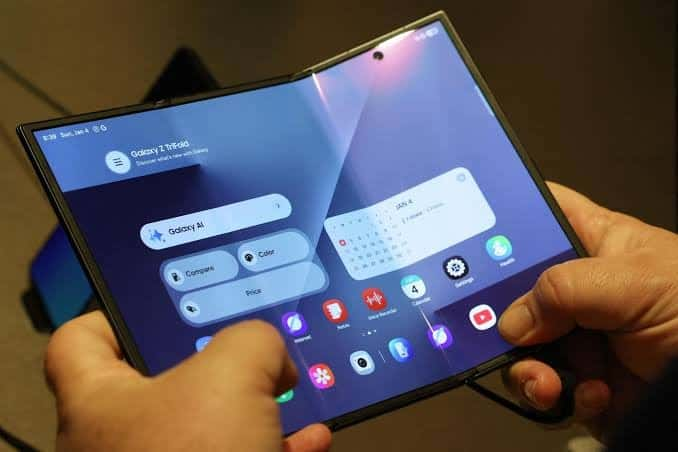
Both phones give you a 7.6-inch inner display, but they're not identical. iPhone Duo's inner screen has a resolution of 2670 × 1878, while Samsung uses 2448 × 1848. Both reach up to 120Hz and 3,000 nits peak outdoor brightness.
Apple also applies a special nano-texture finish to its internal display. The company says this reduces glare and reflections while helping minimize the visibility of the crease. That's potentially important. Display creases have always been one of the compromises of foldable phones. We won't know whether Apple's approach actually makes the crease less noticeable than Samsung's until independent side-by-side testing becomes available.
The outer screens are also close. iPhone Duo has a 5.4-inch 2034 × 1398 display, while Fold8 gives you a slightly larger 5.5-inch 1972 × 1248 screen. Apple therefore wins on pixel density, while Samsung provides slightly more physical screen area.
Display winner on paper: iPhone Duo
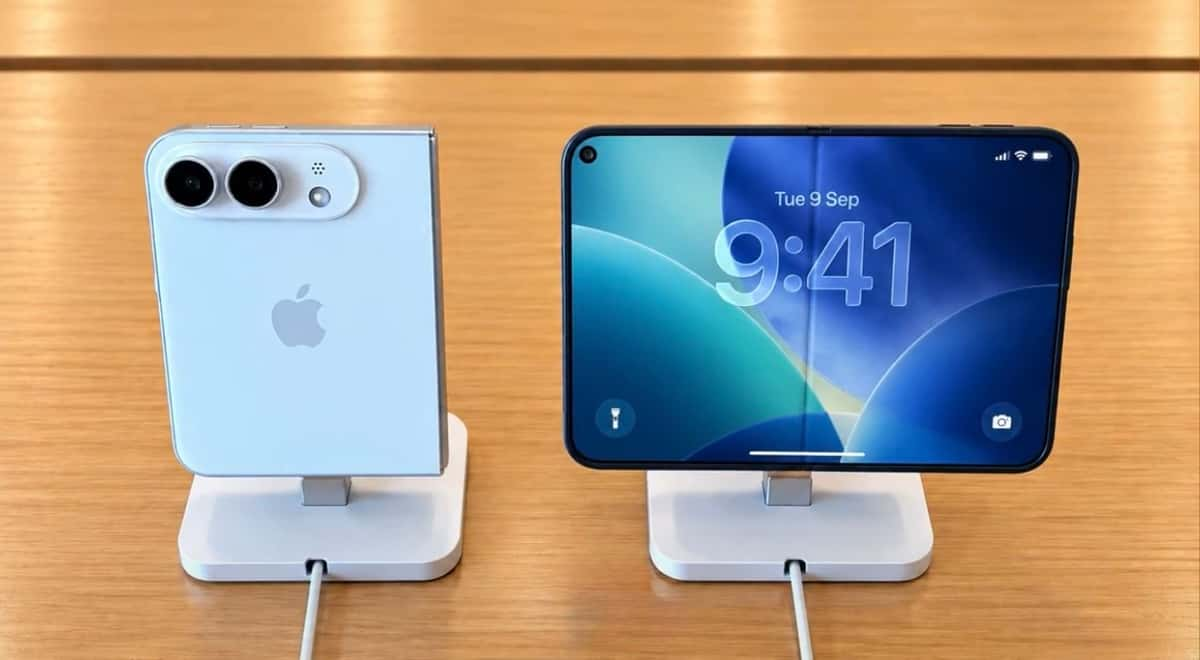
iPhone Duo Has an Unusual Shape
Apple's approach to a folding phone is particularly interesting. Closed, the Duo is intentionally compact. Apple says its 5.4-inch outer display provides around 90% of the screen area of iPhone 18 Pro. Open it and the 7.6-inch screen provides roughly 50% more display area than iPhone 18 Pro Max.
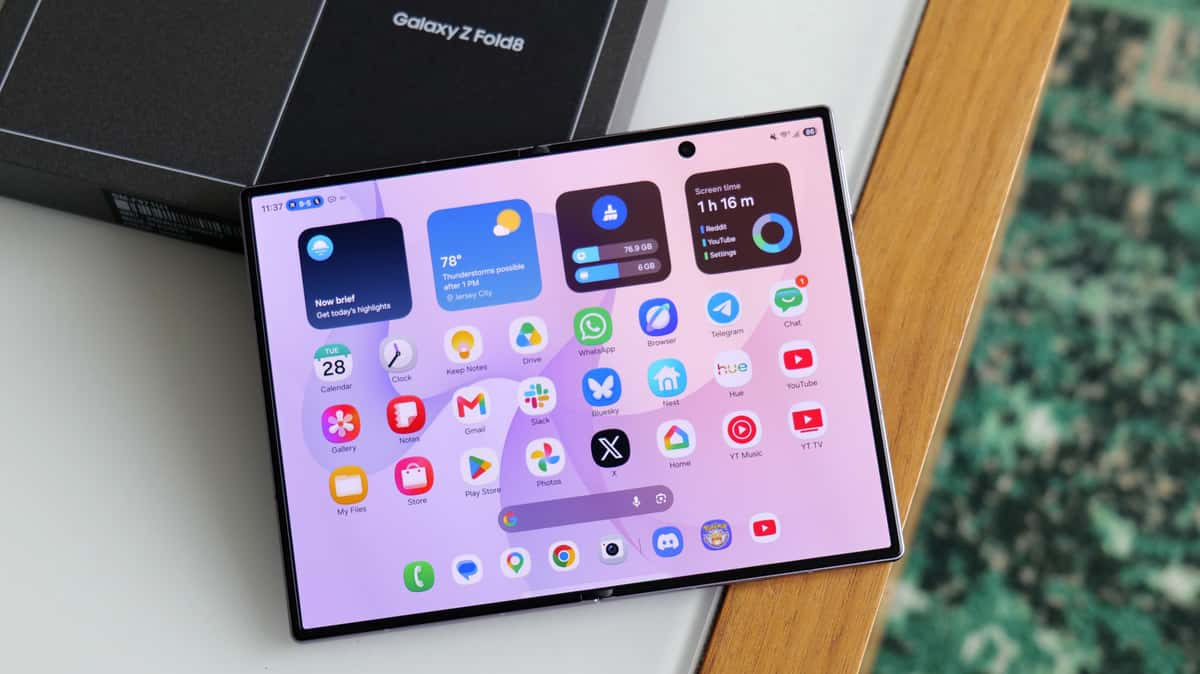
Samsung takes a similar idea but makes the Fold8 slightly wider when unfolded. Its inner display uses an approximately 4:3 aspect ratio, which is particularly useful for documents, dashboards, websites, multitasking and video. Both therefore sit somewhere between a smartphone and compact tablet.
Performance: A20 Pro vs Snapdragon 8 Elite Gen 5
The iPhone Duo uses Apple's new A20 Pro. It's the same chip family used in the iPhone 18 Pro, manufactured using a 2nm process and paired here with a custom vapor chamber. Apple says the A20 Pro includes a six-core CPU, seven-core GPU and dual 16-core Neural Engine. Apple also claims up to 35% better sustained performance than iPhone 17 Pro, although that's Apple's own benchmark comparison rather than a direct comparison with Samsung.
The Galaxy Z Fold8 uses Snapdragon 8 Elite Gen 5 for Galaxy, Qualcomm's flagship platform customized for Samsung.
Samsung pairs it with:
12GB RAM + 256GB
12GB RAM + 512GB
16GB RAM + 1TB
Apple doesn't officially publish an equivalent RAM figure for the Duo.
Performance: Too early to call
Cameras: Surprisingly Similar Hardware
Neither manufacturer has turned its standard foldable into an extreme camera phone. The iPhone Duo has a 48MP Fusion Main camera and 48MP Fusion Ultra Wide. The main sensor also provides an optical-quality 2x telephoto crop, giving users a 4x optical-quality zoom range between the Ultra Wide and 2x view.
Samsung uses:
50MP Wide + 50MP Ultra Wide
with 2x optical-quality zoom from its main sensor. Samsung therefore has a slight megapixel advantage, but megapixels alone don't determine image quality. Apple supports 48MP macro photography, Night mode, Smart HDR 5, Photographic Styles and computational features including Spatial Reframing and Clean Up. Samsung counters with ProVisual Engine, Nightography and Galaxy AI-powered image processing.
Samsung Wins Video Resolution
There's a clearer difference in video. iPhone Duo records up to 4K Dolby Vision at 60fps. Galaxy Z Fold8 can record 8K video, with Samsung's specifications listing playback support up to 8K60 and its camera marketing emphasizing 8K capture.
That gives Samsung the headline resolution advantage. But resolution isn't everything. Apple's Dolby Vision recording, stabilization and computational video processing could still make the Duo extremely competitive for creators. We'll need real camera testing before choosing an overall camera winner.
Inner Cameras Take Opposite Approaches
Samsung gives you a conventional 10MP camera on the inner screen and another 10MP camera on the cover screen. Apple uses a 12MP camera externally but hides its inner FaceTime camera underneath the folding display.
The benefit is obvious: when the Duo is unfolded, there isn't a visible camera hole interrupting the display. The potential trade-off is image quality. Under-display cameras historically have to shoot through the display layer. Apple may have solved much of that problem, but that's something we'll want to test rather than assume.
Battery: Apple Makes an Interesting Claim
Samsung puts a 4,800mAh battery inside the Galaxy Z Fold8 and rates it for up to 26 hours of video playback.
Apple doesn't publish the Duo's battery capacity. Instead, it uses two batteries, one inside each half of the device and quotes: Up to 44 hours video playback using the outer screen and Up to 31 hours using the inner display. Those figures look impressive, but they shouldn't be directly interpreted as proof that Duo lasts 18 hours longer than Fold8 in normal use.
Apple and Samsung conduct battery testing differently. What we can say is that Apple appears to have made battery endurance a major priority despite the folding design.
Charging: iPhone Duo Gets Much Faster
Apple says iPhone Duo can reach 50% charge in around 20 minutes when connected to a 60W-capable or higher adapter. It also supports MagSafe and Qi2 wireless charging at up to 25W. That's especially important because MagSafe has become such a large ecosystem of chargers, stands, wallets and accessories.
Samsung's Fold8 supports wired and wireless charging as well, although Samsung doesn't include a charger in the box.
Touch ID Returns on iPhone
Apple has made another surprising decision. There is no traditional Face ID system listed as the primary biometric authentication method on iPhone Duo. Instead, Touch ID is integrated into the device, with Apple's technical specifications listing a Touch ID fingerprint sensor.
Samsung similarly uses a fingerprint sensor.
The decision likely helps Apple preserve uninterrupted displays and reduce the amount of hardware required around the folding screen.
iPhone Duo Supports Apple Pencil
Here's a potentially significant advantage for students, designers and professionals. Apple says Apple Pencil USB-C support is coming to iPhone Duo later in 2026, and the Pencil will work across either display. That means the unfolded 7.6-inch screen could function as a small digital notebook. You could annotate documents, sketch ideas, take handwritten notes or mark up PDFs directly on the phone.
Samsung has historically been closely associated with stylus-enabled Fold devices, but Samsung isn't advertising equivalent S Pen support as a feature of this standard Fold8.
For stylus buyers, that's an unexpected Apple advantage.
iOS 27 vs Android 17
Hardware isn't necessarily what will determine which phone you prefer. The ecosystem probably will.
iPhone Duo ships with iOS 27.1, with Apple redesigning parts of iOS specifically around folding and multitasking. Apple has also integrated Apple Intelligence and Siri AI.
Samsung gives Fold8 users Android with Galaxy AI, alongside Samsung's mature foldable multitasking environment. Samsung also supports DeX, allowing the Fold8 to provide a desktop-style environment when connected to compatible displays and accessories. For productivity, Samsung therefore has years of foldable-software experience on its side.
Apple's advantage is tighter integration with Macs, iPads, Apple Watch, AirPods and other Apple products.
Storage: Apple Goes to 2TB
Samsung offers:
256GB / 512GB / 1TB
while Apple offers:
256GB / 512GB / 1TB / 2TB
For most people, 256GB or 512GB is plenty.
But photographers, filmmakers and creators who store large amounts of 4K video locally may appreciate Apple's enormous 2TB option.
Connectivity and SIM: Nigerians Need to Know This
There's one specification buyers should pay particular attention to. iPhone Duo is eSIM-only worldwide. It doesn't accept a physical SIM card. It can store eight or more eSIMs and keep two active simultaneously.
For Nigerian buyers, this means checking that your preferred network, number and eSIM setup work exactly as expected before spending several million naira on an imported unit.
Samsung's Fold8 provides a more conventional SIM arrangement depending on market configuration. This could make Samsung considerably easier for some buyers.
Galaxy Z Fold8 Is Dramatically Cheaper in Nigeria
This is where the comparison changes. Samsung's U.S. price starts at $1,899.99, only around $100 below Apple's $1,999 starting price.
But Nigerian pricing is different. A current Konga listing has the Galaxy Z Fold8 256GB at ₦2.2 million, while another seller lists the same storage configuration at ₦2.9 million.
The iPhone Duo won't officially become available internationally until October 23, so there isn't a reliable Nigerian retail price yet. Based on its $1,999 U.S. starting price and the premiums typically associated with early imported flagship devices, I would currently budget roughly:
₦3.8 million–₦4.5 million for an early 256GB iPhone Duo. That is an estimate, not an official Nigerian MSRP. If Samsung's current ₦2.2m–₦2.9m Fold8 pricing holds, the price difference could be enormous.
Which Is Better for Students?
For most students, neither phone makes financial sense purely as a study device. But if budget isn't the issue, iPhone Duo's upcoming Apple Pencil support and large inner display could make it useful for handwritten notes, PDFs and reading. Samsung counters with a more mature multitasking system and DeX.
For a student already using a Mac and iPad, Duo integrates naturally into that ecosystem. For someone using Windows and Google services, Fold8 may be more flexible.
Winner: Depends on ecosystem
Which Is Better for Business?
I'd currently choose the Galaxy Z Fold8. Samsung has a mature foldable multitasking environment, DeX, Galaxy AI and a large 4:3 display that's well suited to spreadsheets, dashboards, documents and video calls.
It's also much lighter. At 201g, carrying Fold8 around all day should be considerably easier than carrying the 254g iPhone Duo.
The iPhone becomes more compelling for businesses deeply invested in Apple's ecosystem.
Which Is Better for Content Creators?
This one is extremely close. Samsung gives you 50MP Wide and Ultra Wide cameras plus 8K video capabilities. Apple gives you dual 48MP cameras, Dolby Vision recording, strong computational photography and the ability to use the folding design for unusual shooting angles.
I'd wait for independent camera comparisons before declaring a winner.
Which Is Better for Multitasking?
Samsung has the safer advantage today. The company has spent years refining Android for its Fold devices.
Apple's iOS 27 foldable interface looks promising, and Apple specifically designed Duo around multitasking on its larger display. But promising software isn't the same thing as years of real-world refinement. Until iPhone Duo actually reaches buyers, Galaxy Z Fold8 remains the proven productivity option.
Biggest Advantages of iPhone Duo
The iPhone Duo gives you a higher-resolution inner display, nano-texture screen treatment, A20 Pro, Apple Pencil support, MagSafe, up to 2TB storage, Apple Intelligence, Siri AI and deep integration with Apple's ecosystem.
Its video-playback endurance also looks excellent. The biggest concerns are its 254g weight, 11.3mm folded thickness, eSIM-only design and $1,999 starting price.
Biggest Advantages of Galaxy Z Fold8
Samsung's biggest achievement might simply be how little the Fold8 weighs. At 201g and only 9.7mm thick when folded, it's remarkably compact for a device containing a 7.6-inch folding display.
You also get Snapdragon 8 Elite Gen 5 for Galaxy, up to 16GB RAM, 50MP Wide and Ultra Wide cameras, 8K video, Galaxy AI, DeX and up to 1TB storage. And in Nigeria, you can already buy one rather than waiting until late October.
iPhone Duo vs Galaxy Z Fold8: Which Should You Buy?
Buyer | Better Choice | Why |
|---|---|---|
Best overall value | Galaxy Z Fold8 | Much cheaper in Nigeria |
Best display on paper | iPhone Duo | Higher resolution + nano-texture inner display |
Best portability | Galaxy Z Fold8 | 201g and 9.7mm folded |
Best Apple ecosystem phone | iPhone Duo | iOS, Mac, Watch, AirPods integration |
Best Android foldable | Galaxy Z Fold8 | Mature Fold software |
Best multitasking | Galaxy Z Fold8 | Fold UI + DeX |
Best for stylus use | iPhone Duo | Apple Pencil support coming |
Best storage | iPhone Duo | Up to 2TB |
Best video resolution | Galaxy Z Fold8 | 8K capability |
Best for early adopters | iPhone Duo | Apple's first foldable |
Best proven option | Galaxy Z Fold8 | Already available |
Best Nigerian buy today | Galaxy Z Fold8 | Local stock from ~₦2.2m |
Final Verdict
Apple has made a surprisingly aggressive first attempt at a foldable. The iPhone Duo isn't simply an iPhone that bends. Its 7.6-inch nano-texture display, A20 Pro, dual 48MP cameras, Apple Pencil support, MagSafe and redesigned iOS 27 experience give Apple a legitimate competitor from its first generation.
But the Galaxy Z Fold8 is currently the smarter purchase for most buyers. Samsung's phone is dramatically lighter at 201g versus 254g, thinner at 9.7mm versus 11.3mm folded, already has a mature foldable ecosystem and can currently be found in Nigeria from approximately ₦2.2 million for 256GB.
Apple's $1,999 Duo could easily enter Nigeria at around ₦3.8m–₦4.5m during the early-import period, although we'll need to wait until its October launch to establish a genuine Nigerian street price.
So the buying decision comes down to this: Buy Galaxy Z Fold8 if you want the better-value, lighter and more proven foldable today. Or wait for iPhone Duo if you're committed to Apple's ecosystem, want Apple Pencil and MagSafe support, or simply want Apple's first foldable regardless of the premium.
On specifications alone, Apple has made this much closer than you might expect. But at current Nigerian prices, Samsung Galaxy Z Fold8 wins the buying guide.
Read more: iPad vs Samsung Galaxy Tab: Which Tablet Should You Buy in Nigeria? 2026 Comparison Guide
Read more: iPhone Duo vs Galaxy Z Fold8 vs Xiaomi 18 Fold vs Huawei Pura X Max: Which Should You Buy?
Read more: iPhone 18 Pro Max vs Samsung Galaxy S26 Ultra: Which Flagship Should You Buy?

Author
Nkechi OkaforMobile device specialist focused on smartphones, tablets, and wearables for the African market. Explore author & articles





