





New Age 80,000mAh vs itel IESS-320T: Which 130W Backup Power Solution Should You Buy?
New Age Heavy Duty 80,000mAh vs itel IESS-320T buying guide comparing battery capacity, 130W output, laptop charging, solar support and prices in Nigeria.
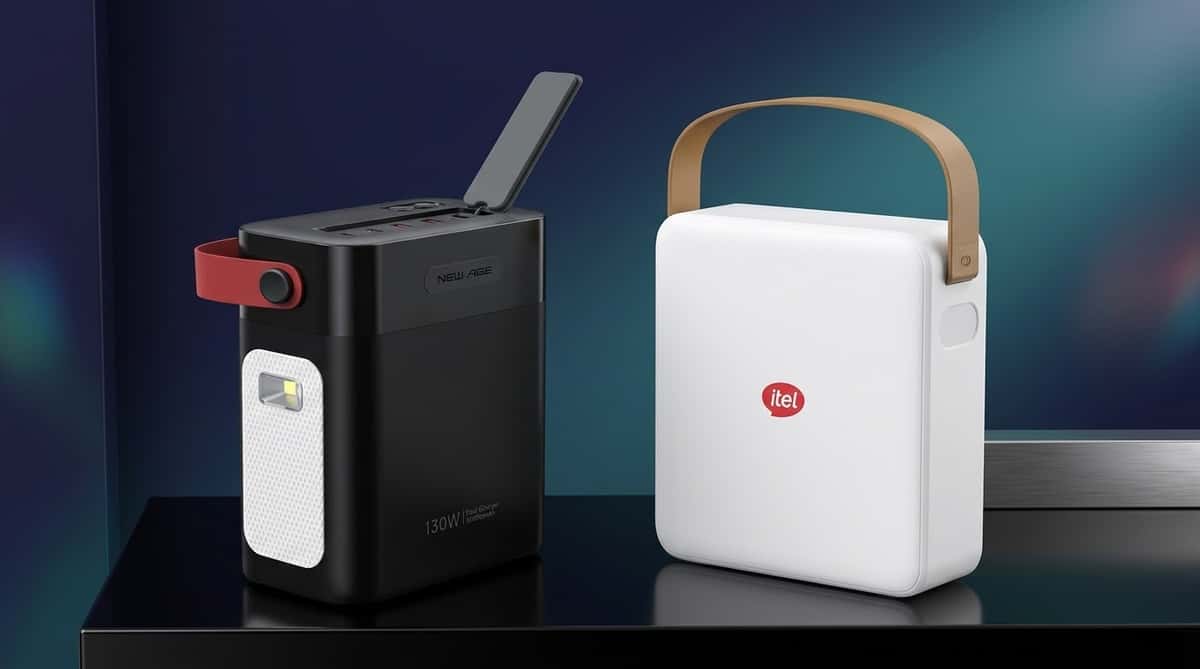
At first glance, the New Age Heavy Duty 80,000mAh and itel IESS-320T Power Go look remarkably similar. Both weigh around 3.5kg. Both advertise up to 130W total output. Both can charge laptops, smartphones and several devices simultaneously. Their Nigerian prices can even overlap.
But after breaking down their specifications, these are two different approaches to portable electricity. The New Age is the better fit for high-power USB-C laptop charging, delivering up to 100W through USB-C. The itel is the more complete small backup-power system, combining a 320Wh LiFePO₄ battery with USB, DC and solar charging support.
Which one should you buy? It depends much more on what you intend to power than the 130W printed on both boxes.
New Age 80,000mAh vs itel IESS-320T specifications
Specification | New Age Heavy Duty A.I. Power | itel IESS-320T Power Go |
|---|---|---|
Battery capacity | 80,000mAh | 100,000mAh / 320Wh |
Approx. nominal energy | 296Wh | 320Wh |
Battery chemistry | Lithium battery | LiFePO₄ |
Maximum total output | 130W | 130W |
Maximum USB-C output | Up to 100W | USB-C1: 65W |
Second USB-C | Yes | Up to 20W |
USB-A | 22.5W × 2 + 10W l | 4 × up to 20W |
DC output | No dedicated DC output | 12V/2A |
Solar charging | Not specified | Yes, up to 100W input |
Maximum charging input | USB-C | Up to 100W |
Display | LED battery display | Battery/status display |
Built-in light | Yes | 2W LED |
Weight | 3.5kg | 3.5kg |
Warranty | 12 months | 12 months |
Nigeria price | ₦112,200 promotional price | ₦107,800–₦115,500 |
Best suited to | USB-C laptops and gadgets | Extended backup and multiple DC/USB devices |
The New Age energy figure is an approximation: 80Ah × a typical 3.7V nominal lithium-cell voltage ≈ 296Wh. New Age's specification lists capacity in mAh rather than Wh.
Battery: 80,000mAh and 320Wh aren't as far apart as they sound
The first mistake would be comparing 80,000mAh against 100,000mAh and assuming the itel stores 25% more usable energy.
Watt-hours are the better measurement when comparing large batteries. Using a typical 3.7V nominal lithium-cell voltage, the New Age's advertised 80,000mAh works out to 296Wh before conversion losses. The itel is explicitly rated at 320Wh.
That puts them much closer than their marketing numbers suggest. The more important difference is battery chemistry. The itel uses LiFePO₄, a chemistry particularly attractive for backup systems because of its cycle life and thermal characteristics. Current retailer specifications advertise more than 3,000 cycles for the IESS-320T.
If I were buying a battery specifically for frequent home or office backup, that would carry significant weight in my decision.
Laptop charging: New Age has a major advantage
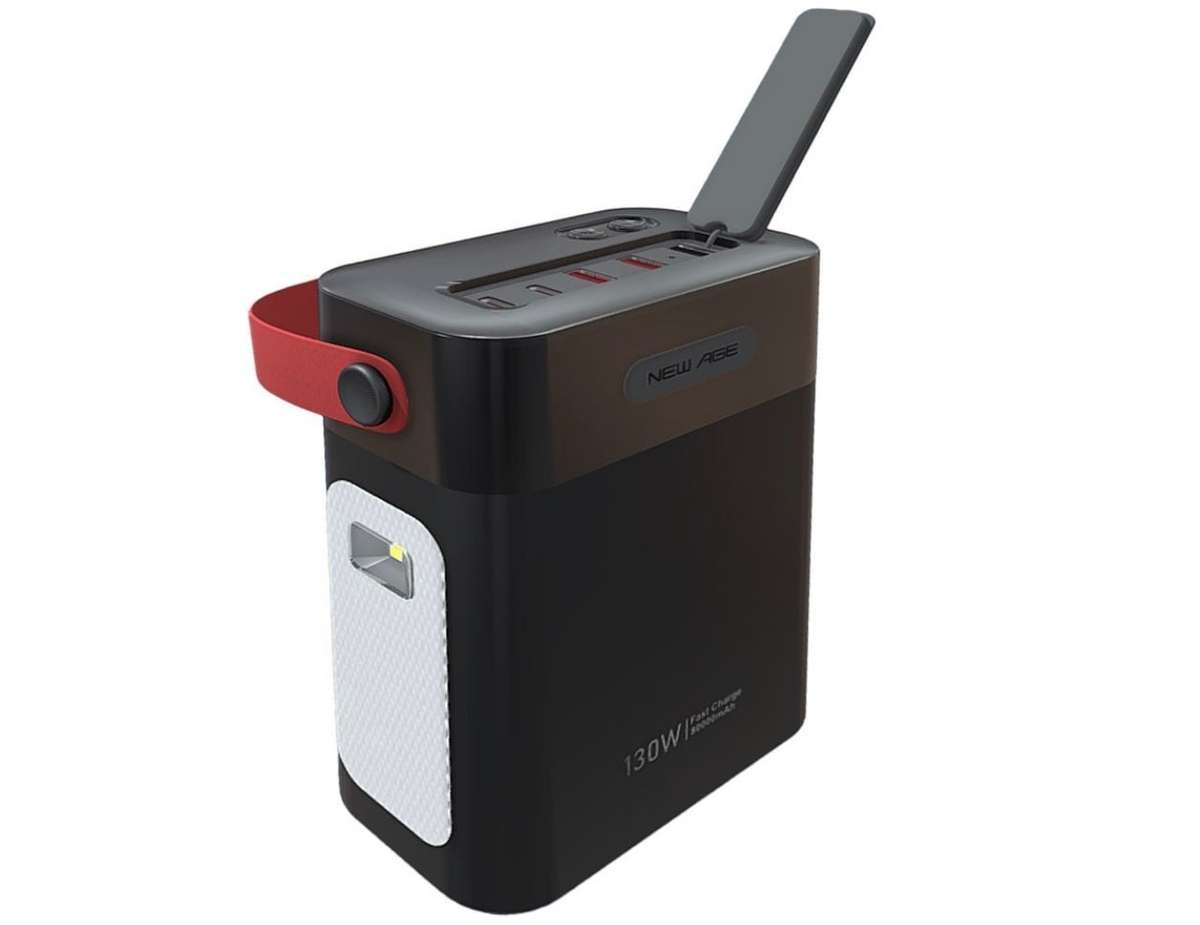
Here the comparison flips. The New Age's strongest specification is its up-to-100W USB-C output. That makes it better matched to higher-powered USB-C laptops.
A 65W ultrabook should have plenty of headroom, while compatible laptops capable of accepting 100W USB Power Delivery can make fuller use of the output.
The itel IESS-320T's primary USB-C port reaches 65W, with its second Type-C connection topping out at 20W. Its four USB-A ports are rated at up to 20W each.
That means the itel's 130W total output does not mean you can send 130W into one laptop. The maximum available from its strongest USB-C connection is 65W.
For a MacBook Air, many business laptops and other 45–65W machines, that's sufficient. For larger MacBook Pro models, workstation-class notebooks or other USB-C laptops that can take 100W, I would choose the New Age.
The itel is much more than a large power bank
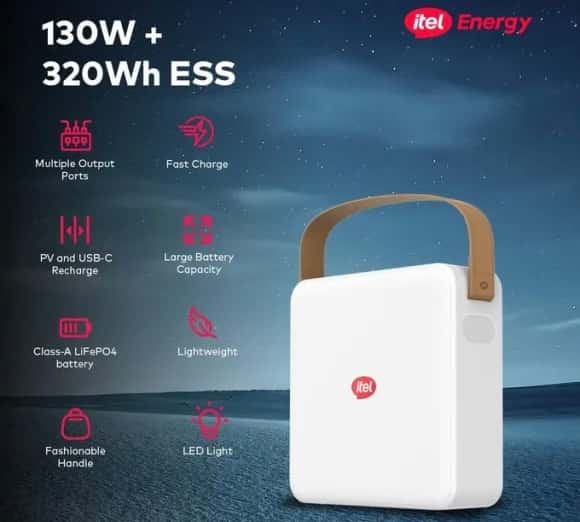
The IESS-320T starts pulling ahead once we stop talking exclusively about USB devices. Its 320Wh LiFePO₄ battery supports DC output and up to 100W charging input, including compatible solar charging. That makes it more useful as an actual backup-energy system.
It can run a Wi-Fi router, DC lighting, compatible DC fan, laptop and other low-power equipment rather than simply recharging portable electronics.
The product has a maximum battery-mode conversion efficiency of at least 93%, two USB-C outputs, four USB-A outputs and DC connections. Its physical dimensions are approximately 190 × 65 × 190mm.
This is the model I would rather leave beside a workstation during an outage. The New Age, meanwhile, makes more sense if nearly everything you own charges over USB.
Both say 130W, but don't misunderstand that number
This is perhaps the most important buying point. Neither device is a 130W appliance power station in the conventional sense.
130W is the combined maximum output. You need to consider the individual port limit and the power requirements of whatever you're connecting. A 10W router, 20W phone and 65W laptop fall comfortably within this class of product. A kettle, microwave, pressing iron, heater or conventional refrigerator does not.
The itel is approximately 4–5 hours for 50–65W Type-C laptops, 18–25 hours for 10–15W routers and 25–30+ hours for a single 10W LED light. Those figures are useful as guidance, although actual runtime will vary with load and conversion losses.
Portability: surprisingly, neither wins
Both are listed at around 3.5kg. That surprised me because the New Age looks more like a conventional oversized power bank, while the itel is explicitly positioned as a portable power station.
At this weight, I wouldn't call either an everyday backpack accessory. They are transportable rather than pocket-portable: reasonable for moving between home, office, car, studio or worksite, but heavy if you're carrying one all day.
Nigeria price: the itel creates a value problem for New Age
Our October 2026 price check makes this comparison particularly interesting.
The New Age promotional price is ₦112,200, while we found the same 80,000mAh model at around ₦96,629 on CDcare, ₦99,500 at JIX Accessories and ₦108,000 on Jumia. Prices vary substantially by seller.
The itel IESS-320T is currently listed at ₦107,800–₦115,500 on the itel Solar storefront. That overlap changes the recommendation. At roughly the same ₦110,000 budget, the itel gives you 320Wh storage, LiFePO₄ chemistry, solar/DC charging capability and a broader backup-power design.
The New Age fights back with one important advantage: 100W USB-C laptop output versus 65W on the itel.
Which should you buy?
For most people building a small backup setup, I would buy the itel IESS-320T. Its LiFePO₄ battery, 320Wh rating, solar charging capability and broader selection of outputs make it the more versatile product. At current Nigerian prices, you're getting substantially more flexibility without paying substantially more.
But there is one group for whom I would choose the New Age 80,000mAh instead: laptop-heavy users. If your primary requirement is charging a USB-C laptop that can draw 80W, 90W or 100W, the New Age's stronger USB-C output matters more than the itel's extra backup features.
So the decision is actually quite simple: Buy the New Age if your laptop is the priority. Buy the itel if backup power is the priority.
For a developer working remotely with a high-powered USB-C laptop, the New Age makes sense. For a home office trying to keep a 65W laptop, router, phones and DC accessories running through outages, I would take the itel.
And if you need to run appliances drawing substantially more than 130W, I would skip both and move up to a larger portable power station.
Our pick for overall backup power: itel IESS-320T
Our pick for USB-C laptop charging: New Age Heavy Duty 80,000mAh
Read more: New Age Heavy Duty 80,000mAh Laptop Power Bank Buying Guide: Who Actually Needs This Much Power?
Read more: itel Power Tank Review: Price, Specs & What It Can Power
Read more: Best Affordable itel Solar Generators in Nigeria: 3 Portable Options for Students and Remote Workers

Author
Nkechi OkaforMobile device specialist focused on smartphones, tablets, and wearables for the African market. Explore author & articles
Related Articles

Oraimo OpenSnap N vs itel BudsFit 5: Which Open-Ear Earbuds Are Better for Nigerians?
Oraimo OpenSnap N and itel BudsFit 5 are affordable open-ear earbuds in Nigeria. We compare design, sound, battery, calls, durability, features and current prices.

Best 20,000mAh Power Banks Under ₦20,000 in Nigeria 2026
We reviewed and researched 20,000mAh power banks you can buy below ₦20,000 in Nigeria, comparing Oraimo, Romoss, itel, New Age and Baseus on charging, capacity and value.
Best Portable Power Banks for Laptop Charging in Nigeria (2026 Buyer's Guide)
Looking for a portable power bank that can charge your laptop and phone? Here are the best laptop-compatible power banks in Nigeria with current prices, features, and buying tips.
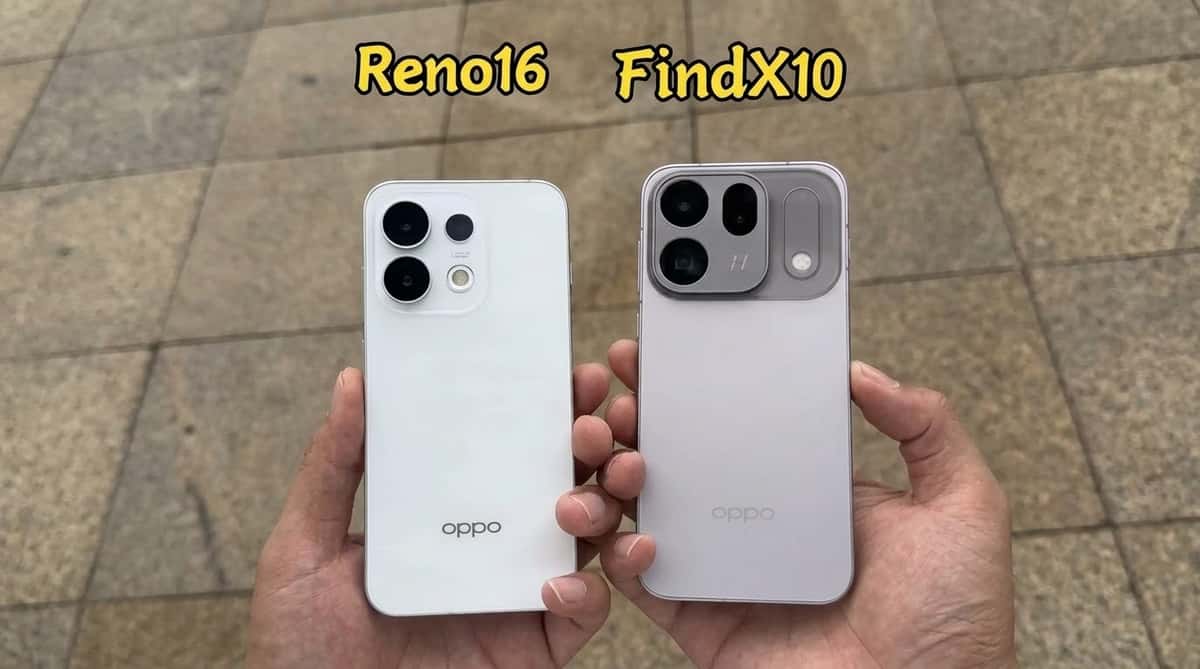
OPPO Reno16 vs OPPO Find X10: The Price Gap Is Big, but So Is the Hardware Difference
OPPO Reno16 vs Find X10 comparison covering cameras, performance, battery, display and prices to see which phone offers better value.

iPhone 17 Pro Max vs Xiaomi 17 Pro Max: Which Is Better?
iPhone 17 Pro Max vs Xiaomi 17 Pro Max comparison covering cameras, performance, displays, battery, software, international price and Nigeria price.

Foldable Phones vs Tablets: Should You Ditch Your iPad or Galaxy Tab?
Foldable phones now open into tablet-like screens. We compare iPhone Duo, Galaxy Z Fold8 and Xiaomi 18 Fold with iPads and Galaxy Tabs to see which users should buy.

Apple Watch Series 12 vs Series 11: Is the Upgrade Worth It?
Apple Watch Series 12 vs Series 11 comparison covering health tracking, performance, battery, design and Nigerian prices to see whether the upgrade is noticeable.
Comments (0)
Leave a comment
Comments cannot be edited or deleted after posting. Please review your comment before submitting.
No comments yet. Be the first to share your thoughts using the form above.