

What Is Your Startup Really Worth? Why AI Companies Can Command 50× Revenue While Others Get Far Less
AI startups are raising at vastly different revenue multiples. Explore what drives startup valuations, what founders should measure, and the lessons for African entrepreneurs.

Two startups can generate similar annual recurring revenue and still receive dramatically different valuations from investors. One may raise at 20 times its recurring revenue; another may secure a deal at 50 times or more. The difference is not necessarily that one has a better product or is growing faster. Investors are also making judgments about the market each company could capture, the durability of its revenue, its competitive position and how large the business might become.
Data compiled by Venture Curator from 31 AI funding rounds between 2024 and 2026 illustrates this divide. Its sample puts the median private AI valuation at 36.7 times annual recurring revenue (ARR) across the period, rising to 54.6 times for rounds in 2026 alone. Those figures are striking, but they describe a selected group of AI deals, not the typical valuation of every startup.
For founders, the useful question is not how to copy the highest multiple. It is how investors arrive at different prices for companies that may look similar on a revenue chart and what evidence can help a business justify its own valuation.
The valuation gap is real, but the comparison needs context
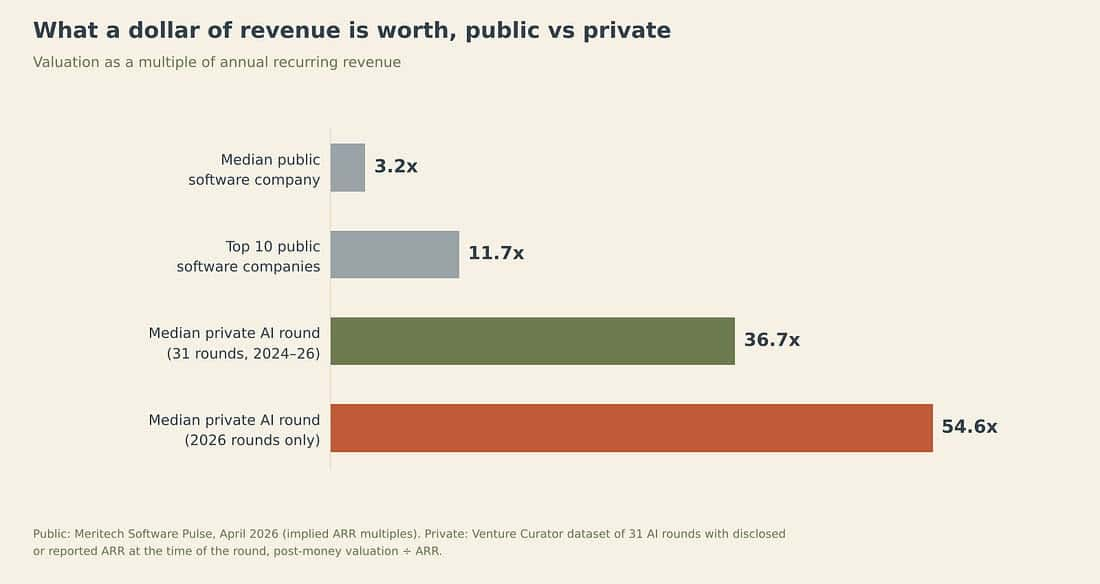
The above chart compares four valuation benchmarks:
Median public software company: 3.2× ARR
Top 10 public software companies: 11.7× ARR
Median private AI funding round across 31 deals in 2024–2026: 36.7× ARR
Median private AI funding round in 2026 alone: 54.6× ARR
The public-market figures are from Meritech April 2026 Software Pulse, while the private figures come from Venture Curator’s own dataset. Meritech reported that public software valuations had fallen significantly from their pre-pandemic-era levels, with the median implied ARR multiple at 3.2× and the top 10 median at 11.7×.
The apparent gap is enormous. Yet the two sides are not directly interchangeable. Public-market multiples reflect the prices investors pay for shares in established listed businesses, while the private figures reflect negotiated funding rounds for a selected set of AI startups. The companies, deal structures, growth expectations and valuation methods differ. Even so, the comparison reveals an important feature of the current market: investors have been willing to pay substantial premiums for selected private AI companies, betting that their future growth and strategic position will justify the price.
Broader funding data supports the view that AI is attracting disproportionate investor attention. Carta reported that AI companies received more than 60% of venture capital raised by companies on its platform in the first quarter of 2026. It also highlighted a substantial gap between valuations for foundational AI model companies and non-AI startups at the same funding stage. This is not evidence that every AI company deserves a premium. It is evidence that the market increasingly distinguishes between businesses investors believe can become exceptionally valuable and those they expect to grow at more conventional rates.
Bigger revenue does not automatically mean a higher valuation
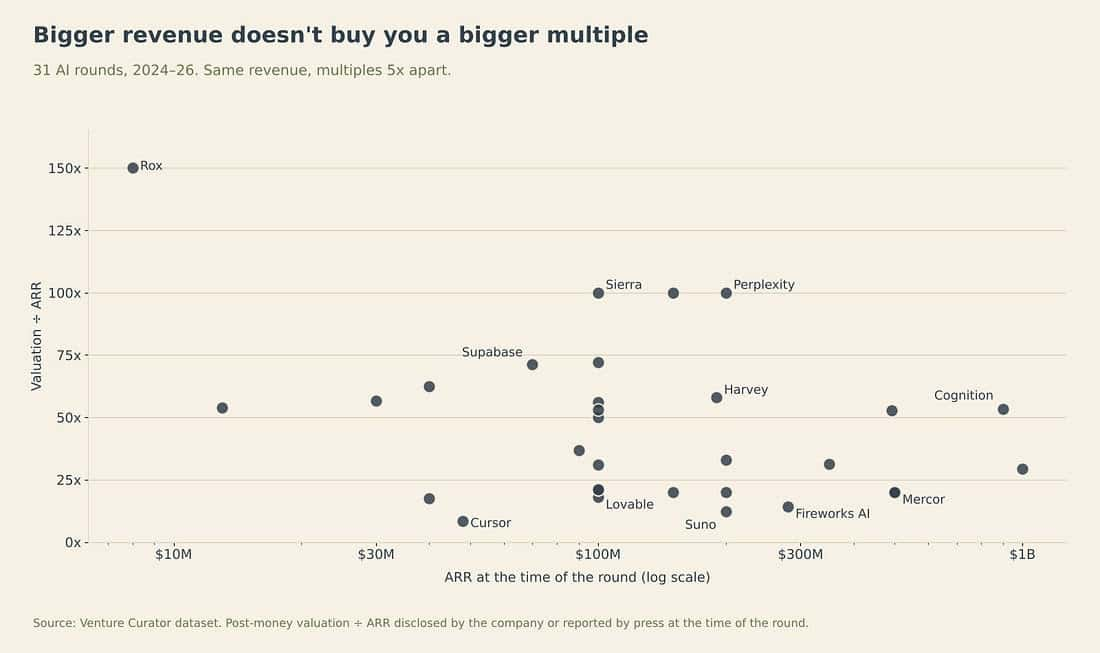
The second chart makes the argument more concrete. It plots 31 AI funding rounds against reported ARR, using a logarithmic revenue axis. The vertical position represents the valuation-to-ARR multiple. The companies are spread across a wide range of valuations even when their reported revenue is broadly comparable. Some companies with ARR around $100 million sit near 20× revenue; others reach multiples of 50×, 70× or 100×.
The chart labels include companies such as Lovable, Harvey, Sierra, Perplexity and Cognition. It suggests that revenue scale alone cannot explain the prices investors have agreed to pay. However, this chart should be read as a collection of reported funding events rather than a controlled experiment. The rounds occurred at different times and may differ in growth rates, customer mix, product scope, investor demand and deal terms. The data does not, by itself, prove that one particular business characteristic caused the valuation gap. What it does show is that ARR is only one part of the valuation discussion.
Investors are buying a forecast, not just today's revenue
A recurring-revenue business can be valuable because its existing customers keep paying and because new customers may continue to arrive. But the same amount of ARR can represent very different businesses.
Imagine two software companies, each generating $10 million in ARR.
Company A has a large customer that accounts for half its revenue. Most contracts are short, customers frequently leave, and acquiring replacements is expensive.
Company B has hundreds of customers, low churn, strong expansion revenue and a product integrated into essential business workflows. Its customer acquisition costs are falling as referrals increase.
Their current ARR is identical, but the risks surrounding that revenue are not. Company B may offer investors a more credible path to sustained growth. These are illustrative examples, not claims about the companies in the chart. The underlying principle is consistent with established valuation practice: Carta identifies growth prospects, customer concentration, market size, competitive advantage and the reliability of revenue as relevant factors in assessing private companies.
Five factors that can change the multiple
1. Revenue quality
Investors need to know whether revenue is recurring, contracted, collectible and likely to continue. A business that reports annual recurring revenue should be able to explain which contracts qualify, how cancellations are treated, and whether usage-based income is genuinely predictable. One unusually strong month should not be presented as proof of a durable annual run rate.
Founders should distinguish recurring revenue from one-off implementation fees, consulting income, hardware sales and other non-recurring payments. Those revenue streams can all be valuable, but they may require different assumptions when forecasting future performance.
A transparent revenue bridge, starting ARR, new customers, expansion, contraction and churn could help investors see where growth is coming from.
2. Growth that can continue
Fast growth attracts attention, particularly in markets where a company can potentially become a category leader. But the quality and repeatability of that growth matter. Investors may ask whether new customers are arriving through a repeatable sales process, whether existing customers are spending more, and whether expansion depends on unusually large discounts or heavy marketing expenditure.
A startup that doubles revenue once is not necessarily as attractive as one that can demonstrate consistent growth across several periods with a clear explanation of what drives it. Founders should show historical growth alongside a credible forecast. The aim is not to promise the fastest possible expansion; it is to make the next stage of growth believable.
3. Retention and customer dependence
Retention helps reveal whether a product creates lasting value. For subscription businesses, two useful measures are:
Gross revenue retention (GRR): how much revenue from existing customers remains after cancellations and reductions, before expansion.
Net revenue retention (NRR): how much revenue remains from existing customers after accounting for cancellations, reductions and expansion.
NRR above 100% means expansion within the existing customer base more than offsets losses and reductions. But it should be considered alongside GRR: a high NRR can hide substantial customer churn if a few remaining customers spend much more. Investors also look at customer concentration. If losing one customer would materially damage the business, the headline ARR may overstate how dependable the revenue base is.
4. Gross margins and the cost of growth
Revenue is not the same as economic value. A software company with strong gross margins may retain more money from each additional dollar of revenue to fund research, sales and expansion. A company whose service requires substantial human labour, expensive infrastructure or costly third-party AI usage may have less room to scale profitably.
For AI startups in particular, founders should understand inference costs, infrastructure expenses, implementation work and the amount of human review required to deliver the product. A compelling fundraising narrative should connect revenue growth to improving unit economics. Investors need to see not only that demand exists, but also how the business could make money as it grows.
5. The size and defensibility of the opportunity
A company may receive a premium if investors believe it can expand into a large market and establish a durable position before competitors catch up. That belief needs evidence. A founder should be able to identify the initial customer segment, explain the problem being solved, show why customers choose the product, and describe what could make it difficult for competitors to replace it.
For AI companies, access to a powerful model is not necessarily a durable advantage when competitors can access similar technology. Proprietary data, deep workflow integration, distribution, trusted customer relationships and specialised expertise may provide stronger differentiation.
The relevant question is not simply whether the technology is impressive. It is whether the business can convert that technology into a lasting commercial advantage.
Why AI valuations deserve extra scrutiny
The enthusiasm around AI creates an additional challenge: expectations can move faster than business fundamentals. Carta's Q1 2026 report found that foundational AI model companies were raising at valuations far above those of non-AI startups at comparable stages. Such differences can reflect enormous capital requirements, strategic importance, investor competition and expectations about future markets. They do not establish a standard multiple that other AI startups should expect.
Public markets provide a useful counterpoint. Meritech's April 2026 analysis noted that the median public software company's implied ARR multiple had fallen to 3.2×, while the top 10 median stood at 11.7×. Its analysis also described a market increasingly concerned with growth, AI exposure and business performance.
Private investors may price in years of future growth, but that expectation creates a hurdle for the next funding round. If a startup raises at a very high multiple and then grows more slowly than expected, it may struggle to justify a higher valuation later—even if its revenue continues to rise. A high valuation is therefore not an unconditional victory. It can give a company more capital while also raising expectations for future performance.
What this means for African founders
The lesson is especially relevant to founders operating in African markets, where access to venture capital, currency conditions and the depth of local funding pools can differ significantly from those in the United States. According to the African Private Equity and Venture Capital Association's 2025 report, Africa recorded $3.9 billion in venture funding across 506 deals during 2025, including equity and venture debt. Equity funding declined year on year even as venture debt expanded. The figures show a market with active investors but a different funding mix from the US AI market.
African startups should not use the 36.7× or 54.6× private AI medians as default valuation targets. Those figures come from a narrow sample of AI funding rounds and may not reflect the companies, sectors, stages or investment terms relevant to a particular African business. Instead, founders should build a valuation case around their own market and the investors they are approaching.
Build evidence that travels across markets
A startup serving Nigeria, Kenya, South Africa or several African markets should show how its customer base can expand, what local adaptation costs, and whether the economics remain attractive as it crosses borders. A company with recurring revenue in multiple markets may be able to demonstrate a larger opportunity than one dependent on a single customer segment. But geographic expansion alone is not enough: investors will want to understand regulatory requirements, distribution costs, local competition and the ability to collect payments reliably.
Prove that revenue is resilient
Currency volatility, changes in purchasing power and customer budget constraints can affect how businesses renew contracts and pay for software. Founders should report retention and churn transparently, show revenue by customer segment or geography where relevant, and explain how pricing changes affect demand. Where customers pay in different currencies, it can help to separate underlying growth from the effects of currency conversion.
This gives investors a clearer view of whether the business is expanding because it is winning more customers, increasing usage or simply reporting a change in translated revenue.
Show how the company can grow without funding every step
A startup that needs substantial new capital each time it enters another market may face different financing constraints from one that can expand through partners, repeatable software deployment or existing customer networks.
Metrics such as gross margin, customer acquisition cost, payback period and cash burn help demonstrate whether growth can become more efficient over time. Founders should be able to explain how additional funding will translate into measurable milestones, rather than treating a larger valuation as the objective in itself.
Use comparable deals carefully
Comparable transactions are useful only when the companies and deal structures are sufficiently similar. A Nigerian fintech, a Kenyan logistics platform, a South African enterprise software company and a US AI coding startup may all use technology, but their revenue models, addressable markets, risks and investor pools differ. Founders should seek recent transactions in their sector, stage and geography, and distinguish between pre-money and post-money valuations. They should also compare the amount raised, the ownership sold and any material terms that affect the economics of the deal.
The objective is to build a defensible range, not to find the largest headline number and assume it applies.
A practical valuation checklist before approaching investors
Before setting a fundraising target, founders should be ready to answer these questions:
Revenue: Can every figure in the ARR calculation be reconciled to contracts, invoices and billing records?
Growth: What has driven growth over the last 12 months, and what evidence supports the forecast?
Retention: How many customers renew, how much revenue is lost, and how much existing customers expand?
Margins: What does it cost to deliver the product, including cloud, AI usage, support and implementation?
Acquisition: How much does it cost to win a customer, and how long does it take to recover that cost?
Concentration: How dependent is the business on its largest customers, channels or suppliers?
Market: What is the realistic initial market, and what evidence supports expansion into adjacent segments?
Terms: What ownership will investors receive, and what rights or preferences come with the investment?
A valuation spreadsheet can help translate these inputs into scenarios, but it cannot determine a definitive market price. Early-stage companies may have limited revenue history, while investor demand and deal terms can substantially affect the final agreement. The output should be treated as a planning tool that helps founders understand trade-offs, not as a promise of what investors will pay.
The real goal is a stronger business, not a higher multiple
The two charts reveal a striking divide: the value investors assign to a dollar of recurring revenue can vary substantially, even among AI companies reporting similar revenue. The evidence does not establish a universal formula for securing a premium. It points to a more useful lesson: valuation depends on what investors believe the revenue can become, how durable that revenue is, and how much risk they must accept to achieve that future.
For founders everywhere, the strongest response is to build a business that can withstand scrutiny. Keep clean financial records, understand the economics of each customer, prove retention, and connect growth to a realistic path toward sustainable margins.
For African entrepreneurs, that discipline is especially important when the most visible valuation headlines come from markets with different funding conditions. A startup does not need to match a Silicon Valley multiple to build a valuable company. It needs to demonstrate a compelling opportunity, reliable execution and a credible route to returns.
A high valuation is a price investors agree to today. A strong business is what gives that price a chance of holding up tomorrow.
Read more: Can Solo Founders Raise Venture Capital? What Investors Want Before Writing a Cheque
Read more: Why AI Startups Get ARR Wrong: A Practical Guide to Usage-Based Revenue
Read more: Your Competitor Just Raised Millions, What Should an African Startup Founder Do Next?
Read more: African Startups Have Raised $2 Billion in 2026 But Where Is the Money Actually Going?

Author
Azeez LiadiAzeez is an AI Engineer, Data Scientist, founder, and Senior Tech Writer at Afritech Connect. A top 1% graduate of Lagos State University, he has worked with international startups and… Explore author & articles





