Why AI Startups Get ARR Wrong: A Practical Guide to Usage-Based Revenue
AI startups can overestimate ARR when customer usage spikes. Learn how to calculate a more reliable revenue run rate, forecast runway and report growth.
Why Are So Many AI Startups Getting ARR Wrong? The Revenue Math Founders Need to Fix
A customer uses your AI product heavily in November. Revenue jumps. Your dashboard annualises that month, your ARR looks spectacular, and your financial model suggests you can afford another engineer. Then usage falls in December, and the growth story disappears.
This is one of the financial traps facing startups that charge for API calls, AI tokens, computing resources or other consumption-based services. Annual recurring revenue (ARR) is only useful when the number reflects revenue that can reasonably be expected to continue. Multiplying one unusually strong month by 12 can turn a temporary spike into a misleading growth signal.
The solution is not to abandon ARR. It is to distinguish contracted revenue from variable consumption, measure how repeatable usage really is, and use more than one number to make business decisions.
Why traditional ARR calculations break for AI businesses
For a subscription business charging a predictable monthly fee, the familiar formula is straightforward:
ARR = Monthly recurring revenue (MRR) × 12
A company with 100 customers paying $500 every month has $50,000 in MRR and a $600,000 annualised recurring revenue figure, assuming those subscriptions remain active.
Consumption-based businesses are different. Customers may pay according to tokens processed, API requests, data stored or computing time. Revenue can expand when usage grows and contract when workloads decline.
Stripe's guide to usage-based pricing explains how consumption pricing connects the customer's usage to billing. That flexibility can make an AI product attractive, but it also makes revenue less predictable when customer activity fluctuates.
Imagine a customer running a large AI batch-processing job in November. The invoice increases sharply, but the customer may not repeat that workload in December. Multiplying November's revenue by 12 assumes the elevated consumption continues for an entire year. That is a scenario, not a forecast.
Three revenue numbers every usage-based startup should understand
A single ARR figure cannot explain every aspect of a consumption-based business. Founders should consider separating their reporting into three measures.
1. Contracted baseline
This is the annualised value of enforceable recurring minimum commitments, including fixed subscription fees and contractual usage minimums where applicable.
For example, a customer paying $10,000 monthly under a 12-month agreement with that minimum commitment contributes $120,000 to the annualised contracted baseline.
2. Usage-based run rate
This measures consumption revenue using a clearly disclosed methodology. One option is to multiply the average monthly usage revenue over the previous three months by 12. Another may use a longer period if customer workloads are highly seasonal. This is a management estimate, not a guarantee that customers will continue consuming at the same rate.
3. Recognised revenue and cash collected
Recognised revenue follows the company's applicable accounting policies. Cash collected records money actually received. Neither should be casually substituted for ARR. A company may invoice a customer before receiving payment. It may also collect prepaid credits that will be recognised as revenue later, depending on the contract and applicable accounting treatment.
These measures answer different questions: what customers have committed to, what their recent behaviour suggests, what the business has earned and what cash is available. The distinction matters because usage-based revenue is not automatically invalid as ARR. Established consumption businesses can report defensible recurring revenue metrics when their methodology is consistent and their assumptions are transparent. The danger is treating every variable dollar as equally predictable.
How one usage spike can distort your financial model
Consider a hypothetical AI startup with $300,000 in monthly subscription revenue and another $150,000 from usage overages and a one-time project. Annualising the entire $450,000 month produces $5.4 million. Annualising only the $300,000 subscription component produces $3.6 million. That is a $1.8 million difference between the two calculations. The first figure also includes a one-time project, which should not be represented as recurring revenue.
Now imagine that usage overages came from a single enterprise customer. If that customer completes its project and reduces consumption, the startup may discover that its headline ARR was never a reliable measure of its underlying business.
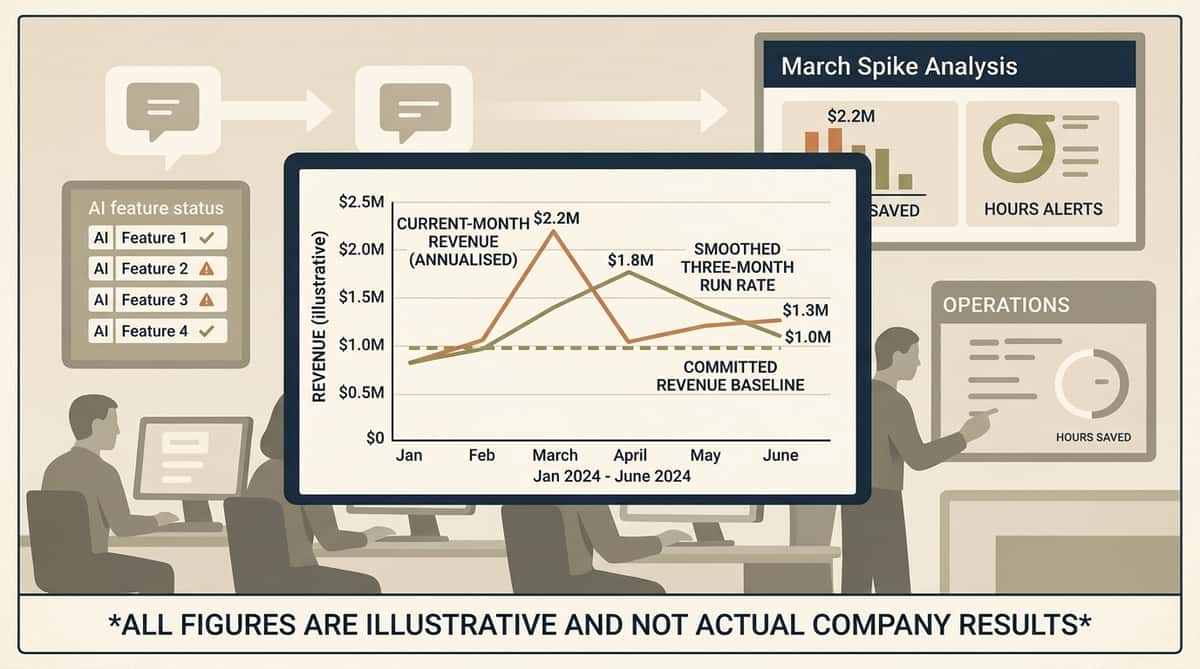
Your supplied chart illustrates the same principle: a November spike makes the current-month annualised line jump above the smoothed run rate and committed baseline. Its values are illustrative, but the financial risk is real.
The problem extends beyond investor presentations. An inflated run rate can distort hiring decisions, cloud-spending budgets, sales targets and runway forecasts. A founder might increase monthly payroll because the revenue dashboard suggests the business has become more resilient, only to face a cash shortfall when usage normalises.
A practical worksheet to calculate a more reliable run rate
Start with the last three to six months of revenue, then classify every material component before annualising it.
Revenue component | Monthly amount | How to treat it |
|---|---|---|
Contracted subscriptions and minimums | $300,000 | Annualise eligible recurring commitments |
Variable customer consumption | $120,000 | Track separately; use a consistent run-rate methodology |
One-time implementation project | $30,000 | Exclude from recurring revenue |
Total monthly revenue | $450,000 | Useful for revenue analysis, but not automatically ARR |
Illustrative figures only.
Free worksheet formula
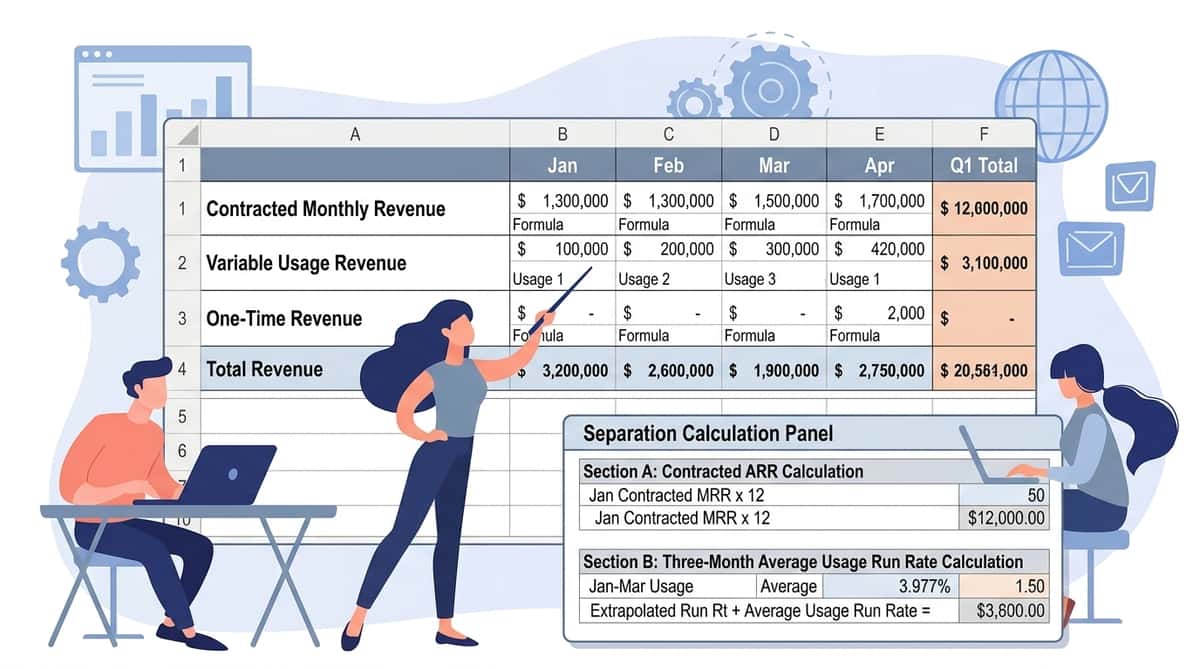
Contracted baseline ARR = eligible monthly contractual commitments × 12.
Three-month variable usage run rate = (usage revenue in Month 1 + Month 2 + Month 3) ÷ 3 × 12.
Total revenue = recurring and non-recurring revenue recognised under the company's accounting policies, as applicable.
Forecast cash runway = available cash ÷ expected monthly net cash burn, using a realistic forward-looking cash forecast.
For example, if eligible monthly contractual commitments are $300,000, contracted baseline ARR is $3.6 million. If usage revenue over three months is $80,000, $120,000 and $160,000, the average is $120,000 per month, giving a variable usage run rate of $1.44 million.
You can report these separately rather than presenting $5.04 million as though every dollar has the same level of certainty. This is a management worksheet, not a substitute for accounting advice. Revenue recognition, contract enforceability and the appropriate ARR definition depend on the company's circumstances and reporting policies.
What AI founders should measure beyond ARR
A better revenue model combines financial metrics with customer behaviour. Track monthly revenue by customer, recurring commitments, usage variability, customer concentration, gross margin, retention and net revenue retention. For AI products, also examine the cost of delivering each unit of consumption. Rising revenue is less attractive if inference costs, infrastructure bills or support requirements rise faster.
Look at the largest customers individually. Ask whether their usage is recurring, seasonal, tied to a specific project or driven by a temporary workload. Compare current consumption with the customer's historical pattern and contractual minimum.
A three-month average is useful for smoothing volatility, but it is not universally sufficient. A seasonal business may need 12 months of history; a newly launched product may have too little data for a reliable average. In those cases, disclose the uncertainty instead of presenting the estimate as a proven trend.

What this means for African SaaS startups
For African founders, revenue forecasting can be especially important when operating costs and customer payments are exposed to foreign-exchange movements, cross-border payment friction or variable cloud bills. These risks differ by country, customer base and business model, so they should be measured rather than assumed.
A Nigerian SaaS company selling to local SMEs may collect relatively small recurring payments while paying for some infrastructure in dollars. A startup serving international enterprise customers may earn foreign-currency revenue but still face unpredictable consumption and concentrated customer exposure.
Both need to distinguish a strong billing month from sustainable cash generation. This is particularly relevant to founders working through early customer acquisition. Our guide on getting your first 50 customers as an early-stage startup in Africa explores the challenge of building a customer base. As that base grows, founders should also understand whether revenue comes from stable commitments, repeat usage or occasional high-value projects.
Before committing to additional staff or infrastructure, run a downside scenario: What happens if your biggest customer's usage falls by 30%? What if two customers pay late? What if cloud costs increase while consumption revenue remains flat?
Those scenarios may reveal more about financial resilience than a single headline ARR number.
The number investors need is the one you can defend
Investors do not need every startup to have perfectly predictable revenue. They need founders to explain what is recurring, what is variable, what is contracted and what could change. That means documenting your calculation methodology, applying it consistently and explaining material changes. If your company reports a usage-based run rate, state the measurement period and identify unusual events that affected it. If you change the methodology, explain why and show how the change affects comparability.
For founders preparing to raise capital, transparent financial reporting belongs alongside the wider evidence of business quality discussed in our guide to what investors want before writing a cheque to solo founders.
The bottom line: ARR should help you understand the business you are building, not the business one unusually busy customer made possible for a month. Separate contractual commitments from variable consumption, test whether usage is repeatable and forecast cash using realistic scenarios. A less impressive number that survives scrutiny is more useful than a headline figure that collapses when the next invoice arrives.
Read more: How Founders and Students Can Build Businesses With Coding Agents
Read more: Your Competitor Just Raised Millions, What Should an African Startup Founder Do Next?
Read more: Are LinkedIn Ads Worth It for B2B Businesses? What the Data Reveals About ROI and Sales
Read more: African Startups Have Raised $2 Billion in 2026 But Where Is the Money Actually Going?

Author
Azeez LiadiAzeez is an AI Engineer, Data Scientist, founder, and Senior Tech Writer at Afritech Connect. A top 1% graduate of Lagos State University, he has worked with international startups and… Explore author & articles