





Arnergy 5kW vs itel 6kW 20.48kWh: Which Is the Better Alternative to Unstable Grid Power?
Meta description: Arnergy 5kW vs itel 6kW 20.48kWh comparison for homes and businesses. We compare battery storage, inverter capacity, AC runtime, solar expansion, price and long-term value.
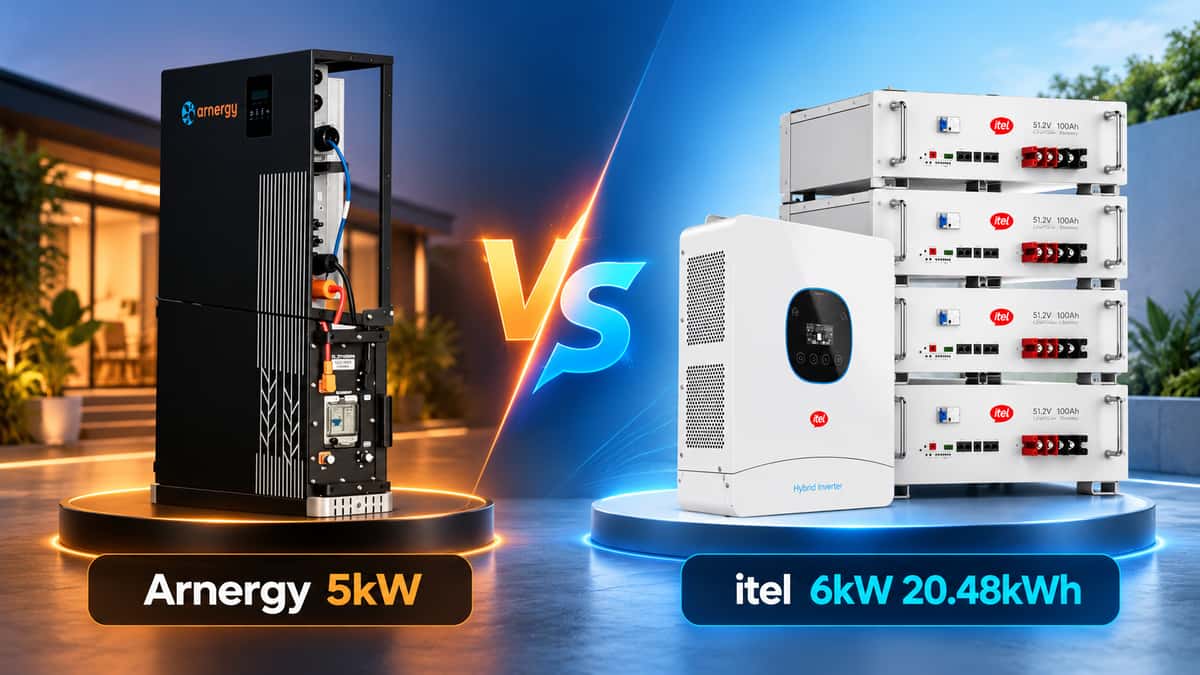
Living or running a business with unreliable grid electricity changes how you should think about backup power. A small inverter can keep lights and a television running, but once air conditioning, refrigerators, computers and other essential appliances enter the equation, battery storage becomes just as important as inverter wattage.
That is what makes the Arnergy 5kW system and itel 6kW/20.48kWh package interesting. Their prices start surprisingly close to each other, but they solve the power problem differently. Arnergy gives you a 5kW hybrid inverter with scalable 5–15kWh LiFePO4 storage and strong solar integration. The itel package combines a more powerful 6kW inverter with a huge 20.48kWh lithium battery bank specifically configured for long overnight backup.
If my priority were replacing hours of unreliable grid supply every day, I would pay more attention to that battery difference than the extra 1kW of inverter power.
Arnergy 5kW vs itel 6kW specifications and price
Specification | Arnergy 5kW | itel 6kW |
|---|---|---|
Inverter output | 5,000W | 6,000W |
Battery storage | 5kWh, expandable to 15kWh | 20.48kWh |
Battery configuration | Modular LFP | 4 × 5.12kWh lithium |
Published usable storage | 80% DOD specified | Approx. 18.4kWh |
Battery voltage | 48V | 48V |
Solar support | Yes | Yes, panels can be added |
Maximum PV input | 8kWp+ | Hybrid inverter supports future solar |
MPPT | Dual MPPT | MPPT hybrid inverter |
Grid charging | Yes | Yes |
Generator integration | Yes | Not highlighted for this package |
Transfer time | 0ms listed | 10ms listed for IPV-6K48U inverter |
Protection rating | IP65 | IP54 inverter |
Published battery cycles | 6,000+ | Not specified on package page |
Warranty | 5 years | Certified installation required for warranty |
Panels included | No | No |
Installation included | No | No |
Nigeria price | From ₦4,530,000 | ₦4,966,500 |
Prices and availability checked October 2026. Arnergy currently lists configurations from ₦4.53 million up to ₦9.05 million, depending on battery capacity. The itel 20.48kWh package is ₦4,966,500 before installation and accessories.
The battery comparison changes everything
Put the entry prices beside each other and the itel immediately becomes interesting. Arnergy's starting package gives you 5kWh, while spending roughly ₦436,500 more on the itel package takes storage to 20.48kWh.
That is more than four times the nominal battery capacity. Arnergy specifies an 80% depth of discharge, meaning the 5kWh configuration should not be treated as 5kWh of everyday usable energy. The battery can, however, be expanded to 15kWh. Its LFP cells are rated for more than 6,000 cycles, and Arnergy backs the system with a five-year warranty.
The itel package uses four 5.12kWh batteries for 20.48kWh total capacity, with approximately 18.4kWh quoted as usable storage. For long blackouts or overnight operation, that capacity advantage is enormous.
Can they run a 1.5HP AC, refrigerator, TV and lights?
This is where buyers need to distinguish power from energy. Both inverters can comfortably accommodate the running load of a typical 1.5HP inverter AC alongside a refrigerator, television, router, lights and laptop, provided startup surges and the total connected load remain within the system's limits.
But keeping those appliances running for hours is a battery problem. itel's own load calculation uses approximately:
1.5HP inverter AC: 1,100W
Inverter refrigerator: 150W
TV, decoder and Wi-Fi: 100W
LED lighting: 50W
Phone and laptop charging: 100W
Its example estimates around 14.4–15kWh of overnight consumption. With roughly 18.4kWh of usable storage, the 20.48kWh battery bank has enough theoretical headroom for a long night under a carefully managed load. We would not promise exactly 12 hours. Air-conditioner compressor behaviour, thermostat setting, room temperature, refrigerator cycling, inverter losses and additional appliances all affect runtime.
The 5kWh Arnergy is a different proposition
The entry-level Arnergy shouldn't be evaluated as though its 5kWh battery can match 20.48kWh. It can't. If you continuously pulled 1.5kW from approximately 4kWh of usable battery energy, simple arithmetic gives only around 2.7 hours before accounting for real-world system losses.
In practice, appliances cycle rather than continuously drawing their rated power, so actual runtime can differ considerably. The 5kWh version makes more sense for load management: refrigerators, lighting, electronics, fans, televisions and shorter periods of heavier appliance use.
If you want overnight AC, I would look toward Arnergy's 10kWh or 15kWh configurations, not the base battery.
Arnergy has the stronger solar architecture
Where Arnergy fights back is system design. The 5kW hybrid inverter accepts more than 8kWp of PV input, uses dual MPPT, and can synchronize solar, grid and generator sources. It also offers a published 0ms transfer time, IP65 protection, battery monitoring and integrated BMS management. That makes it attractive if your goal isn't simply storing grid electricity but progressively reducing dependence on it.
Start with batteries and grid charging today, add a properly sized solar array, and daytime sunshine can directly support loads while replenishing storage.
The itel is also future-ready for solar, despite this particular package shipping without panels. In fact, itel sells a related 20.48kWh configuration with a 3.28kW solar array. But the no-panel package we're comparing here is explicitly positioned around charging its batteries from grid electricity during available supply and using that stored energy later.
What does charging 20.48kWh from the grid cost?
Large batteries don't create free electricity. itel estimates that replenishing its overnight usage requires around 16kWh of grid energy, with approximately 5.5–6 hours of continuous supply for a full recharge under its stated setup. That means the system is primarily shifting when you consume grid electricity rather than eliminating the electricity bill.
Solar changes that equation significantly. If your location receives good daytime sunlight and you install enough PV capacity, part of your daily energy can come from the panels rather than continually purchasing grid units or burning fuel in a generator.
That is why anyone spending around ₦5 million on backup power should think beyond surviving tonight's outage and consider what the system will cost to operate over several years.
Price in Nigeria: itel offers extraordinary storage per naira
This is the part of the comparison that surprised me. The itel 6kW + 20.48kWh battery package costs ₦4,966,500. The package breaks down to one 6kW hybrid inverter and four 5.12kWh batteries.
Arnergy currently starts at ₦4,530,000 for its 5kW inverter and 5kWh LFP configuration, with larger storage options pushing the price as high as ₦9.05 million.
Neither comparison price includes solar panels or installation. Arnergy additionally excludes logistics and maintenance, while itel states that accessories such as breakers and cables plus installation are charged separately. That means you should request a complete installed quotation before paying. A ₦4.9 million product can become meaningfully more expensive after cabling, protection equipment, changeover work, installation and solar panels are added.
Which should you buy?
For maximum overnight backup per naira, I would choose the itel 6kW/20.48kWh package. At roughly ₦4.97 million, its battery capacity makes far more sense for a home, shortlet apartment, office or small business trying to run a 1.5HP inverter AC, refrigerator, lights, TV, internet equipment and computers through extended outages.
The Arnergy system is more compelling as a scalable long-term energy platform.
Its 6,000+ battery-cycle specification, five-year warranty, IP65 protection, 8kWp+ PV capability, generator/grid/solar integration and modular 5–15kWh storage make it attractive for buyers building a carefully engineered hybrid solar system rather than simply maximizing battery capacity today.
My decision would therefore be straightforward: Choose itel if your immediate problem is surviving long outages and overnight blackouts. Choose Arnergy if you want a modular solar-first system that you intend to expand and integrate into a broader energy setup.
And if your target is genuinely 12 hours of AC plus refrigeration, lighting, TV and electronics, don't buy the 5kWh Arnergy configuration expecting comparable endurance. Battery capacity matters, and 5kWh versus 20.48kWh is simply too large a difference to ignore.
For smaller budgets and lighter loads, you can also read our guides to affordable itel solar generators, the itel Power Tank, and our EcoFlow DELTA 3 Air buying guide.
Read more: Power Your Nigerian Home Around the Clock: Is the itel IPV-6K48U 6kW Solar Inverter Worth ₦599,500?

Author
Adebayo JohnsonSenior tech editor with over 4 years of experience covering mobile and gadget technology. Explore author & articles
Related Articles

Best Affordable itel Solar Generators in Nigeria: 3 Portable Options for Students and Remote Workers
Looking for affordable backup power in Nigeria? We compare three itel solar generators by price, battery capacity, power output, solar charging and use cases.

Power Your Nigerian Home Around the Clock: Is the itel IPV-6K48U 6kW Solar Inverter Worth ₦599,500?
Looking for an affordable solar inverter for your Nigerian home? We review the itel IPV-6K48U 6kW hybrid inverter, including price, capacity, durability, warranty, battery requirements and what it can power.

EcoFlow DELTA 3 Air Buying Guide: Price, Specs, Best Uses and Limitations
EcoFlow DELTA 3 Air buying guide covering Nigeria price, 960Wh and 1920Wh models, runtime, appliances it can power, limitations and whether it suits students, bachelors and businesses.

Best Budget Phones With 5,000mAh+ Batteries to Buy in Nigeria
Looking for a cheap phone with a 5,000mAh or bigger battery? Here are 10 budget phones worth considering in Nigeria, including Redmi, itel, Tecno, Infinix and Samsung.

Best Affordable Tablets for Students and Kids in Nigeria: itel VistaTab Go vs VistaTab 30 Pro
Looking for an affordable tablet for a student or child in Nigeria? We compare the itel VistaTab Go and VistaTab 30 Pro, including price, display, battery, performance and learning features.

itel PowerPulse Turbo 60 Review: Is This ₦80,000 Power Bank Worth It for Laptop and Phone Users in Nigeria?
The itel PowerPulse Turbo 60 is a 60,000mAh, 65W power bank designed to charge laptops, phones and multiple devices. Here is its Nigerian price, features and buying guide.
Best Portable Power Banks for Laptop Charging in Nigeria (2026 Buyer's Guide)
Looking for a portable power bank that can charge your laptop and phone? Here are the best laptop-compatible power banks in Nigeria with current prices, features, and buying tips.
Comments (0)
Leave a comment
Comments cannot be edited or deleted after posting. Please review your comment before submitting.
No comments yet. Be the first to share your thoughts using the form above.