

Meta Releases Wonder, Opens Spark: What Its New AI Models Mean for Businesses
Meta’s Muse Wonder and Spark Open models expand the options for AI agents and local deployment. Here is what their costs, capabilities and licensing mean for businesses.
Meta is making a new argument in the AI race: businesses should not have to choose between powerful proprietary models and open-weight systems with more control over deployment.
In October 2026, the company introduced Muse Wonder and Muse Wonder Full, two proprietary models designed for complex tasks and AI agents. It followed that announcement by releasing Muse Spark Open, a multimodal model whose weights developers can download, customise and run on their own infrastructure, subject to its licence.
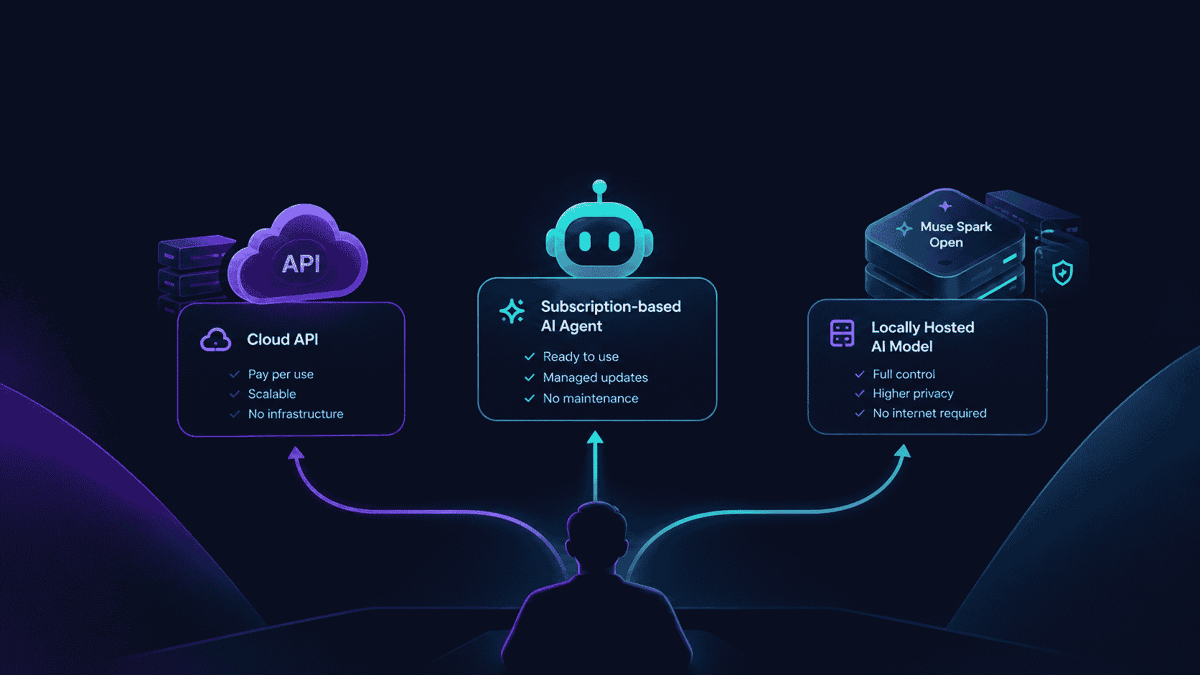
The releases give developers three different ways to approach advanced AI. They can access Muse Wonder through an API, use the more capable Wonder Full through a subscription, or explore self-hosting with Spark Open. Each option comes with different costs, technical requirements and levels of control.
For African businesses, this is more than another round of model launches. It raises a practical question: can better AI models help smaller companies build useful products and automate work without creating a new dependency on expensive infrastructure and overseas services?
The answer depends less on the headline benchmark scores than on how businesses choose, deploy and evaluate these models.
What Meta has released
Meta’s new models sit at different points in the balance between capability, access and control.
Model | Access | What it offers |
|---|---|---|
Muse Wonder Full | Muse Code subscription | Meta’s most capable model in this release, aimed at demanding professional and agentic tasks |
Muse Wonder | Meta Model API and Muse Code | A proprietary model available to developers, with usage-based API pricing |
Muse Spark Open | Downloadable weights and third-party inference providers | A customisable, multimodal model that can be self-hosted or accessed through a provider |
Meta introduced the Wonder series on October 12, describing the models as designed for personal and professional agents, complex coding and work across areas such as law, finance and health. The company subsequently released Spark Open’s weights on October 15.
The distinction is important for developers. Access to a model through an API means a company can start building without purchasing and maintaining the hardware needed to run it. Downloadable weights offer more control, but the company takes on more responsibility for deployment, updates, security and performance. These are different operating choices, not simply three versions of the same product.
How capable are the new models?
The models reported performance puts Meta back into serious competition at the upper end of the AI market, although the results should be interpreted in context.
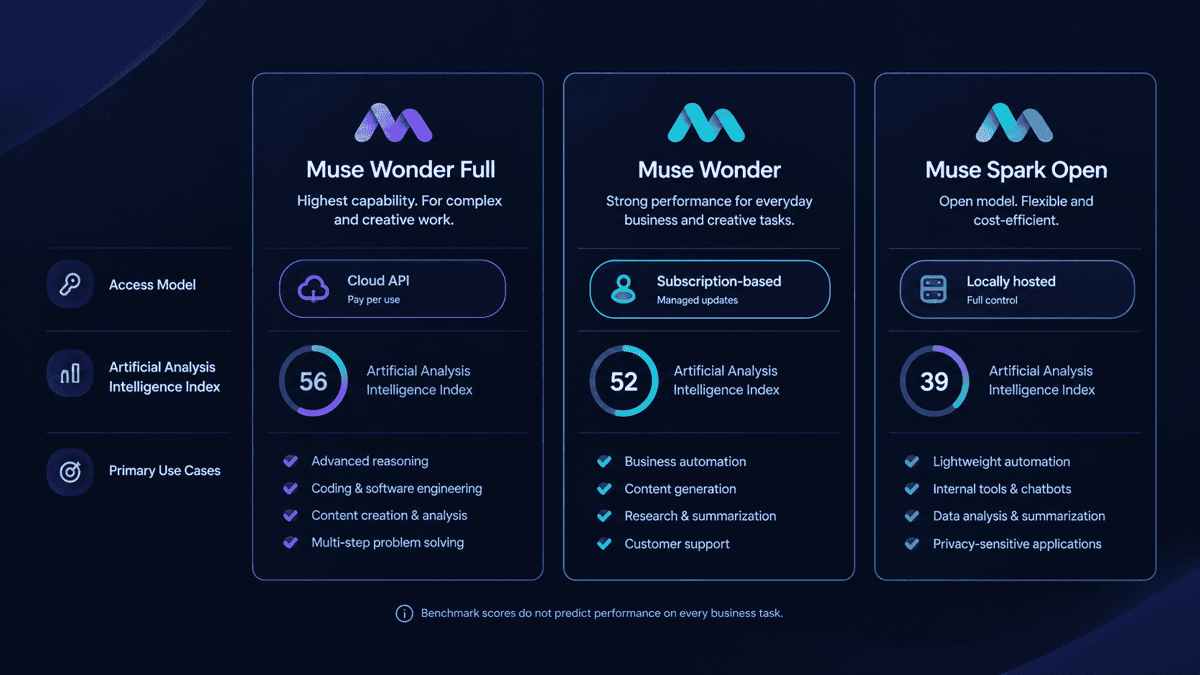
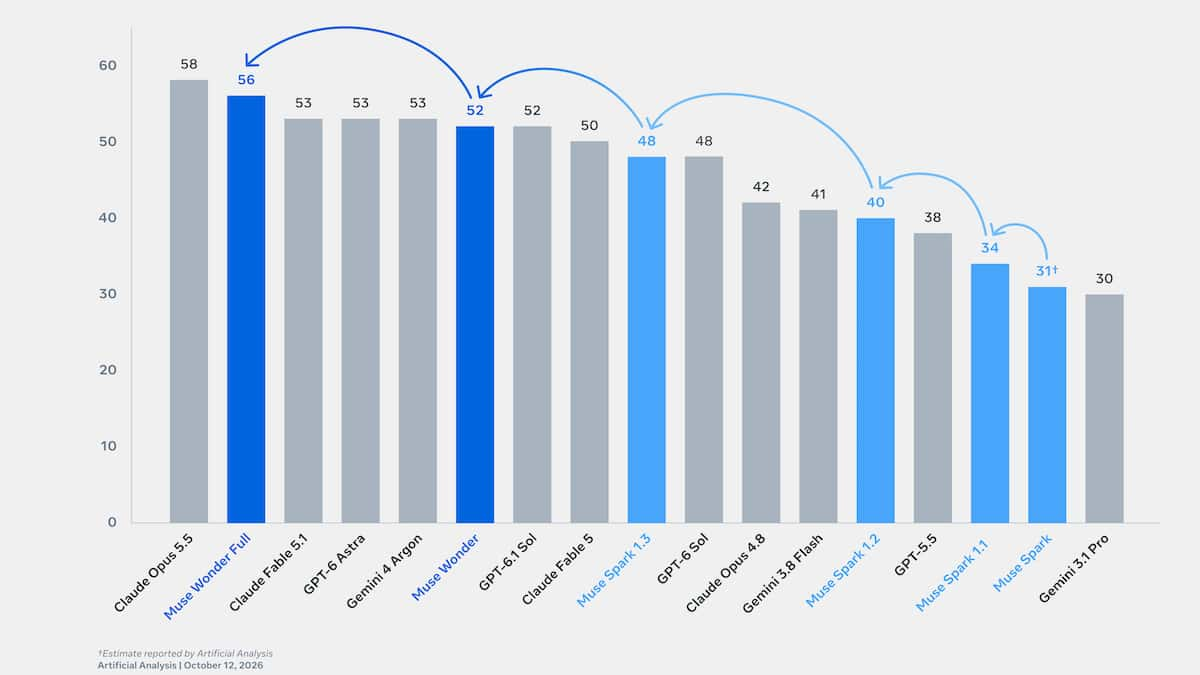
In its October assessment, Artificial Analysis gave Muse Wonder Full an Intelligence Index score of 56, Muse Wonder 52, and Muse Spark Open 39. The index combines results from ten evaluations covering areas including reasoning, coding, professional tasks and knowledge. It is useful for comparing broad performance, but it cannot establish which model will perform best for a particular company's workflow. Artificial Analysis's assessment of Muse Wonder reports that Wonder Full performed strongly across several professional and agentic benchmarks. Its results were particularly competitive on some coding and sustained-task evaluations.
Spark Open's score is lower, but that does not make it irrelevant. A business building an internal assistant, a document-processing tool or an AI feature for a customer-facing application may not need the most capable model available. It needs a model that handles its own tasks accurately at a sustainable cost. There is also a multimodal advantage. Meta describes Spark Open as accepting text, images, audio and video, while producing text output. This gives developers a possible route to applications that process more than typed questions and documents.
Consider a logistics business that needs to extract information from delivery documents, examine photographs of damaged packages and summarise recorded customer complaints. A multimodal model could help combine these tasks in one workflow. It would still need testing for local terminology, document quality, accuracy and the consequences of an incorrect result.
The cost question: API access versus running your own model
For many businesses, the first barrier to AI adoption is not access to a model. It is the cost of using that model frequently enough to support a real service. Artificial Analysis has Muse Wonder at US$4 per million input tokens and US$20 per million output tokens. Its benchmark-based estimate places the cost of an Intelligence Index task at approximately US$4.52. That task estimate is a testing measure, not a prediction of what every business request will cost.
Muse Spark Open has lower listed API rates: US$1.25 per million input tokens and US$4.25 per million output tokens. Artificial Analysis estimates its Intelligence Index task cost at about US$0.84. These figures are based on the provider pricing and benchmark methodology published by Artificial Analysis. Actual expenditure will vary with the length of prompts, output size, reasoning settings, caching and how a system is designed.
Wonder Full, meanwhile, is available through Muse Code's subscription offering rather than the public API route described for Wonder. The subscription is a different purchasing model from paying per token, so businesses should compare the actual plan terms and usage limits against their workload before committing.
For an early-stage startup, the cheaper model may be the more sensible place to begin. A business can test a workflow on a lower-cost model and use a more capable model only when the task justifies the additional expense.
For example, a customer-support system might use a less expensive model to categorise routine questions and reserve a stronger model for complex complaints. The company should measure whether this approach preserves answer quality rather than assuming that routing automatically saves money.
There is another consideration for African businesses: dollar-denominated pricing exposes local operating costs to exchange-rate movements. A service that appears affordable during a pilot can become harder to sustain as usage grows or the local currency weakens. Token prices are only one part of the budget; monitoring, integration, staff time and quality assurance also count.
Spark Open makes local deployment possible but not cheap
The most interesting part of Meta's release may be Spark Open's availability for local deployment. Meta says the model has 816 billion total parameters, with 42 billion active per token, and a context window of approximately one million tokens. It uses a sparse mixture-of-experts architecture, activating a subset of its parameters for each token rather than using every parameter in the same way.
That does not mean a computer needs memory for only 42 billion parameters. The full model weights still have to be loaded for inference. Meta says its optimised setup can run on two Apple Mac Studio systems with M5 Ultra chips, each configured with up to 512GB of unified memory. Its technical documentation also describes other hardware configurations, including multi-GPU servers. This is a significant engineering development, but it should not be confused with making the model practical for every small business. Two high-memory Mac Studio systems or a suitable multi-GPU server represent a substantial capital investment, with additional costs for power, cooling, maintenance and technical expertise.
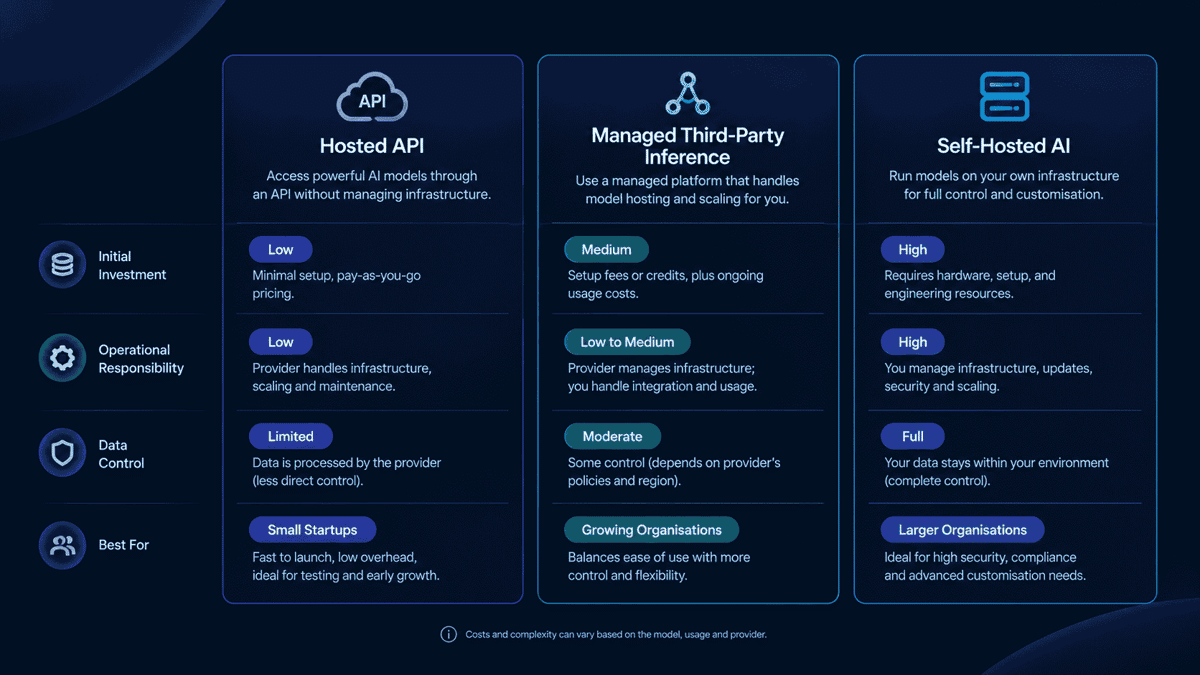
For most small businesses, accessing Spark Open through a hosted API may be more practical than purchasing hardware. Local deployment becomes more attractive when a company has sustained demand, suitable technical staff, strict data-control requirements or a clear reason to operate its own infrastructure.
Universities, research labs, larger software firms and AI infrastructure providers may be better positioned to experiment with self-hosting. They can spread infrastructure costs across multiple projects or users instead of assigning the entire expense to one application. There is a further distinction between keeping data on your own infrastructure and making a system secure. Self-hosting can reduce dependence on an external inference provider, but it does not automatically provide encryption, access controls, reliable backups, secure logging or protection against misuse. Those remain the operator's responsibility.
Is Spark Open really open source?
The term “open” requires some care. Meta has released Spark Open's model weights under the Muse Model License, allowing users to access, modify, fine-tune, distribute and build derivatives from the model subject to its conditions. That is a meaningful opportunity for developers who want more control than a proprietary API normally offers. However, the licence includes obligations. Products or services using the model must display the required “Built with Muse Spark Open” attribution in an allowed location, and use is subject to the model's acceptable-use policy.
It also contains a specific provision for businesses providing models as a service. If the licensee and its affiliates exceed US$20 million in aggregate gross revenue during a consecutive 12-month period, the licence requires notification to Meta and a separate written agreement before offering Spark Open or derivatives as part of that model-serving business. This is not a general US$20 million cap on every commercial use: the licence describes exemptions, including internal use and incorporating the model into a company's own product where that product is not itself a model-as-a-service offering.
Developers should read the Muse Model License and applicable usage policy before building a commercial service. Meta has not made the Wonder models' weights available under the same arrangement. Wonder and Wonder Full remain proprietary offerings.
The broader lesson is that downloadable weights provide technical access, but the licence determines what a business can do with them. Entrepreneurs should review those conditions early, particularly if they plan to offer AI inference as a paid service, redistribute a derivative model or build a product intended to scale internationally.
What this means for African businesses and entrepreneurs
The models' importance for Africa is not that every company should start running a large AI model locally. It is that businesses have more options for matching AI capability to their actual needs.
1. Start with a business problem, not the model
An SME does not need a frontier model simply because it is available. A retailer may need help answering repetitive customer questions, a professional-services firm may need document extraction, and a startup may want to speed up software development. Before choosing a model, identify the process that is slow, expensive or difficult to scale. Establish a baseline, define what a good result looks like, and test whether AI improves the outcome enough to justify the cost.
For routine classification, extraction or summarisation, a smaller and less expensive model may be sufficient. More capable models become relevant when tasks involve complex reasoning, longer workflows or multiple types of input.
2. Treat local languages and context as a test requirement
A model's ability to process text, images, audio and video does not prove that it will handle Nigerian accents, local expressions, mixed-language conversations or industry-specific terminology reliably. A business serving customers in Ghana or elsewhere in Africa should evaluate its chosen model using real, permissioned examples from the intended audience. That includes checking how it handles names, currency values, addresses, local business documents and ambiguous requests.
The same principle applies to regional expansion. A model that performs well for one customer group may need further testing before being used across different countries or languages.
3. Calculate the full cost of ownership
API pricing makes it easier to start, but costs can rise as customers generate more requests and agents perform multiple steps per task. Self-hosting shifts some of those costs from usage fees to infrastructure and operations. Founders should estimate likely monthly volume, average input and output size, the number of model calls per workflow, and the cost of monitoring and human review. They should also consider exchange-rate exposure and whether their chosen provider offers dependable access in the markets they serve.
A small pilot with measured results is more useful than a broad commitment based on a model's headline price.
4. Keep sensitive information and permissions under control
Businesses using AI for customer support, finance, health, legal work or internal operations need clear rules for what data can be sent to an external service. Self-hosting may give an organisation more direct control over data handling, but it brings additional security responsibilities. Hosted services also require careful review of their terms, retention policies, access controls and operational safeguards.
For AI agents that can send messages, change records or execute transactions, begin with limited permissions and require human approval for consequential actions. A model's ability to complete a task is not a substitute for a safe workflow.
5. Look for opportunities to build, not just consume
For African software entrepreneurs, Spark Open offers another model to evaluate when building specialised tools, particularly where multimodal input or deployment control is valuable. Researchers and developers can also investigate fine-tuning or adapting the model for a narrower task. But the competitive advantage is unlikely to come from simply wrapping a powerful model in another chat interface. More durable value may come from combining AI with trusted local data, domain expertise, integrations, customer relationships and an understanding of how work is actually done in a particular market.
A model is an enabling component. The product still has to solve a problem people will pay to fix.
Meta's return to open weights changes the choice, not the fundamentals
Meta's release brings a useful combination to the AI ecosystem: proprietary models positioned for demanding agentic work and an open-weight alternative that developers can inspect, customise and deploy within the limits of its licence. Artificial Analysis's results suggest that Muse Wonder Full is competitive with leading models on several demanding evaluations, while Spark Open offers a lower-cost API option and a route to self-hosting. The trade-offs are clear: stronger capability can cost more, and greater infrastructure control requires more engineering and operational responsibility.
For businesses, the practical opportunity is to make more deliberate choices. A startup can begin with hosted inference, evaluate results on its own workflows and consider local deployment only when the economics, privacy requirements and technical capacity justify it. The release does not remove the challenges of affordability, foreign-currency costs, reliable connectivity, data quality or AI governance. It gives developers more options for working around some of them.
Ultimately, the model that matters most to a business is not necessarily the one at the top of a benchmark. It is the one that delivers a dependable improvement to a real workflow, at a cost the business can sustain.The question for founders is no longer simply which AI model is most powerful. It is which combination of capability, cost and control makes sense for the product they are trying to build.
Read more: Claude Code vs OpenAI Codex vs Qoder: Which AI Coding Tool Is Best for Developers?
Read more: Open-Weight AI Is Catching Up to GPT-5.5 But There's a Growing Safety Debate
Read more: Cassava Adds NVIDIA Nemotron to Its AI Platform: What It Could Mean for African Businesses
Read more: How Founders and Students Can Build Businesses With Coding Agents

Author
Azeez LiadiAzeez is an AI Engineer, Data Scientist, founder, and Senior Tech Writer at Afritech Connect. A top 1% graduate of Lagos State University, he has worked with international startups and… Explore author & articles





