iPhone 17 Pro Max vs iPhone 18 Pro Max: Price & Specs Comparison in Nigeria
iPhone 17 Pro Max vs iPhone 18 Pro Max compared for Nigeria. We examine current prices, cameras, battery, performance and the upgrades that actually matter.

The iPhone 18 Pro Max is finally here, which changes the question for Nigerian buyers.
It's no longer:
Should you buy the iPhone 17 Pro Max or wait for the 18 Pro Max?
Now it's:
Does the iPhone 18 Pro Max improve enough to justify paying more than a discounted iPhone 17 Pro Max?
After comparing the two generations, we think the answer is more interesting than the familiar “new iPhone is faster” story.
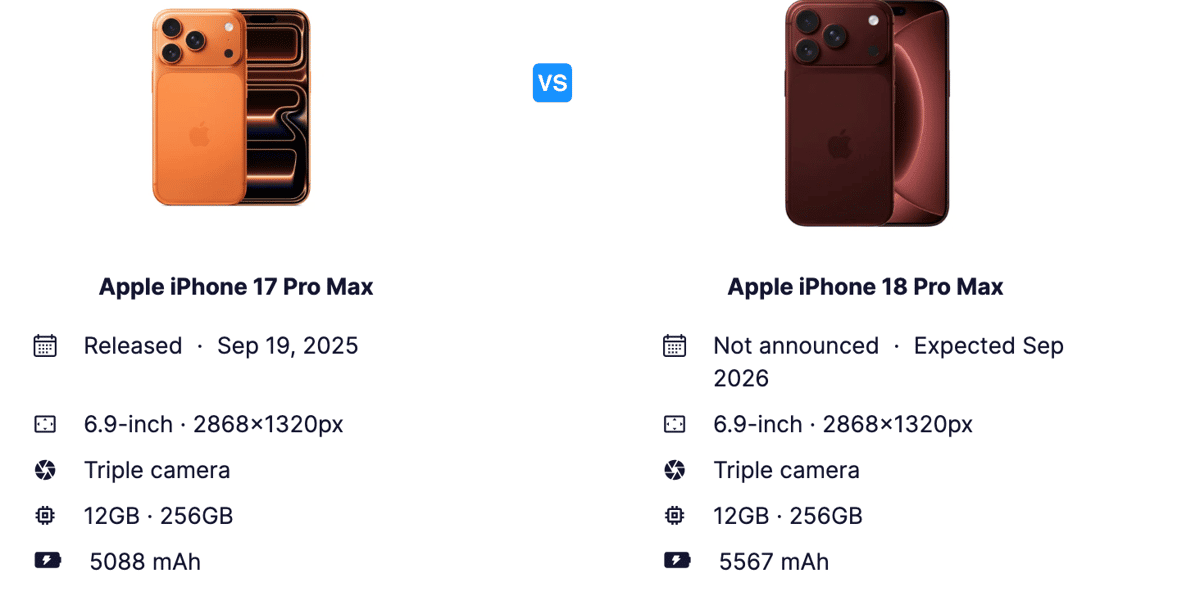
The displays remain similar in size. Both have three 48MP rear cameras. Both start with 256GB storage and go up to 2TB. And visually, you're still getting Apple's familiar large Pro Max format.
But underneath those similarities, Apple has made changes that could actually affect everyday use: variable aperture, A20 Pro, a larger battery, substantially longer rated endurance, faster charging, improved thermal management and a smaller Dynamic Island.
Let's examine what those differences actually mean.
iPhone 17 Pro Max vs 18 Pro Max: Quick Comparison
Feature | iPhone 17 Pro Max | iPhone 18 Pro Max |
|---|---|---|
Display | 6.9-inch OLED, 120Hz | 6.9-inch OLED, 120Hz |
Processor | A19 Pro | A20 Pro |
Main camera | 48MP, fixed aperture | 48MP, variable aperture |
Ultrawide | 48MP | 48MP |
Telephoto | 48MP | 48MP |
Maximum optical-quality zoom | 8x | 8x |
Front camera | 18MP Center Stage | 18MP Center Stage |
Video playback | Up to 37 hours | Up to 43 hours |
Wired fast charge | 50% in ~20 min | 50% in ~15 min |
Storage | 256GB–2TB | 256GB–2TB |
Starting US price at launch | $1,199 | $1,299 |
Nigeria 17 Pro Max 256GB | ₦2,379,000 | — |
The table makes the two phones look similar. But we'd pay particular attention to camera control, battery life and sustained performance, because those are where the newer model moves beyond a routine processor refresh.
Price in Nigeria: This May Decide Everything
The iPhone 17 Pro Max launched in the US at $1,199 for 256GB. Apple has increased the US starting price of the iPhone 18 Pro Max to $1,299 for 256GB. Storage options remain 256GB, 512GB, 1TB and 2TB.
In Nigeria, the older phone is already becoming more interesting because its price is moving.
At the time of our latest check, iStore Nigeria lists the iPhone 17 Pro Max at:
256GB: ₦2,379,000
512GB: ₦2,779,000
1TB: ₦3,579,000
2TB: ₦3,979,000
Those prices have already shifted from some of the higher figures we saw earlier in the year. The wider Nigerian market can be cheaper still.
Recent market tracking found new 256GB units around ₦2.1 million–₦2.28 million, depending on retailer, while certified/used stock can fall considerably below that.
That creates the real comparison. The iPhone 18 Pro Max doesn't need to be better than the 17 Pro Max.
Of course it is newer. It needs to be better enough to justify whatever price gap you find when you're ready to buy.
Performance: A19 Pro vs A20 Pro
This is one area where Apple has made more than a naming change. The iPhone 18 Pro Max uses the new A20 Pro, manufactured using a 2nm process.
Apple says it has 50% more memory bandwidth than A19 Pro and uses a new 7-core GPU with performance up to 40% faster than the previous generation in Apple's testing.
There's also a Dual 16-core Neural Engine with 32 total cores, putting considerably more emphasis on on-device AI.
But here's the practical question: Will someone browsing Instagram, using WhatsApp, watching YouTube and taking photos notice a 40% GPU improvement?
Probably not most of the time. The A19 Pro is already extremely powerful.
Where we'd expect A20 Pro to become more relevant is:
High-end gaming
Video editing
On-device AI
Computational photography
Long editing/export workloads
Professional applications
Keeping the phone for many years
Apple has also redesigned the vapor chamber, giving it three times more surface area than the previous generation and connecting A20 Pro more directly to the cooling system. That's arguably more interesting to us than a benchmark number.
Peak performance is easy. Maintaining performance during a long gaming session, video export or heavy AI workload is harder.
Battery: Six More Hours Is Not a Small Change
The original rumours focused heavily on battery capacity. Now that the phone is official, we'd stop obsessing over unconfirmed mAh numbers and look at Apple's directly comparable endurance claims instead.
Apple rates the iPhone 17 Pro Max for:
Up to 37 hours of video playback
Up to 33 hours of streamed video
The iPhone 18 Pro Max increases that to:
Up to 43 hours of video playback
Up to 38 hours streamed
That's six additional hours in Apple's standard video-playback test. Apple also now gives a broader “typical use” figure of up to 29 hours per charge for the 18 Pro Max.
Those aren't our own battery-test results, so we'd treat them as Apple's controlled testing rather than guaranteed everyday runtime.
But the generational difference is large enough to be interesting. For Nigerian users, battery improvements can matter more than another processor benchmark.
Long commutes, mobile hotspot use, unstable electricity, video recording, 5G and hours away from a charger all make endurance useful.
This is one upgrade we'd want to verify with our own real-world battery testing.
Charging Is Faster Too
The original comparison expected both generations to remain around the same charging speed. That didn't happen. The iPhone 17 Pro Max can reach approximately 50% in 20 minutes with a suitable 40W-or-higher adapter.
Apple now rates the iPhone 18 Pro Max for approximately: 50% in 15 minutes
with a compatible 60W-capable adapter supporting the required charging standard.
Five minutes doesn't look dramatic on paper. But fast charging is most valuable when you don't have much time.
Apple also says five minutes of wired charging can provide around seven hours of video playback on the 18 Pro Max.
That's potentially useful when power returns briefly and you need to top up quickly.
Camera: Variable Aperture Is the Upgrade We'd Actually Test
This is probably the most technically interesting difference. Both generations use three 48MP rear cameras.
So anyone looking only at megapixels might conclude that almost nothing changed.
That's precisely why megapixels alone are a poor way to judge cameras. The iPhone 18 Pro Max introduces a variable-aperture 48MP Fusion Main camera.
Instead of operating at one fixed aperture, Apple provides:
f/1.48
f/1.8
f/2.8
f/4.0
That gives the camera more control over how much light enters through the lens and how depth of field behaves. This could matter in two very different situations.
In lower light, the wider f/1.48 setting can allow more light into the camera.
In bright conditions—or situations where you want more of the scene in focus—a narrower aperture can be useful.
And for creators who want greater control over natural depth of field, variable aperture makes the main camera more flexible than the fixed-aperture system on the 17 Pro Max.
But this is also where we'd avoid simply repeating Apple's marketing.
The test we'd actually want to perform is: same subject, same lighting, 17 Pro Max versus 18 Pro Max at different apertures.
Does f/1.48 meaningfully improve night photography?
How natural is the depth separation?
Does stopping down produce visibly sharper group photographs?
How does it affect video?
Those results would tell us much more than “variable aperture” printed on a specification page.
Zoom Isn't Necessarily the Reason to Upgrade
The 18 Pro Max still uses a 48MP Fusion Telephoto camera providing 4x optical magnification and up to 8x optical-quality zoom.
That's important because the newer phone doesn't automatically give you dramatically longer telephoto reach.
If your main reason for upgrading is:
I want much more zoom.
we wouldn't assume the 18 Pro Max transforms that experience. The bigger camera story this year is how Apple handles light and depth with the main camera, rather than simply pushing another giant zoom number.
The Front Camera Isn't a Major Generational Change
Both generations already use Apple's 18MP Center Stage front camera. So this isn't an area where we'd expect someone moving from the 17 Pro Max to immediately feel that they have a completely different phone.
The 18 Pro Max does add additional Pro controls and continues features including Center Stage, Dual Capture and ultra-stabilized video.
For someone coming from an older iPhone, however, the front-camera experience will still represent a much bigger jump.
Display: Familiar Size, Small Refinements
Both phones use a 6.9-inch Super Retina XDR OLED display with ProMotion up to 120Hz. The iPhone 18 Pro Max resolution remains 2868 × 1320.
So don't expect the basic viewing experience to suddenly feel revolutionary if you're moving from a 17 Pro Max.
Apple has, however, improved anti-reflection and made the Dynamic Island smaller on the 18 Pro generation.
Those are welcome refinements. But we wouldn't upgrade from a 17 Pro Max purely for the display.
If you're coming from an iPhone XR, 11 or another older LCD iPhone, that's a completely different story. The jump to a large 120Hz OLED flagship display will be immediately obvious.
Something Else Changed: The iPhone 18 Pro Max Is Heavier
The original rumours suggested the 18 Pro Max might be slightly lighter. The finished product went in the opposite direction.
Apple lists the iPhone 18 Pro Max at 249g. That's a heavy smartphone.
Part of the trade-off appears to be the larger battery and upgraded internal hardware. If you already find large Pro Max phones uncomfortable, this isn't the generation that suddenly becomes compact.
We'd strongly recommend holding one before buying if weight bothers you.
Siri AI and Apple Intelligence
There's another difference that won't show up in a conventional camera-and-battery comparison. The iPhone 18 Pro Max ships with iOS 27 and Apple's new Siri AI experience.
Apple describes Siri AI as more conversational and personal, with Apple Intelligence increasingly integrated across the system.
The A20 Pro also puts substantially more hardware behind on-device AI workloads.
But we'd separate two questions: Can the iPhone 18 Pro Max run newer AI features well? Yes, that's clearly one of Apple's priorities.
Do you need an iPhone 18 Pro Max specifically to benefit from Apple Intelligence? No. The iPhone 17 Pro Max remains an Apple Intelligence-capable device. So AI alone wouldn't make us abandon a perfectly good 17 Pro Max.
Connectivity Gets an Under-the-Hood Upgrade
Both generations support Wi-Fi 7 and Bluetooth 6. The iPhone 18 Pro generation adds Apple's C2 cellular modem system.
Apple says C2 provides faster uploads than C1X while consuming 15% less energy.
This is another feature we'd rather evaluate in actual Nigerian network conditions than simply accept as a universal improvement.
Real cellular performance depends heavily on:
MTN/Airtel/Glo/9mobile coverage
Location
Congestion
Signal strength
Available spectrum
Network configuration
A better modem can't create good network coverage where none exists. But improved modem efficiency could contribute to the 18 Pro Max's battery gains during mobile-data use.
What Does This Mean for Nigerian Buyers?
This is where we'd split buyers into two groups. If you're using something like: iPhone XR → iPhone 17 Pro Max
that's already an enormous upgrade. You'd gain OLED, 120Hz ProMotion, dramatically better cameras, USB-C, Apple Intelligence, 5G and far stronger performance. If you find the 17 Pro Max at a substantial discount, we'd seriously consider saving the money. But if you're choosing between two similarly priced new phones, the 18 Pro Max now has meaningful advantages rather than merely being one year newer.
The bigger battery rating, faster charging, variable-aperture camera, A20 Pro and improved thermal system all add up.
What If You Already Own the iPhone 17 Pro Max?
This is where we'd be much more conservative. The 17 Pro Max remains extremely capable.
You're not gaining:
A larger display
More storage tiers
More rear cameras
A completely different design
A dramatically longer telephoto zoom
A fundamentally different iPhone experience
You are gaining:
A20 Pro
Variable aperture
Better rated battery life
Faster charging
Better sustained-performance hardware
Smaller Dynamic Island
C2 modem
New camera controls
Those are legitimate improvements. Whether they're worth replacing a one-year-old flagship is another question.
We'd wait for the feature that solves an actual problem you have rather than upgrading simply because the model number increased.
Frequently Asked Questions
Is the iPhone 18 Pro Max officially available?
Yes. Apple announced the iPhone 18 Pro and Pro Max on September 9, 2026, with general availability beginning September 18.
How much is the iPhone 17 Pro Max in Nigeria?
At the time of our latest check, iStore Nigeria lists the 256GB model at approximately ₦2,379,000. The wider Nigerian market can be cheaper depending on seller, region, warranty and whether the device is new or used.
How much is the iPhone 18 Pro Max?
Apple's official US starting price is $1,299 for 256GB. Nigerian pricing varies by retailer and availability, so we'd compare current authorised and independent-retailer prices rather than converting the US price directly into naira.
Does the iPhone 18 Pro Max have better battery life?
According to Apple's comparable video-playback testing, yes. The 17 Pro Max is rated for up to 37 hours, while the 18 Pro Max reaches 43 hours. That's Apple's laboratory claim; actual endurance depends on how you use the phone.
Does the iPhone 18 Pro Max have variable aperture?
Yes. This is no longer a rumour. The 48MP Fusion Main camera provides f/1.48, f/1.8, f/2.8 and f/4.0 aperture options.
Should I upgrade from iPhone 17 Pro Max?
We'd first ask what problem you're trying to solve. Battery life, charging speed and greater main-camera control are the strongest practical reasons we see.
If your 17 Pro Max already comfortably handles everything you do, the generational difference is less compelling.
Final Verdict
The iPhone 18 Pro Max turned out to be a more substantial upgrade than the early specification comparisons suggested. Not because Apple changed everything.
It didn't. The screen remains 6.9 inches. Storage still starts at 256GB. There are still three 48MP rear cameras, and the overall Pro Max concept remains familiar.
The meaningful changes are underneath. A20 Pro brings significantly more graphics and AI performance.
The redesigned cooling system targets sustained performance rather than short benchmark bursts.
Battery playback increases from Apple's 37-hour rating to 43 hours.
Charging to 50% drops from roughly 20 minutes to 15 minutes with the appropriate equipment.
And most interestingly, variable aperture gives the main camera a capability the 17 Pro Max simply doesn't have.
For someone already carrying an iPhone 17 Pro Max, we don't see a universal reason to replace it after one year.
The improvements are meaningful, but the older phone hasn't suddenly become slow, obsolete or incapable.
For someone buying today, however, we'd approach the decision differently.
Check the actual Nigerian price difference. If the 17 Pro Max is several hundred thousand naira cheaper, the older flagship becomes much easier to justify—especially for someone who mainly uses WhatsApp, social media, photography, streaming and ordinary productivity.
If the price difference is relatively small, the 18 Pro Max's battery improvements, faster charging, A20 Pro and variable-aperture camera make the additional spend easier to understand.
That's ultimately the comparison we'd make in Nigeria: not “Which phone has the bigger specification?” but “What am I getting for the extra naira?”
Because once both phones are this powerful, price difference and how long you intend to keep the phone matter more than annual upgrade hype.
Read more: iPhone 18 Pro Max vs Samsung Galaxy S26 Ultra: Which Flagship Should You Buy?
Read more: iPhone Duo vs Galaxy Z Fold8 vs Xiaomi 18 Fold vs Huawei Pura X Max: Which Should You Buy?
Read more: iPhone Duo vs Samsung Galaxy Z Fold8: Specs, Price and Which Foldable Should You Buy?

Author
Adebayo JohnsonSenior tech editor with over 4 years of experience covering mobile and gadget technology. Explore author & articles