Moove Exits Nigeria After Uber: Why Is Africa’s $2 Billion Mobility Giant Leaving Its Home Market?
Moove is exiting Nigeria after Uber, transferring ₦35 billion in vehicles to drivers. What went wrong, and what does it mean for Nigeria's mobility market?
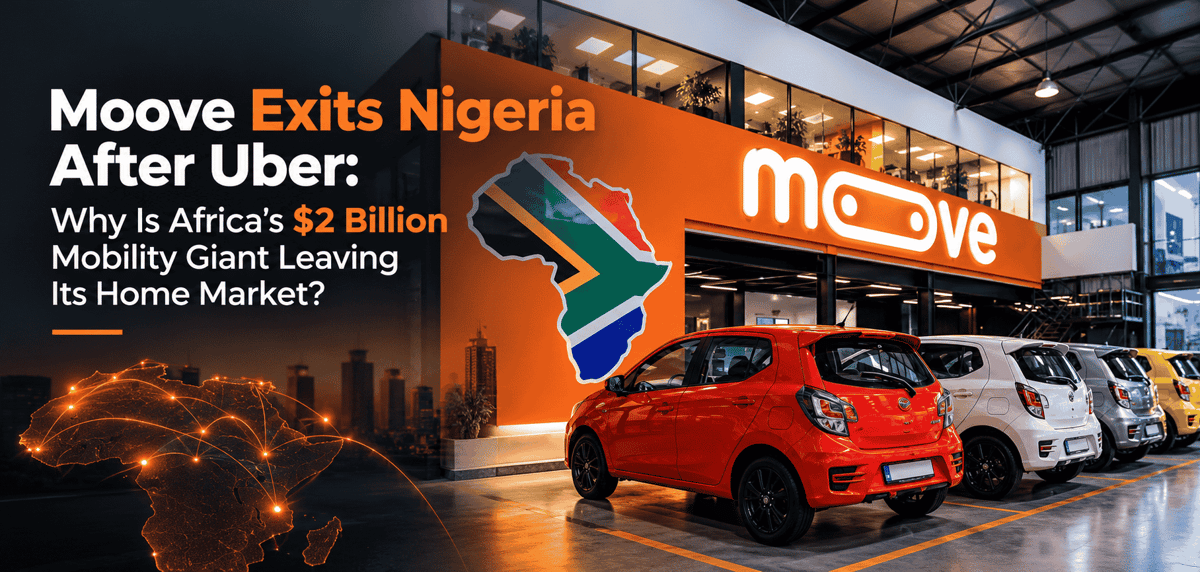
Nigeria has just witnessed something unusual in its technology ecosystem: a startup founded in Lagos, which went on to become a multibillion-dollar global mobility business, is leaving the country where its journey began.
On October 8, 2026, Moove announced that it was concluding its Nigerian operations after six years, barely a month after Uber ended its 12-year presence in the country. But unlike a conventional business shutdown, Moove is leaving behind something extraordinary.
The company says it will transfer vehicles worth approximately ₦35 billion ($26.3 million) to eligible customers currently operating them, without requiring further payment to Moove for the vehicles themselves. It also announced that staff members would receive a free car under its Thank You Nigeria initiative.
That makes the announcement both a celebration and a warning. Moove has helped thousands of Nigerians gain access to vehicles and earn a living. Yet the same company, now operating tens of thousands of vehicles globally, says it can no longer sustain its Nigerian business model.
How did a Nigerian startup achieve so much internationally, only to conclude that remaining in its home market no longer makes commercial sense?
And with Uber also gone, should Nigerians expect more mobility companies to leave or could this create an opportunity for a new generation of local operators?
From 76 vehicles in Lagos to 42,000 globally
Moove was founded in Lagos in 2020 by Ladi Delano and Jide Odunsi to solve a problem many Nigerian drivers understood firsthand. People wanted to work in ride-hailing, but buying a suitable vehicle was beyond their financial reach. Traditional vehicle financing was often difficult to access, especially for workers whose income came from gig platforms rather than conventional salaried employment.
Moove's approach was to finance vehicles through rental and Drive-to-Own arrangements, enabling drivers to earn income while working toward ownership. The company began with just 76 vehicles in Lagos. Six years later, Moove says its global operations cover 42,000 vehicles across 29 cities. Its ambitions expanded beyond traditional ride-hailing financing into fleet management, global mobility services and autonomous-vehicle operations.
In August, Moove announced a $250 million financing round at a valuation of approximately $2.1 billion, cementing its position among Africa's most valuable technology startups. Its rise also formed part of our analysis of Africa's new unicorns and why Moove's success matters beyond fintech.
But Moove's international expansion makes its Nigerian exit even more significant. This is not a small startup that failed to raise capital. It is a globally successful business deciding that the economics of its original market no longer justify continued operations.
Moove's Nigerian success cannot be measured by funding alone
Before focusing entirely on why Moove is leaving, it is worth examining what it achieved. According to the company, more than 9,000 customers used its Drive-to-Own and rental products in Nigeria over six years. Those customers generated approximately ₦57 billion in revenue through Moove-financed vehicles. That figure represents revenue generated by the customers using those vehicles, not Moove's own revenue or profit.
Behind those figures are drivers who earned income, supported families and participated in a market that might otherwise have excluded them because they couldn't afford vehicles.
The company's final gesture is particularly significant. Moove says eligible vehicles valued at about ₦35 billion will pass into customers' full ownership, with no further vehicle payments owed to Moove. The company says this arrangement is effective from October 1, 2026.
For an eligible driver, the difference could be enormous. Instead of continuing to make financing payments, that driver may now own an income-generating asset outright. Ownership, however, does not eliminate fuel, maintenance, insurance, licensing or other operating costs.
The transfer also applies to eligible vehicles, so customers should verify their individual status, documentation and any remaining administrative requirements directly with Moove. This is an important distinction between a company leaving customers stranded and one attempting to preserve value for them as it departs.
Why is Moove leaving Nigeria?
The most revealing explanation came from Moove's co-founder and co-CEO, Ladi Delano. In an October 8 interview with BusinessDay, Delano explained that Uber was the principal platform supporting Moove's Nigerian model at scale. When Uber withdrew from Nigeria in September, the operating environment changed materially. Moove evaluated alternatives but concluded that continuing the Nigerian business under its existing model was no longer sustainable.
That explanation reveals a deeper problem. Moove was not simply selling cars. Its financing model depended on drivers having access to sufficient commercial activity to generate income and meet their obligations. If a major ride-hailing platform disappears, the consequences can extend beyond the platform itself. Drivers lose access to a source of trips. Vehicle financiers may face uncertainty about repayment capacity. Fleet operators must reassess utilization and operating costs.
One company's exit can destabilize an entire chain of connected businesses. Uber ended its Nigerian operations on September 2, after 12 years, saying it was reassessing business priorities and focusing on markets where it could create greater value at scale.
We covered that earlier departure in Uber Is Leaving Nigeria After 12 Years — And Bolt and inDrive Are Ready to Take Its Riders.
Moove's decision suggests Uber's exit had consequences beyond passengers choosing another app. It removed a key commercial foundation from a financing business built partly around Uber's ecosystem.
What happens to Nigerian drivers and customers now?
For eligible Moove customers receiving full vehicle ownership, the immediate financial effect could be positive. They may be able to continue earning through other ride-hailing platforms, private transport arrangements or commercial vehicle services without owing Moove further payments for the vehicles.
However, owning a vehicle and having a profitable transport business are different things. Drivers still need paying customers. They still face fuel expenses, spare-part prices, insurance, vehicle maintenance and the challenge of setting fares customers can afford.
For customers who are not eligible for the vehicle transfer, the publicly available announcement does not establish every contractual outcome. They should obtain written confirmation of their individual arrangements.
For passengers, Moove's departure is not identical to losing another ride-hailing booking app. Moove primarily supported access to vehicles and mobility operations.
Nevertheless, if fewer drivers can obtain affordable financing, that could eventually affect vehicle supply and competition across the wider market.
Nigeria's mobility problem is bigger than Moove and Uber
Nigeria has enormous transportation demand. Millions of people need to commute, deliver goods, visit customers and move between cities. But demand alone does not guarantee a profitable mobility business.
The difficult question is whether fares can simultaneously satisfy passengers, drivers, vehicle owners, financing companies and platforms. Nigeria's rising fuel and maintenance costs, inflation and pressure on household purchasing power have made that balance harder to maintain.
Consider a simple example. A passenger wants a cheaper ride. The driver wants higher earnings because petrol, tyres and servicing have become more expensive.
The platform needs revenue to operate. A vehicle-financing company needs repayments. Each participant is responding rationally to their own costs, yet the overall business model can become unsustainable.
This is why Moove's exit should not be interpreted merely as another foreign-backed startup abandoning Nigeria. It raises a structural question about whether mobility companies can build durable economics in the country's present operating environment.
Is Nigeria's electric-mobility industry also in trouble?
This is where an important distinction must be made. Moove's exit does not mean Nigeria's electric-vehicle industry is collapsing. Moove is a mobility and vehicle-financing company, not simply an electric-vehicle manufacturer or charging-network operator. Nigeria's electric-mobility market is still developing, and investment continues.
In August, Nigeria had approved tax waivers for nearly 4,000 electric vehicles during the first half of 2026. The same report identified electricity reliability, charging infrastructure and vehicle affordability as major barriers to wider adoption. Electric motorcycles and three-wheelers may offer a more immediately practical opportunity than privately owned electric cars.
For commercial riders, reducing daily petrol expenditure can have a direct financial benefit. Companies such as MAX and Spiro are pursuing this opportunity through electric motorcycles and battery-swapping infrastructure.
Research organization RMI reports that Lagos has seen its battery-swapping network grow from a handful of stations to more than 100 over three years.
Meanwhile, Spiro announced in June that it had closed a $270 million funding round to expand its electric mobility and battery-swapping infrastructure across African markets, including Nigeria.
Government investment has not stopped either. On September 30, Nigeria's Presidential Initiative on CNG and Electric Vehicles announced the deployment of 35 additional buses in Lagos, comprising 15 CNG buses and 20 electric buses.
These developments show that Nigeria's mobility transition is not moving in one direction. Some business models are retreating while others are attracting capital.
Does Moove's departure create opportunities for competitors?
Potentially, yes. Bolt, inDrive and other transport operators may benefit from changes in driver availability and customer preferences following Uber's departure.
But Moove's exit creates a more complicated opportunity. If drivers increasingly own their vehicles outright, some may become more financially independent and able to choose where and how they operate.
At the same time, new drivers who still need vehicle financing could face fewer established options. That may create space for alternative financing providers, leasing companies, cooperatives, fleet-management startups and electric-vehicle operators.
But these businesses should not assume that Moove's departure means an easy market has suddenly opened. They would be entering the same environment that Moove found commercially difficult. A successful replacement would need to solve the underlying economics, not merely reproduce Moove's original model with a different logo.
For example, electric motorcycle financing linked to predictable delivery demand might have different economics from financing petrol-powered cars dependent on a single ride-hailing platform. Battery swapping, fleet maintenance and diversified commercial customers could also help reduce some operational risks. These are opportunities worth investigating not guarantees of profitability.
Will investors become reluctant to fund Nigerian mobility startups?
Some investors may become more cautious. Two prominent mobility-related departures within weeks naturally raise questions about Nigeria's operating costs, regulatory environment, market structure and long-term commercial sustainability.
A founder seeking capital for a vehicle-financing business may now face tougher questions.
What happens if a major ride-hailing partner exits?
How many platforms generate income for your drivers?
How do you manage fuel-price shocks?
What happens when maintenance costs rise faster than fares?
How do you recover financing when utilization falls?
But it would be wrong to conclude that investors will stop backing Nigerian mobility businesses altogether. The continued expansion of battery-swapping infrastructure, financing for African electric mobility and public transport electrification suggests that investors are still interested in business models with a credible route to sustainable economics.
The question may shift from: How many vehicles can you deploy?
To: How much does each vehicle earn, what does it cost to operate, and how resilient is the business when market conditions change?
That would be a healthy change in investment discipline. It also connects with our earlier examination of African startups raising more than $2 billion in 2026 and where that capital is actually going.
Fundraising can validate investor interest. It does not guarantee that a business model will work in every market.
Moove's exit leaves Nigeria with a difficult lesson
There are two ways to interpret Moove's departure The first is to see another successful Nigerian technology company leaving its home market after achieving global recognition. That is disappointing.
The second is to recognize what Moove built. A company that started with 76 vehicles in Lagos expanded to 42,000 vehicles across 29 cities, achieved a multibillion-dollar valuation and says it helped more than 9,000 Nigerian customers participate in the mobility economy.
Its decision to transfer approximately ₦35 billion worth of vehicles to eligible customers also means its departure could leave many drivers with something more valuable than continued access to a financing platform: ownership.
Both interpretations matter. But the larger lesson for Nigeria is uncomfortable.
A country can produce globally successful technology companies without creating the conditions that allow every one of those companies to remain commercially viable at home.
Moove's departure after Uber should encourage deeper questions about transportation costs, affordable financing, infrastructure, electricity, local partnerships and the economics of mobility platforms.
Nigeria does not lack people who need transportation. It does not lack entrepreneurs willing to build solutions. And recent electric-mobility investments suggest it has not completely lost investor interest.
What remains difficult is building transport businesses that passengers can afford, drivers can earn from, financiers can sustain and investors can support over the long term.
Moove has demonstrated that a Nigerian startup can become a global mobility giant. Its exit now raises a different question:
Can Nigeria build a mobility market strong enough to retain the next Moove?
Read more: Kenya’s ARC Ride Raises $33.3 Million as Africa’s Electric Motorcycle Race Accelerates
Read more: Shuttlers Pod Takes on Bolt and inDrive After Uber's Nigeria Exit
Read more: Bolt Brings Ride-Hailing to ChatGPT: What It Means for Nigerians and Africa

Author
Kwame MensahTech journalist covering AI, software, and emerging technologies impacting Africa's digital landscape and beyond.. Explore author & articles