OpenAI Opens ChatGPT Ads to Nigerian and South African Businesses as AI Advertising Expands
OpenAI has expanded ChatGPT Ads to Nigeria and South Africa. Explore its 1.2 billion weekly users, local campaign costs, business opportunities and limitations.
Businesses in Nigeria and South Africa now have another place to advertise online: ChatGPT. OpenAI announced on October 21, 2026, that it was expanding its advertising platform to 26 additional countries, including both African markets, bringing the service to 89 countries worldwide.
The expansion gives local businesses a new way to reach people while they research a product, compare alternatives or explore a service through an AI conversation. Rather than relying entirely on search results, social media feeds or professional networking platforms, advertisers can now explore a channel built around what people are trying to accomplish. The opportunity comes with significant scale. OpenAI says ChatGPT has more than 1.2 billion weekly users, and more than 100,000 advertisers have run campaigns since the advertising service launched. Those figures make ChatGPT a potentially important addition to the digital marketing mix, although its audience size alone does not guarantee that a particular campaign will produce sales.
For African businesses, the central question is whether advertising inside an AI assistant can help them reach customers at the right moment and whether the cost of acquiring those customers will compete with established platforms such as Google, Meta, TikTok, LinkedIn and X.
ChatGPT is becoming an advertising platform, not just an AI assistant
ChatGPT advertising model is different from the familiar social media feed. Users may ask questions such as which laptop is suitable for university, how to choose a wedding venue, what software a small business needs or which skincare products fit their budget. An advertisement relevant to that conversation could introduce a business while the user is still considering their options.
OpenAI says its ad system considers signals such as the context of the current conversation, the advertiser's landing page, ad copy and targeting settings. Advertisers can also provide context hints describing the types of conversations in which their products or services may be relevant. These hints help guide ad matching but do not guarantee that an advertisement will appear for a specific question. OpenAI's advertising guide explains that ads appear below ChatGPT responses and include the advertiser's name, headline, description, image and landing page. This creates a different opportunity from simply buying impressions on a social network. A brand can potentially reach someone who is actively exploring a need rather than someone who happens to scroll past a sponsored post. That does not mean ChatGPT advertising is equivalent to a recommendation from the AI. OpenAI says advertisements are labelled, separate from its answers, and do not influence the answers ChatGPT provides.
More than 1.2 billion weekly users create a sizeable potential audience
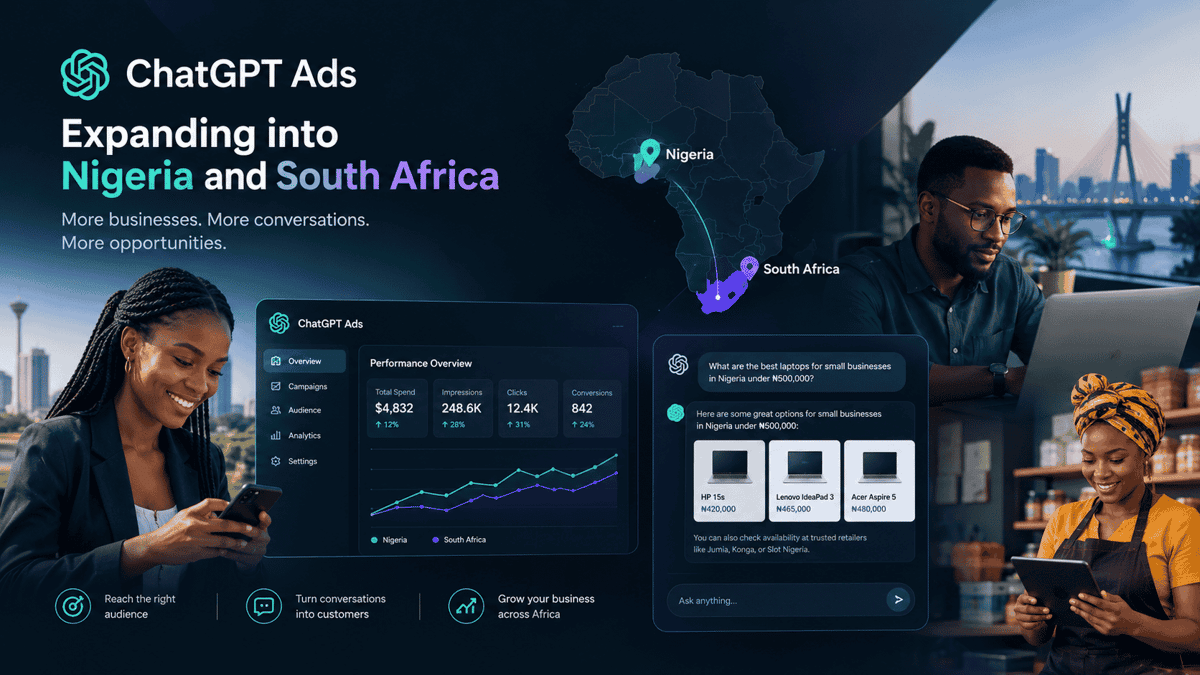
The audience figure is one reason businesses may want to evaluate the platform early. OpenAI reported more than 1.2 billion weekly ChatGPT users in its October 21 announcement. It also said over 100,000 advertisers had already run campaigns since the advertising business launched. These are global figures, not estimates of the number of users or advertisers in Nigeria or South Africa.
The company has not disclosed in the announcement how many weekly users it has in either country, how many of them will see ads, or how much inventory will initially be available to local advertisers. This is important when estimating market potential. A large worldwide audience does not tell a Nigerian retailer how many people in Lagos might see its campaign, or how much it will cost to generate a qualified lead in Johannesburg. Still, the expansion signals that OpenAI is developing advertising into a substantial business. Report has it that on August 31 that OpenAI's advertising operation had reached a US$1 billion annualised revenue run rate, according to the company. An annualised run rate projects a current rate of revenue across a year; it is not the same as having collected US$1 billion in advertising revenue during that year.
The growth of the company gives advertisers a reason to pay attention. But the more important measure for an individual business will be whether ChatGPT delivers qualified prospects, purchases or other measurable results at an acceptable cost.
What ChatGPT Ads cost in Nigeria and South Africa
One important detail for local advertisers is that the minimum budget depends on the account's billing currency. It is not universally US$25 a day. OpenAI's current campaign setup guidance has the following minimum daily budgets:
Billing currency | Minimum daily budget | 30-day budget at the minimum |
|---|---|---|
Nigerian naira (NGN) | ₦3,250 | ₦97,500 |
South African rand (ZAR) | R83 | R2,490 |
US dollar (USD) | $25 | $750 |
These are minimum campaign budgets, not estimates of the cost per customer or a guarantee that the campaign will generate a particular volume of traffic. Taxes, bank charges, currency conversion and other applicable fees may affect the final cost.
For a Nigerian business whose account is billed in naira, the minimum of ₦3,250 a day translates to about ₦97,500 over 30 days. A business billed in dollars faces a minimum of $25 a day, equivalent to $750 over 30 days. The naira amount for a dollar-billed campaign will depend on the exchange rate and payment charges.
OpenAI treats a daily budget as an average over a seven-day period. Actual daily spending can vary, with a maximum of twice the selected daily budget on an individual day and no more than seven times the daily budget across the applicable week. Advertisers who need tighter control over the total amount should consider a campaign-total budget where available.
For businesses, the sensible starting point is to choose a budget based on how much they can afford to test, not simply the maximum they can spend.
Why the timing matters: ChatGPT is becoming easier to access in local markets
The advertising expansion is happening alongside a wider shift in how people access AI tools. ChatGPT offers multiple subscription tiers, including Go, Plus and Pro. These plans provide different levels of access, and OpenAI supports local-currency subscription pricing in Nigeria and South Africa. Its customers can pay for standard subscriptions by credit or debit card, while purchases made through the iOS or Android apps are billed through the relevant app store and may appear in local currency.
Users may encounter prices around ₦7,000 for a lower-cost plan or ₦32,000 for a higher-tier plan, depending on the plan, checkout route and current pricing. These figures should be checked at checkout rather than treated as universal prices. ChatGPT Go, Plus and Pro are different products; the lower-priced plans should not be described as the Pro subscription. Local pricing and familiar payment methods can reduce some of the friction involved in paying for AI tools. That may encourage more people to use ChatGPT for work, study, shopping research and business planning. However, paid subscription availability does not prove how many people in Nigeria or South Africa use ChatGPT, and it does not establish how many users will be exposed to advertising. OpenAI has not published country-level audience figures alongside this expansion.
There is also a difference between access to ChatGPT Ads as an advertiser and seeing ads as a user. OpenAI says ads may appear for eligible users on the Free and Go plans. Plus, Pro and business subscriptions remain ad-free. The company has not announced that every eligible user in Nigeria or South Africa will immediately begin seeing advertisements.
Visual ads could give brands another way to present products
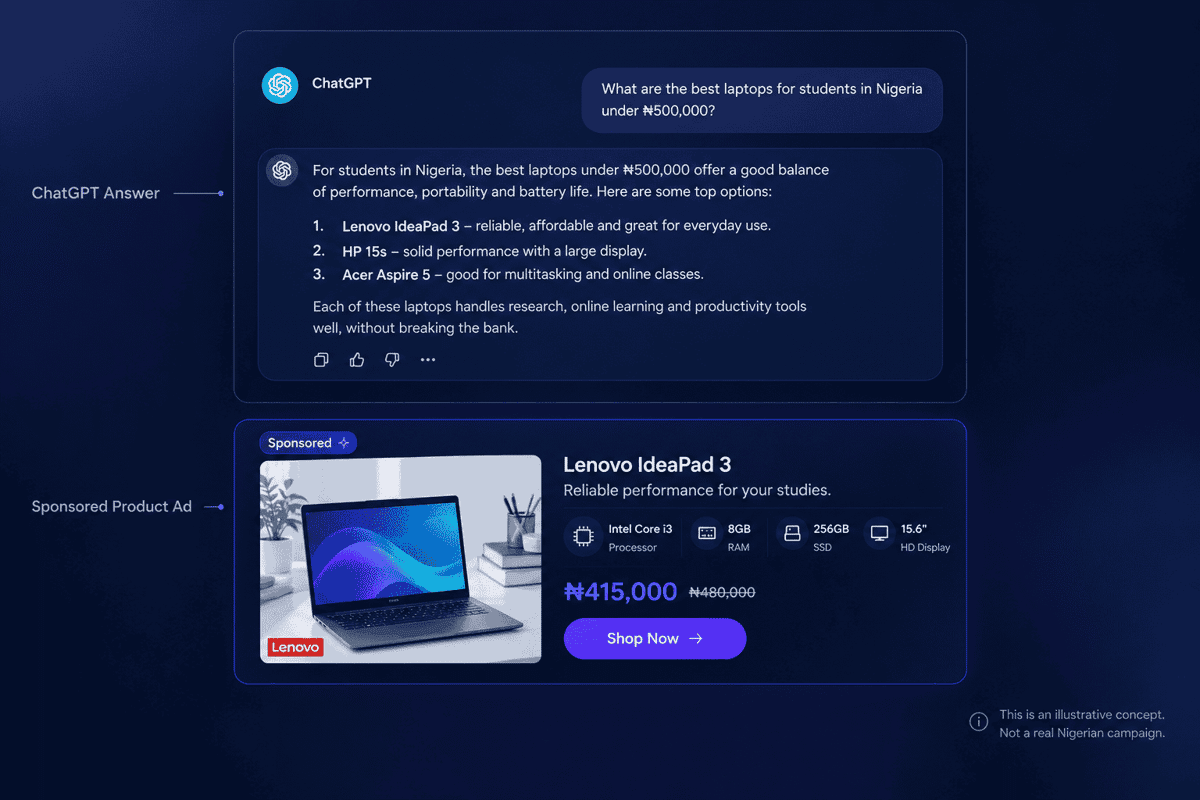
OpenAI is also developing more visual advertising formats. On October 5, the company announced a multi-image format intended to help users explore products and services through imagery. It said the initial test would take place in the United States during image generation in ChatGPT, with ads labelled and kept separate from the image being created.
For product-led businesses, visual advertising could help explain what a product looks like, how it is used or what experience it offers. Fashion, home furnishings, beauty, travel and consumer electronics are examples of categories where imagery may help customers understand an offering before clicking through. But there is an important limitation: the announcement describes a test, not confirmation that the visual format is already available to advertisers in Nigeria and South Africa. Businesses should check the ad formats offered in their accounts before preparing campaigns around a particular placement.
The more immediate opportunity is to test the advertising options actually available to them, then adapt creative assets as OpenAI expands the platform.
Which African businesses could benefit most?
ChatGPT Ads may be most useful for businesses whose customers ask questions, compare options or seek help choosing a solution before making a purchase.
Retailers and e-commerce businesses
A retailer selling laptops, phones, appliances or fashion products could use ChatGPT Ads to introduce a product to people researching what to buy. The ad would still need a clear product page, accurate pricing, delivery information and a simple purchase process.
For Nigerian retailers, trust remains important. Customers should be able to confirm that the product is available, understand delivery fees and find a reliable way to contact the seller.
Education and professional training
Training providers, online course businesses and professional certification companies may be able to reach people exploring career changes or learning a new skill. A useful campaign would direct users to a page that clearly explains the curriculum, price, entry requirements and expected outcomes. Education advertisers should avoid exaggerated promises about employment or guaranteed earnings.
Travel, hospitality and experiences
Hotels, tour operators, event venues and travel agencies could target people exploring holiday destinations, accommodation or activities. The effectiveness of these campaigns will depend on how closely the ad matches the customer's needs and whether the business can provide up-to-date availability and pricing.
Business software and B2B services
Software providers, IT consultants, accounting services and other B2B businesses may find value in reaching people researching how to solve a business problem. These products often require explanation and comparison, making a contextual advertising channel worth testing. However, companies selling high-value enterprise services may still need LinkedIn, industry events, direct outreach and sales teams to nurture prospects after the first interaction.
Local services and appointment-based businesses
Depending on campaign targeting and available inventory, businesses such as repair services, professional practices and home-service providers may test whether ChatGPT can help them attract customers who are actively looking for a solution. This group should start with a focused geography and a landing page designed to generate calls, bookings or enquiries rather than sending every visitor to a generic homepage.
ChatGPT Ads versus Google, Meta, LinkedIn, TikTok and X
ChatGPT is entering an advertising market where businesses already have several ways to reach customers. The choice should depend on the objective, not the novelty of the platform.
Platform | Where it can be useful | Main consideration |
|---|---|---|
Google Ads | Capturing search demand from people looking for a product or service | Competition and search costs can be high in valuable categories |
Meta Ads | Reaching audiences through Facebook and Instagram, visual discovery and retargeting | Strong creative and audience testing are important |
TikTok Ads | Discovery through short-form video, especially for products that benefit from demonstrations | Creative production and audience fit can determine performance |
LinkedIn Ads | B2B marketing, professional audiences and account-focused campaigns | Costs can be high for some audiences, so lead value matters |
X Ads | Reaching audiences around topics, public conversations and communities | Results depend on audience fit, campaign objectives and creative |
ChatGPT Ads | Introducing products and services during conversational research and comparison | The channel is new, and country-level reach and local performance benchmarks remain limited |
No platform is automatically the cheapest or best for every business. A campaign's real cost depends on competition, targeting, creative, conversion rate, product margins and how much a customer is worth.
For a business capturing existing demand such as someone searching for a wear dress or a specific phone model, Google may remain a strong starting point. A fashion brand trying to generate interest in a new collection may prefer Instagram or TikTok. A B2B software company seeking decision-makers may value LinkedIn. ChatGPT Ads adds a different potential touchpoint: a person exploring a problem in conversation. Businesses should test whether that context creates incremental customers, rather than shifting budgets simply because the platform is new.
For a deeper comparison, read our guides on Google Ads vs Meta Ads vs TikTok Ads vs LinkedIn Ads and whether LinkedIn Ads are worth it for B2B businesses.
The limitations businesses should understand
The size of ChatGPT global audience makes the service worth watching, but there are several reasons to approach it as a testable channel rather than a guaranteed growth engine.
Local audience data is limited: OpenAI has announced the global user total but has not provided corresponding figures for Nigeria or South Africa. Advertisers will need campaign results to learn which audiences and placements deliver value.
Costs per result are not guaranteed: A minimum budget tells a business how little it can spend to run a campaign, not how much it will pay for a sale. Businesses should compare cost per qualified lead, customer acquisition cost and revenue generated with their existing campaigns.
The platform is still evolving: Advertising objectives, formats, buying options and measurement capabilities may change as OpenAI expands the service. Visual ads in particular should not be assumed to be available in every market.
Context hints are not exact-match keywords: Advertisers can describe the types of conversations where their products may be relevant, but OpenAI says those hints guide ad matching rather than guaranteeing placement in a specific conversation.
Users' trust is part of the experience: ChatGPT is used for research and sometimes for sensitive questions. OpenAI says ads do not influence its answers and conversations remain private from advertisers. Businesses should still avoid misleading claims, intrusive landing pages or campaigns that exploit sensitive situations.
Finally, international targeting may require additional steps. OpenAI says some new self-service accounts are initially restricted to advertising in their home country. International targeting becomes available after identity verification and the required home-market advertising spend. Companies in Nigeria or South Africa hoping to target customers in other countries should check their account's eligibility before building a cross-border campaign.
How businesses in Nigeria and South Africa can get started
OpenAI has confirmed that both countries are available for self-service Ads Manager access. The legal entity responsible for advertising and billing must be based in a supported country. Businesses can begin through ChatGPT Ads Manager. A practical starting process is:
Check eligibility and create an account: Confirm that the business's legal entity and billing details meet the requirements in OpenAI's Ads Manager availability guide.
Choose one business objective. Decide whether the campaign should generate visibility, website traffic or a supported conversion action. OpenAI offers Views, Clicks and Conversions objectives.
Set a test budget: Start with a daily budget that the business can afford to evaluate. Remember that daily spending can fluctuate within the seven-day limits, and confirm the billing currency shown in the account.
Select the market and platform: Choose the countries and supported platforms available in Ads Manager. If the campaign targets another country, check whether the account has international targeting eligibility.
Prepare a clear advertisement and landing page: Use a concise headline, accurate description, relevant image and a landing page that matches the offer. Show prices, eligibility, delivery or service details wherever relevant.
Set up tracking before launch: Use campaign reporting, conversion measurement where eligible, and UTM parameters to connect traffic with activity in the business's analytics system. OpenAI's reporting includes impressions, clicks, spend, click-through rate, average cost per click, average cost per thousand impressions and conversions.
Evaluate business results, not just clicks: Compare the cost of qualified leads, sales or bookings with other advertising channels. If the campaign attracts visitors who do not convert, revise the targeting, creative or landing page before increasing spend.
What African businesses should take away
The arrival of ChatGPT Ads in Nigeria and South Africa is a meaningful expansion of the region's digital advertising options. It gives businesses an opportunity to test a channel built around conversational discovery, supported by a global platform that OpenAI says reaches more than 1.2 billion people each week. The opportunity should not be confused with guaranteed access to a huge local audience or an automatic reduction in customer acquisition costs. Country-level audience data is not yet public, the product continues to evolve, and advertisers will need to establish their own performance benchmarks.
For African businesses, the most sensible approach is to start with a specific customer problem, a realistic budget and a measurable objective. Retailers, education providers, travel companies, software firms and service businesses may all have reasons to experiment but only results will show whether ChatGPT deserves a permanent place in their marketing mix.
The real opportunity is not to abandon Google or social media advertising. It is to discover whether reaching people during an AI conversation can bring in customers those channels are missing.
Read more: How to Get Your First 50 Customers as an Early-Stage Startup in Africa
Read more: Meta Releases Wonder, Opens Spark: What Its New AI Models Mean for Businesses
Read more: Marketplace Advertising: How Discovery Is Changing Customer Acquisition
Read more: Are LinkedIn Ads Worth It for B2B Businesses? What the Data Reveals About ROI and Sales

Author
Azeez LiadiAzeez is an AI Engineer, Data Scientist, founder, and Senior Tech Writer at Afritech Connect. A top 1% graduate of Lagos State University, he has worked with international startups and… Explore author & articles